A Φ14 mm germanium blank cut on a conventional coring machine leaves a 5–10 mm kerf ring — that’s often more material wasted than the lens itself weighs. For drone thermal camera lens production, where every blank runs $40–90 depending on purity, that waste margin isn’t just wasteful; it changes the economics of the entire production line. VIMFUN’s SGI 40 closed-loop wire saw cuts the same blank with a 0.5–0.6 mm kerf, dropping blank-to-lens yield loss from 30–40% to under 8% in our process qualification runs.
Miniaturized drone optics sit at the intersection of three competing demands: weight, performance, and cost. The optical assembly in a commercial drone thermal payload typically has a total weight budget of 80–120 g for the lens group. Germanium elements in the Φ10–25 mm range dominate this segment. Getting consistent material yield from those small blanks while holding surface quality tight enough for subsequent grinding and polishing — that’s where the cutting process either makes or breaks the line.
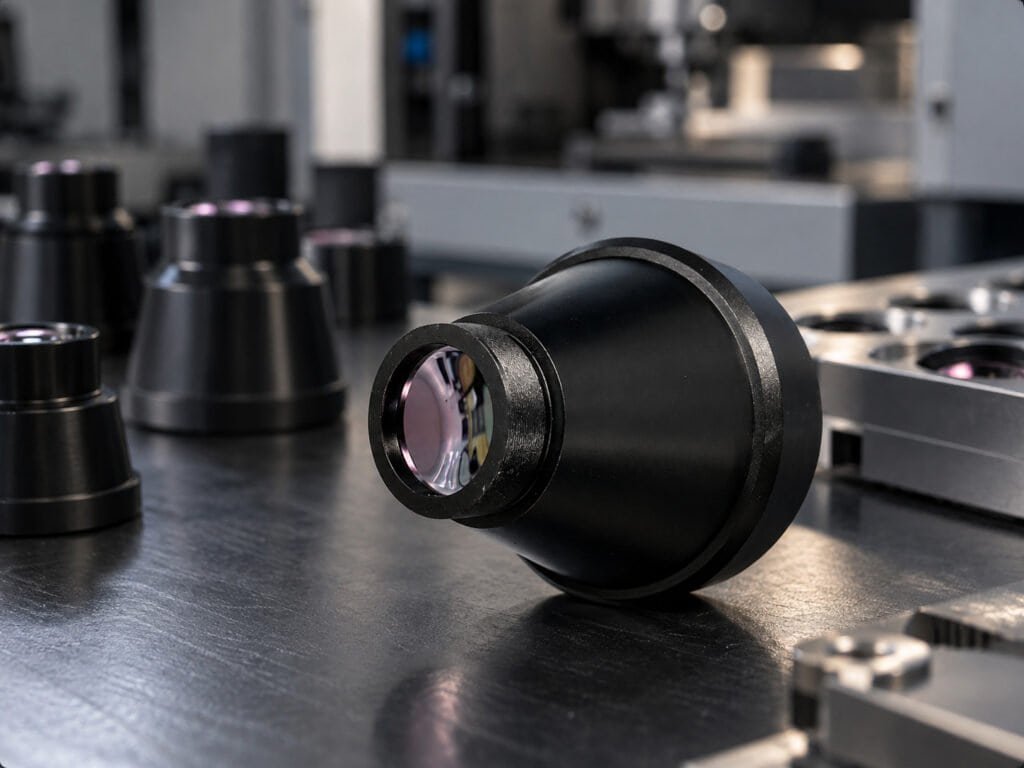
Why Drone Thermal Camera Lens Production Demands a Different Cutting Approach
Standard IR optics manufacturing equipment was designed around larger elements — CO₂ laser lenses, FLIR sensor covers, vehicle-mounted thermal imagers — typically in the Φ40–100 mm range. The process tolerances and tooling geometries for those formats don’t scale down cleanly.
Three specific problems show up when you push conventional coring or ID-saw approaches into the Φ10–25 mm drone optic range:
Clamping instability. Small germanium discs have a low surface area-to-mass ratio once you start slicing below Φ20 mm thickness. Conventional edge-clamping fixtures designed for 50 mm+ blanks create asymmetric stress on the workpiece during cut, and you start seeing warpage and microfracture at the cut face. We’ve seen chipping rates of 0.3–0.8 mm edge breakout on ID-saw runs for Φ12 mm blanks — that’s a non-starter for optics with a clear aperture tolerance of ±0.1 mm.
Kerf waste at small scale. A 6 mm kerf on a Φ60 mm blank is ~10% material loss. A 6 mm kerf on a Φ12 mm blank is geometrically similar but the slice you’re recovering is proportionally much thinner — you might be producing a 2.5 mm thick lens from a 3.5 mm slice allowance. The math doesn’t work.
Heat load on thin sections. ID-saw cutting generates significant localized heat. Thin germanium discs (under 4 mm) warp under thermal gradient during cutting. Wire saw cutting, by contrast, uses continuous abrasive slurry flood, which keeps the cut zone at near-ambient temperature.
The kerf data is the simplest way to see the difference: coring machines run 5–10 mm kerf; the VIMFUN SGI 40 closed-loop wire saw runs 0.5–0.6 mm contour kerf. That’s a 10× improvement in material efficiency — directly translating to cost per good lens.
VIMFUN SGI 40: Key Parameters for Drone Thermal Camera Lens Production
The SGI 40 is the platform we use for drone-format germanium optic cutting. Here are the operational parameters that matter for this application:
| Parameter | VIMFUN SGI 40 | Conventional Coring Machine |
|---|---|---|
| Wire diameter | 0.35–0.65 mm | N/A (coring bit Φ6–12 mm) |
| Maximum wire speed | 80 m/s | N/A |
| Machining accuracy | ≤ 0.03 mm | ±0.1–0.2 mm |
| Max ingot size | Φ185 mm × 400 mm | Φ100 mm typical |
| Contour kerf width | 0.5–0.6 mm | 5–10 mm |
| Edge chipping | < 0.1 mm | 0.3–0.8 mm |
| Thermal input to workpiece | Low (flood cooling) | Medium–high |
The ≤ 0.03 mm machining accuracy gives enough dimensional budget for the subsequent centering and chamfering step on the C-120L to clean up to final blank geometry without overcutting into the clear aperture zone. If your cut-blank tolerances are loose — ±0.15 mm or worse — the centering pass has to remove more stock, and on a Φ12 mm element that’s a meaningful diameter reduction.
One thing worth knowing: the SGI 40 handles ingots up to Φ185 mm × 400 mm, so you’re not limited to small-batch drone lens production. If your product mix includes both drone-format lenses and larger automotive or industrial thermal imaging elements, the same machine covers the contour cutting step across all formats. That flexibility matters if you’re evaluating a single platform to support multiple product lines.
For facilities evaluating capital investment, the SGI 40 is priced at $31,000–$39,000 depending on configuration — significantly below the installed cost of a multi-axis coring system with equivalent throughput and accuracy. CapEx is approximately 65% lower than traditional coring-and-grinding front-end combinations. Typical investment payback is 12–18 months at moderate production volumes.
The Five-Stage Production Line for Drone Thermal Camera Lens Production
VIMFUN supplies complete turnkey line configurations for drone thermal camera lens production, not just the cutting front end. Here’s how the five stages link together and what each step contributes:
Stage 1 — Contour Cutting (SGI 40)
Ingot arrives. The SGI 40 slices out blanks per the lens diameter plan, with 0.5–0.6 mm kerf. Output: rough blanks at target diameter ±0.05 mm, thickness allowance for subsequent grinding.
Stage 2 — Slicing (SGI 40)
The same SGI 40 platform handles wafer-mode slicing for flat-element formats (windows, filters, detector covers). Wire diameter selection — 0.35 mm for fine-pitch, 0.65 mm for faster throughput — depends on slice thickness target and surface quality spec.
Stage 3 — Centering and Chamfering (C-120L)
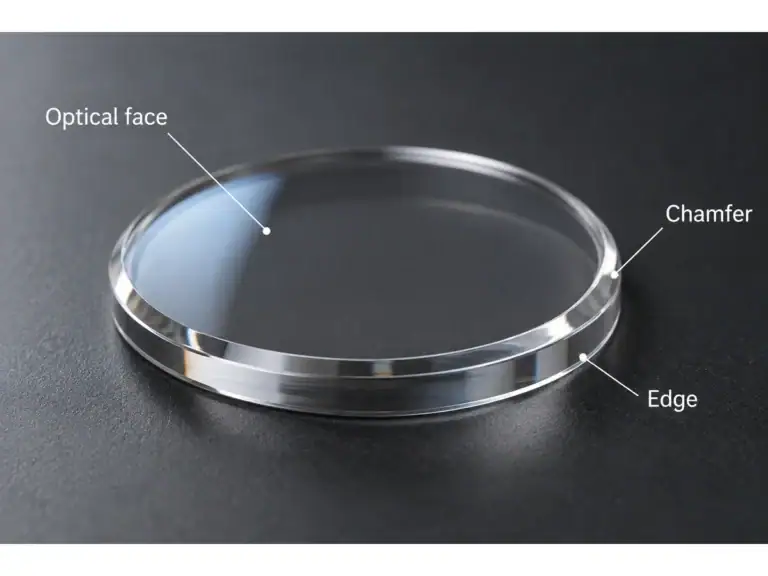
Blanks are centered to true optical axis and chamfered to spec. This step corrects diameter and squareness errors from the cut. The C-120L accepts the loose-tolerance cut blank from Stage 1 and delivers a centered blank ready for curved surface generation.
Stage 4 — Spherical Grinding (G-100)
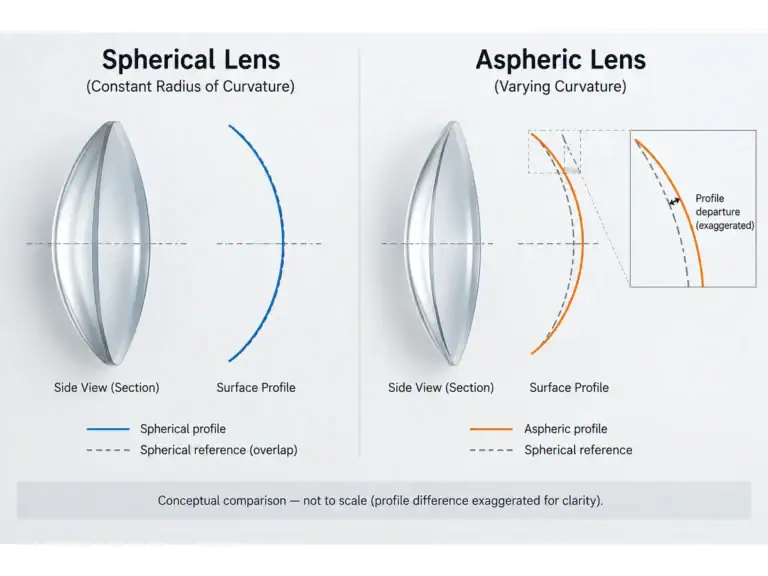
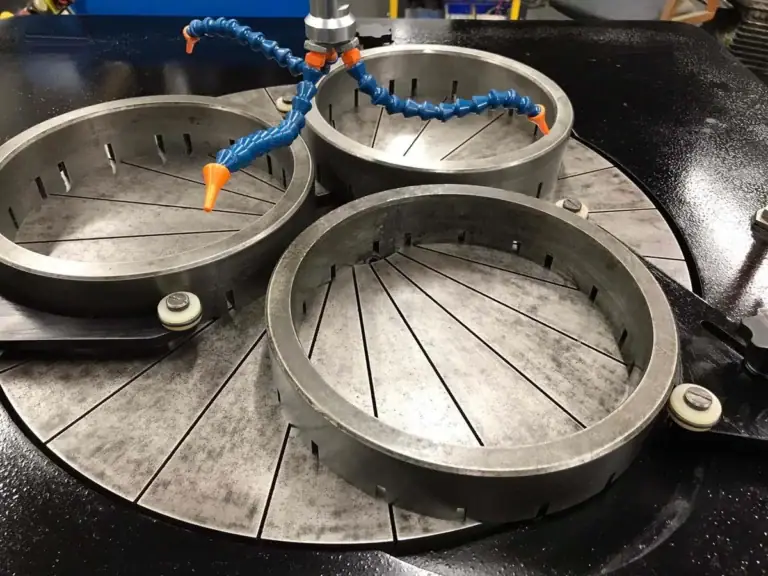
The G-100 generates the curved surfaces — concave or convex — using diamond cup wheel tooling. Surface figure control at this stage drives downstream polishing time. Getting the radius error under ±0.5 fringe before polishing saves 30–40% polishing cycle time.
Stage 5 — Polishing and AR Coating
Final polishing removes grinding sub-surface damage and achieves surface roughness Ra < 0.5 nm for the transmission band. AR coating for 8–14 μm LWIR reduces reflection loss from ~36% (bare Ge) to under 2% per surface.
We offer this as a full line sale or as a front-end module upgrade — see the section below on integration with existing equipment.
Practical Limitations: What Wire Saw Cutting Doesn’t Solve
Fair warning: wire saw cutting solves the material waste and chipping problems, but it introduces different process constraints.
Setup time per diameter. Switching between a Φ12 mm and a Φ22 mm lens profile on a wire saw requires reprogramming the contour path and often re-tensioning the wire guide. On a coring machine, you swap the bit in 10 minutes. If you’re running 15 different lens diameters in daily production, the wire saw’s flexibility comes with a higher per-lot setup overhead.
Wire wear management. At 80 m/s wire speed on germanium, wire wear rate is meaningful. Closed-loop wire systems on the SGI 40 recirculate wire, which extends wire life and reduces consumable cost, but operators need to monitor wire diameter degrade over a production run. If you skip that monitoring step, late-run cuts will show kerf width creep from 0.55 mm toward 0.70–0.75 mm, which affects blank diameter repeatability.
Thin slice stability below 1.5 mm. For drone lens formats requiring very thin elements (< 1.5 mm finished thickness), the wire saw cut slice can exhibit bow due to residual stress in the germanium ingot. We’ve seen this on high-dislocation-density Ge material from certain suppliers. Adding a stress-relief anneal step before cutting eliminates it, but it adds a process step you wouldn’t need with a coring approach on thicker elements.
These aren’t deal-breakers — just real constraints you need to plan around.
How VIMFUN’s SGI 40 Fits Into an Existing Drone Optics Production Line
Not every buyer is building a greenfield line. A Dutch precision optics company we worked with had existing centering, grinding, and polishing capacity that was fully depreciated — replacing it made no economic sense. Their problem was specifically at the front end: their coring machines were generating 35% material waste on small germanium elements, and chipping rates on Φ14–18 mm blanks were causing 18% reject rates at incoming inspection for the grinding stage.
We replaced only the cutting front end with the SGI 40. Their existing C-120L-equivalent centering equipment accepted the tighter-tolerance cut blanks without modification. Chipping defects at the grinder incoming dropped from 18% to under 2%. Germanium material cost per shipped lens dropped 28% within the first quarter of operation.
They recovered the SGI 40 investment within one fiscal year — consistent with the 12–18 month payback range we typically see on these front-end upgrades.
This modular approach — swap the cutting step, keep downstream equipment — is often the lowest-risk entry point for shops evaluating infrared optics manufacturing equipment upgrades. The full turnkey line makes sense for new facilities or capacity expansions; the front-end module makes sense for existing shops with a specific yield problem at cutting.
If you’re evaluating the full production workflow, the IR lens production line page covers how these five stages integrate at the system level, including throughput calculations and footprint requirements.
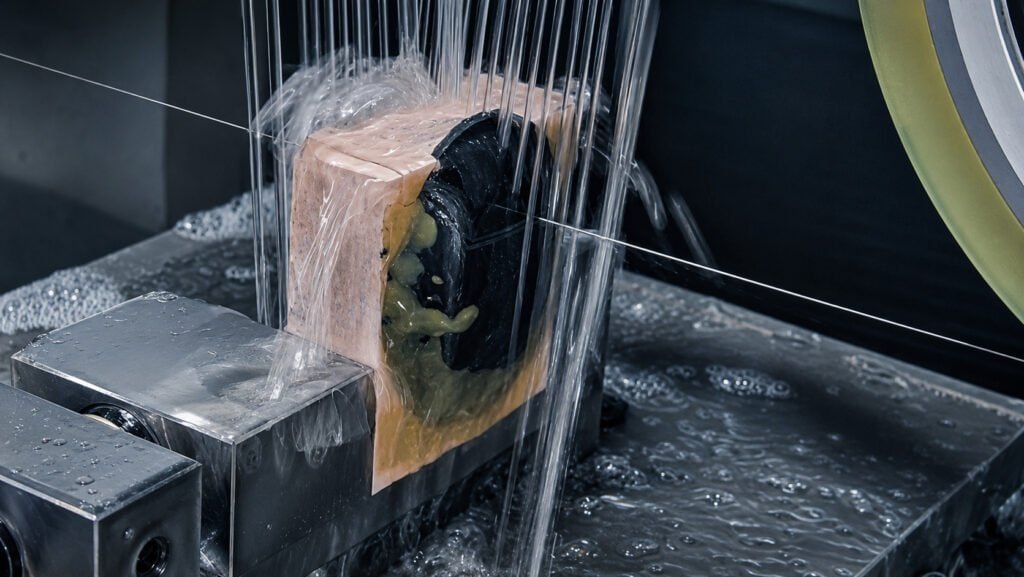
Drone Thermal Camera Lens Production vs. Adjacent Applications
Buyers often arrive at this topic from adjacent searches — automotive thermal imaging or FLIR production — and the process requirements diverge more than you’d expect.
| Parameter | Drone Thermal (Φ10–25 mm) | Automotive Thermal (Φ30–60 mm) | FLIR Production (Φ25–50 mm) |
|---|---|---|---|
| Weight budget | Critical (<120g lens group) | Moderate | Moderate |
| Volume per batch | Low–medium (10–500 pcs) | High (1,000–50,000 pcs) | Medium |
| Dimensional tolerance | ±0.05 mm diameter | ±0.03 mm diameter | ±0.02 mm diameter |
| Primary cutting challenge | Small blank clamping, kerf waste | Throughput, consistency | ITAR/export compliance |
| Preferred cutting method | Wire saw contour | Wire saw slicing + coring | Wire saw slicing |
The automotive thermal imaging lens equipment page covers the higher-volume, tighter-tolerance automotive use case. The thermal imaging lens manufacturing equipment for that segment uses similar SGI 40 platforms but with different wire diameter selection and throughput optimization.
For germanium lens blank cutting covering the general principles of blank preparation regardless of final application, that page explains kerf loss mechanics and surface quality specifications in more detail.
The thermal imaging lens manufacturing equipment overview covers the full equipment landscape — cutting, grinding, polishing — with specification comparison tables across lens formats.
FAQ: Drone Thermal Camera Lens Production with VIMFUN SGI 40
Q: Can the VIMFUN SGI 40 cut germanium blanks as small as Φ10 mm for miniature drone thermal payloads?
Yes. The SGI 40 handles contour cutting down to Φ10 mm lens profiles with 0.5–0.6 mm kerf. The closed-loop wire system maintains ≤ 0.03 mm positional accuracy across the cut path, which is critical for holding blank diameter tolerance on small elements where each 0.1 mm matters.
Q: What surface quality does the SGI 40 achieve after cutting, before grinding?
Post-cut surface roughness on germanium is typically Ra 0.6–1.2 μm, with TTV (total thickness variation) of 8–15 μm on Φ50 mm elements. This is within the incoming spec for the G-100 spherical grinding step without a pre-grind lapping pass, which saves one process step compared to ID-saw cut blanks that often require a surface normalization lap first.
Q: How does VIMFUN support drone thermal camera lens production for low-volume R&D batches versus production runs?
The SGI 40’s programmable contour cutting is well-suited for both. For R&D batches of 10–50 lenses, you’re loading the lens profile into the control system and running with full closed-loop position feedback — same setup as a production run, just fewer cycles. We typically recommend running the first 20 pieces as a process qualification batch before committing ingot material to full production. Vimfun applications engineering supports this process validation step as part of equipment commissioning.
Q: What is the total capex for a complete drone thermal lens production line using VIMFUN equipment?
The SGI 40 front end (contour cutting + slicing) runs $31,000–$39,000. The full five-stage line — SGI 40 cutting, C-120L centering, G-100 grinding, polishing system, and AR coating station — is configured based on throughput requirements. CapEx for a complete line is approximately 65% lower than equivalent traditional coring-and-grinding setups. Contact Vimfun at daria@endlesswiresaw.com for a line configuration quotation based on your lens diameter range and monthly output target.
Q: What germanium material grades does the SGI 40 support for drone lens production?
The SGI 40 works with standard polycrystalline and single-crystal germanium ingots. Ge purity of 5N (99.999%) is typical for LWIR optics. Zone-refined single-crystal Ge for high-performance drone thermal payloads is fully compatible. The main variable is dislocation density — high-dislocation material from some suppliers shows more residual stress, which can cause bow on thin slices. An ingot anneal step before cutting addresses this if you encounter it.
About VIMFUN
VIMFUN specializes in precision wire saw cutting and optical grinding/polishing equipment for infrared, semiconductor, and advanced ceramic materials. Products include the SGI 40 germanium ingot wire saw, C-120L centering machine, G-100 spherical grinder, and complete turnkey IR lens production lines. Learn more at https://www.opticalcutting.com.
About the Author
Written by the VIMFUN Applications Engineering Team — specialists in IR optical component process development, including germanium, ZnSe, ZnS, and chalcogenide glass cutting and polishing lines.