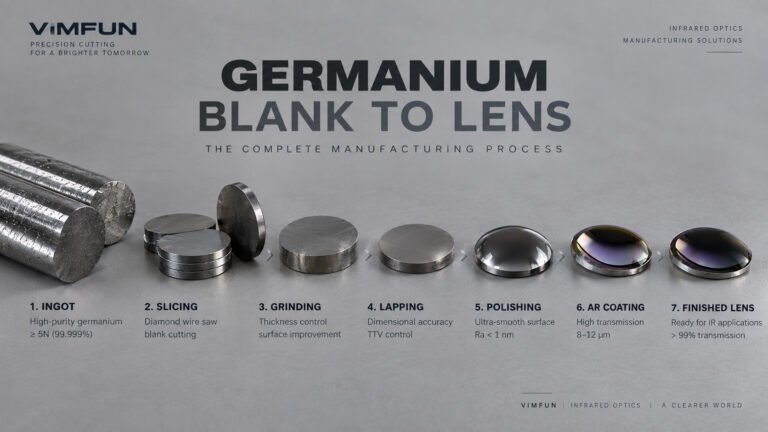
A 200 mm germanium ingot costs $6,000–$10,000 at current spot prices. Traditional core-drilling wastes 5–10 mm of material per blank cut; diamond wire saw cutting reduces that kerf to 0.5–0.6 mm. On a line running 50 ingots per month, that single process change recovers over $240,000 in annual material value.
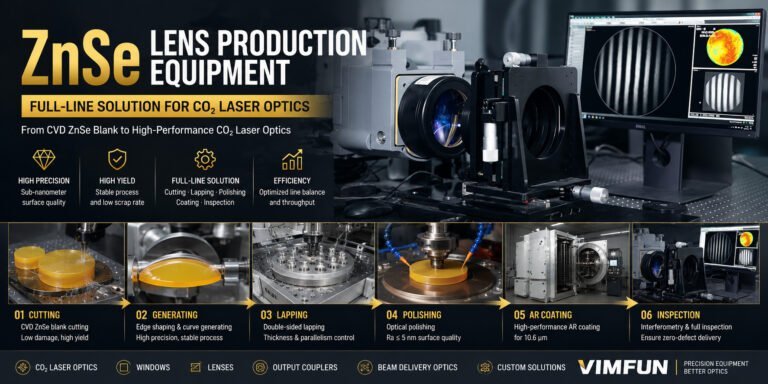
But blank cutting is only stage one. Getting from ingot to a finished, coated IR lens requires five sequential manufacturing stages, each with its own equipment, its own process parameters, and its own tolerance requirements that constrain what the next stage can work with.
Most IR lens production line problems aren’t caused by bad machines. They’re caused by machines that weren’t selected to work together — where the cutting stage outputs geometry that centering can’t hold, or where grinding surface finish exceeds what the polishing step can correct in a reasonable cycle time. This guide explains what a complete IR lens production line includes, how to configure it for different materials, and where the integration decisions actually matter.
What a Complete IR Lens Production Line Includes
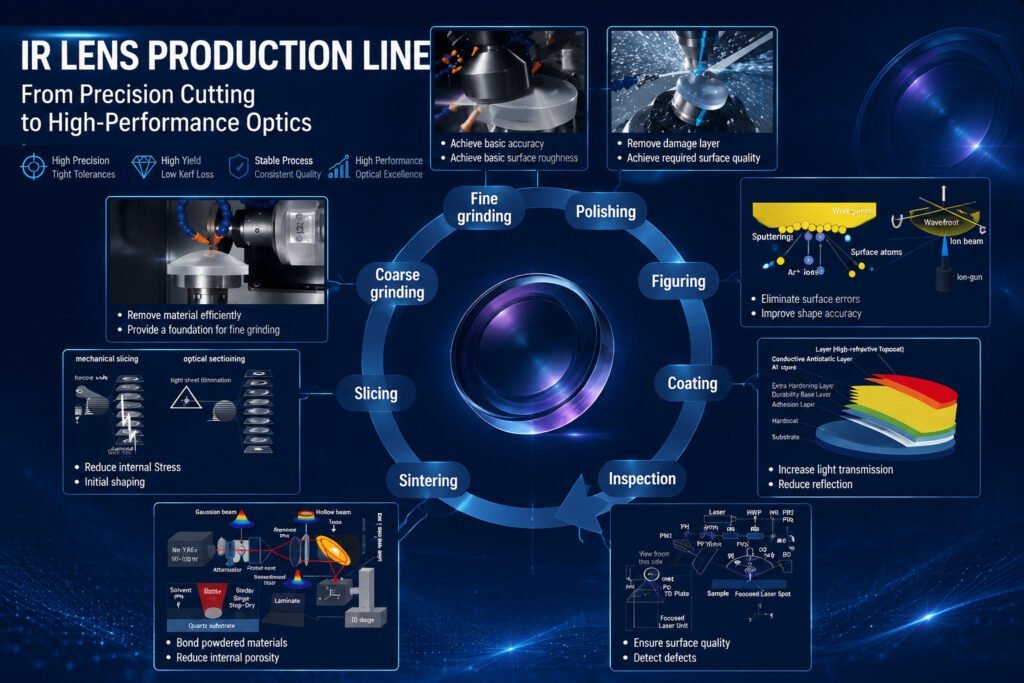
An IR lens production line runs through five stages regardless of material. The equipment differs; the sequence doesn’t.
Stage 1 — Blank Cutting
Raw material — germanium ingot, CVD ZnSe blank, or ZnS plate — is cut to near-net shape. For circular lenses cut from cylindrical ingots, this is typically a slicing operation. For non-circular elements or complex contours, it becomes CNC contour cutting.
The critical parameter here is kerf width. Traditional core-drilling (coring out blanks from an ingot with a hollow drill) wastes 5–10 mm of material per blank. A diamond wire saw cuts a 0.5–0.6 mm kerf. On a 200 mm germanium ingot worth $6,000–$10,000, the difference in material utilization is significant — roughly $200–$600 per ingot recovered rather than turned into swarf.
Stage 2 — Centering and Chamfering
The cut blank is ground to final circular diameter and edge-chamfered. A spindle centering machine aligns the blank optically and removes material from the edge to bring diameter into spec. For Φ50 mm germanium lenses, typical cycle time at this stage is 1–3 minutes.
Edge quality here matters more than most buyers expect. Chips at the blank edge propagate inward during grinding and are the leading cause of cosmetic defects (chips, fractures at the aperture edge) that appear only at final inspection — after the lens has passed through grinding and polishing.
Stage 3 — Surface Generation
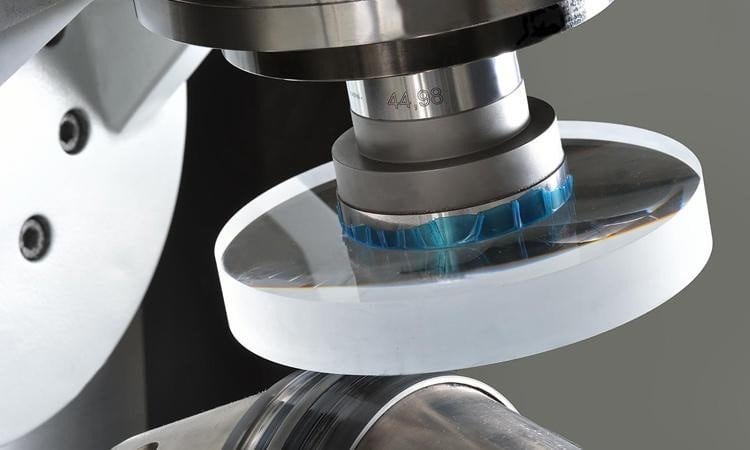
Both optical surfaces are generated to target radius of curvature by grinding. For spherical surfaces, this uses a cup wheel running against the lens in a rotary motion. Surface roughness after grinding: Ra 0.6–1.2 μm. Total indicator variation (TTV) for a Φ50 mm element: 8–15 μm. Typical cycle time per surface: approximately 5 minutes.
For aspheric surfaces, generation requires CNC-controlled grinding with real-time form compensation — a significantly more complex process.
For equipment specifications covering both convex and concave (internal) spherical generation, see our germanium lens grinding equipment overview.
Stage 4 — Polishing
Ground surfaces are polished to final optical quality. Target roughness: Ra < 5 nm. Polishing is chemistry-dependent in a way that grinding isn’t: slurry composition, pad material, and rotational speed interact to determine whether you’re removing material efficiently or generating subsurface damage.
Polishing is typically the takt-time bottleneck in a high-volume IR lens production line. If you’re planning capacity, account for polishing cycle time before sizing the upstream stages.
Stage 5 — AR Coating
Finished lenses go into a vacuum deposition chamber for anti-reflection coating. For thermal imaging germanium, the standard is BBAR (broadband AR) for 8–12 μm, targeting >95% transmission per surface. DLC (diamond-like carbon) overcoats add durability for harsh environments. ZnSe CO₂ laser lenses typically receive single-wavelength AR at 10.6 μm.
Total cycle time for a Φ50 mm double-convex germanium lens through all five stages: approximately 50 minutes, not including coating queue time.
Configuring an IR Lens Production Line for Different Materials
“IR lens production line” describes a category, not a fixed configuration. The material being processed drives which equipment is required, which parameters are run, and where the process constraints are tightest.
Germanium Lines
Germanium is the primary material for thermal imaging lenses in the 8–12 μm range. Its high refractive index (n ≈ 4.0) makes it optically efficient; its cost ($1,800–$2,400/kg, optical grade) makes material utilization a first-order concern.
A germanium IR lens production line prioritizes blank cutting efficiency above all else. Diamond wire saw cutting (line diameter 0.35–0.5 mm, cutting speed 30–50 m/s) recovers 8–15× more material per ingot than core-drilling. For a line processing 50 ingots per month, that recovery represents over $240,000 in annual material savings at current prices.
Coolant: mineral oil. Germanium tolerates aqueous coolants, but oil provides better surface finish and tool life.
Grinding: moderate speeds, conventional bonded-abrasive tools. Germanium is brittle (fracture toughness ~0.6 MPa·m½) but not unusually hard (Mohs 6). Standard IR optics grinding parameters apply.
Polishing: aqueous slurries are acceptable. Cerium oxide is the standard abrasive for germanium.
For the cutting equipment specifics, see our germanium lens cutting machine overview.
ZnSe Lines
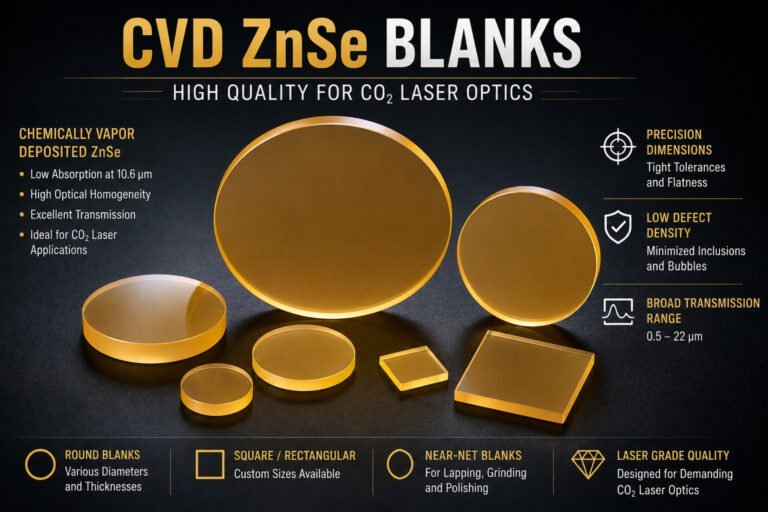
ZnSe is the dominant material for CO₂ laser optics at 10.6 μm — output couplers, focusing lenses, beam expanders. It’s also used in broadband IR applications requiring transmission from 0.6–20 μm.
The process constraint that changes everything about a ZnSe IR lens production line: water reactivity. ZnSe reacts with water to form zinc hydroxide and hydrogen selenide. Aqueous coolants in cutting or grinding are not just suboptimal — they degrade the surface chemically, produce inconsistent results, and in enclosed environments generate a toxic byproduct.
Oil-based coolant systems throughout, separate from any germanium line sharing the same floor.
ZnSe is softer than germanium (Mohs ~3) but more fragile in thin cross-sections. Feed rates during blank cutting must be reduced relative to germanium parameters. Edge chipping risk is higher. The ZnSe lens cutting machine parameters differ accordingly from a germanium setup.
Polishing: non-aqueous chemistry or carefully buffered slurries. ZnSe polishing is more process-sensitive than germanium.
ZnS Lines
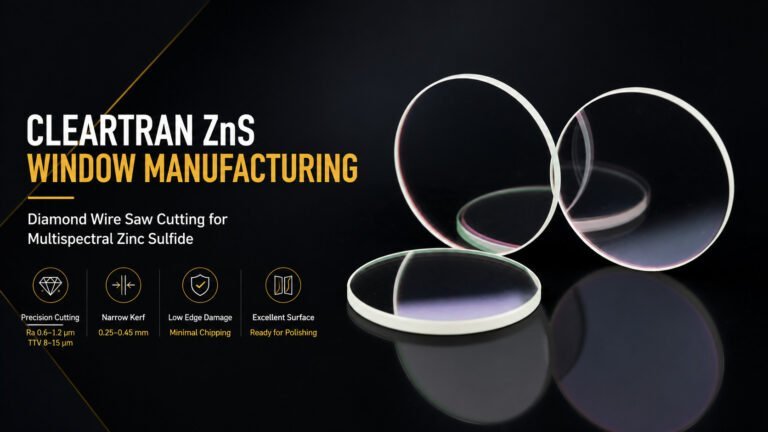
ZnS covers two distinct grades: standard ZnS for 8–12 μm and CVD multispectral ZnS (Cleartran) for 0.4–12 μm visible-through-LWIR transmission. Multispectral ZnS requires tighter final surface tolerances.
ZnS is used more for windows, domes, and hyperhemispheres than for refractive lenses, which affects blank geometry. Dome production requires a different cutting approach than disc blanks. The ZnSe hardness range applies to ZnS — oil coolant mandatory.
For lines designed to run ZnSe and ZnS alongside each other, dedicated coolant circuits rather than changeover procedures are strongly recommended. Cross-contamination between ZnSe and ZnS chemistry causes process instability that’s difficult to diagnose.
Why Integration Matters More Than Individual Machine Specifications
The standard IR lens production line procurement process goes: issue RFQ for cutting machine, issue RFQ for grinding machine, issue RFQ for polishing machine, compare specifications in isolation, order from three suppliers. Install. Then troubleshoot for six months.
The problem isn’t any individual machine’s specifications. It’s that each machine’s output tolerances weren’t matched to the next stage’s input requirements.
What an integrated tolerance chain looks like for a germanium Φ50 mm lens line:
- Cutting output: TTV ≤ 15 μm, edge chip < 0.1 mm, kerf width ≤ 0.6 mm → feeds centering without intermediate inspection yield loss
- Centering output: diameter ±0.01 mm, squareness ≤ 2 arcmin → feeds grinding without re-fixturing
- Grinding output: Ra 0.6–1.2 μm, subsurface damage ≤ 2 μm depth → polishing removes damage zone without extra stock removal cycles
- Polishing output: Ra < 5 nm, surface figure ≤ λ/4 at 633 nm → AR coating adhesion is consistent across the batch
A yield improvement from 30% to 70% on a germanium lens line doesn’t typically require replacing machines. It usually requires establishing this tolerance chain explicitly and auditing which stage is failing to deliver it. Sunluo Optical achieved approximately 30% yield improvement after transitioning their cutting stage to diamond wire saw, eliminating the geometric variability introduced by their previous core-drilling process.
The infrared optics manufacturing equipment selection guide covers the individual equipment categories. This page focuses on how those categories connect.
Equipment Selection Criteria for an IR Lens Production Line
1. Material compatibility range
If you expect to run both germanium and ZnSe on the same equipment, confirm coolant system flexibility. Oil-only lines are compatible with both; water-coolant equipment is not.
2. Diameter range
Most IR lens production lines process elements from Φ15 mm (miniature camera modules) to Φ100 mm (larger thermal imaging objectives). Some defense-adjacent industrial applications reach Φ185 mm. Equipment rated for Φ50 mm that you later need to run at Φ100 mm is a capacity constraint you’ll pay to solve.
3. Takt time matching
For a three-shift germanium line producing Φ50 mm biconvex lenses: cutting is approximately 5 minutes per blank, grinding is 10 minutes total (both surfaces), polishing is 6 minutes total. These numbers mean you need roughly one grinding cell per cutting machine and equal or slightly more polishing capacity than grinding.
4. Single-supplier vs. multi-supplier integration
A single-supplier IR lens production line configuration shortens integration time and keeps the tolerance-matching responsibility with the equipment vendor. Multi-supplier configurations allow best-in-class selection at each stage but move integration responsibility to the buyer.
For buyers setting up a first IR optics line, the integration complexity of multi-supplier configurations is typically underestimated by 6–12 months.
5. Serviceability
IR optics lines are capital-intensive. A grinding spindle failure on a germanium line processing $10,000 ingots carries significant daily downtime cost. Confirm spare parts lead time and local service coverage before selecting equipment.
The germanium lens grinding equipment G-100 and G-250 models are designed for both germanium and ZnSe/ZnS parameter ranges, covering both convex and concave surface generation. Spindle specifications are documented in the product datasheets.
Configure Your IR Lens Production Line
No two IR lens production lines are identical. The right configuration depends on:
- Material or materials to be processed (Ge / ZnSe / ZnS / mixed)
- Element diameter range and shape (spherical / aspheric / window / dome)
- Production volume (prototype shop / small batch / high-volume OEM)
- Existing equipment to be retained vs. full greenfield installation
Vimfun’s equipment covers stages 1 through 4 of the IR lens production line: diamond wire saw cutting (SGI 40, SGR 40), centering (C-120L, C-185L), and surface generation/grinding (G-100, G-250). Coating (stage 5) is handled through our partner network.
Complete line delivery lead time: 8–14 weeks depending on configuration. Use the form below or contact us on WhatsApp to discuss your specific requirements.
Frequently Asked Questions
Can one production line handle both germanium and ZnSe?
Yes, with dual coolant infrastructure. The cutting and grinding machines are mechanically compatible with both materials. The primary operational change is coolant type — germanium uses mineral oil or water; ZnSe requires oil only. We recommend separate coolant circuits rather than changeover procedures for production environments.
What volume justifies a dedicated IR lens production line?
The economics improve significantly above 200 elements per month at Φ50 mm. Below that threshold, toll processing or hybrid arrangements — own cutting stage, outsourced polishing — often have better capital efficiency.
How long does installation and commissioning take?
For a 4-stage line (cutting through grinding), on-site installation is typically 5–7 working days. Process validation with customer-supplied raw material adds 2–4 weeks depending on element geometry and tolerance requirements.
What’s the difference between this and an infrared optics production line?
An IR lens production line specifically refers to refractive lens manufacturing — the 5-stage sequence from ingot to finished lens. Infrared optics more broadly includes windows, domes, beamsplitters, and other elements that use different blank geometries and, in some cases, different stage sequences.