
Germanium Lens Manufacturing Equipment
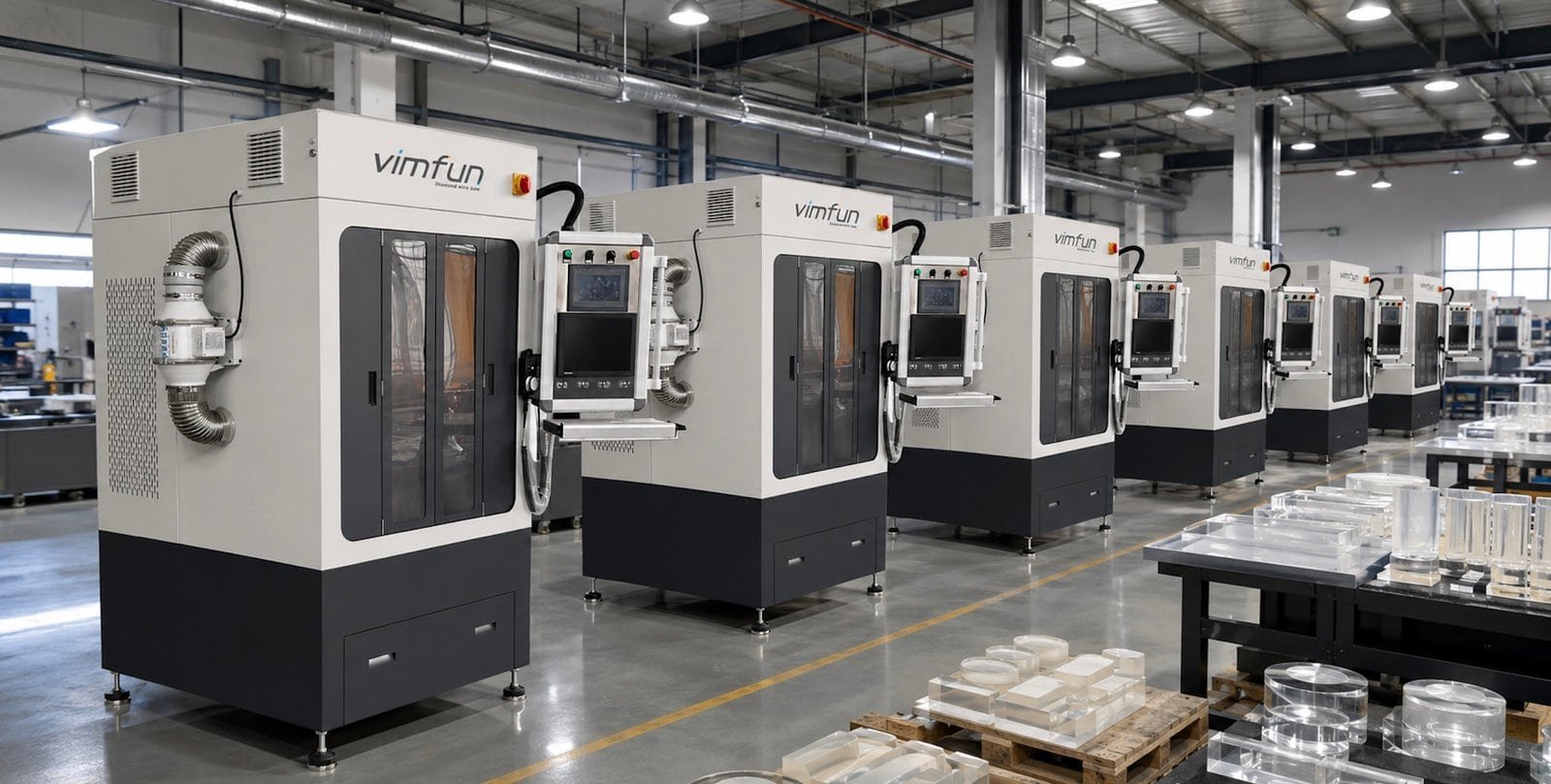
A complete germanium lens manufacturing equipment line from one supplier — five stages, one tolerance budget, ISO 10110 drawing flow station to station. Closed-loop endless-wire saws for ingot cutting, bonded-grit spindle grinders for spherical generation, aspheric polishers and DLC / BBAR coating chambers for the finishing end.
How does a Ge lens travel from raw ingot to coated optic?
The Vimfun germanium lens manufacturing equipment line is built around five processing stations that share one tolerance budget. Each stage's output is the next stage's input spec — no per-vendor translation, no surprise rework.
Germanium lens manufacturing on a $1,800–$2,400/kg substrate is a yield game. Every kerf width, every edge chip, every micron of subsurface damage shows up as material loss or downstream rework. The five-stage line below holds the budget for those numbers across stations instead of leaving them as each supplier's separate problem.
Stage 1 — Ingot cutting
Closed-loop endless-wire saws turn raw Ge ingots into wafers, lens blanks, or free-form contours. Kerf is ~0.5 mm — roughly 1/10th of a core drill's 5–10 mm. Three machine choices cover most jobs: the SG40 for routine wafer slicing, the SGR40 for rotary prism / polygon work, and the SGI 40 for DXF free-form contour cuts on full-size Ge stock.
Stage 2 — Edge centering
Centering happens BEFORE grinding, not after — this matters for tolerance flow. The C-series centering machines (C-120L for Ø ≤ 120 mm, C-185L for Ø ≤ 185 mm) use mechanical centering with a centroscope optical-axis check to land decenter inside 20 arc-seconds before the spherical-generation cycle starts. Centering equipment available on request as part of the line build.
Stage 3 — Spherical / aspheric grinding
Bonded-grit cup wheels on a vibration-controlled spindle generate convex, concave, or flat surfaces on the centered blank. Two machine ranges: the G-100 for Ø 10–100 mm small-aperture thermal-imaging optics, and the G-250 for Ø 80–250 mm large-aperture and chalcogenide work. Form holds inside ±0.005 mm; the form-error budget left here sets the polisher's removal target.
Stage 4 — Polishing
An aspheric polisher (up to Ø 300 mm) takes the ground surface to optical finish on a single spindle that handles aspheric, spherical, and flat. Final Ra lands below 5 nm; form irregularity holds to better than 1λ at 633 nm. Polishing machines available on request as part of the line build.
Stage 5 — AR coating
Bare germanium reflects ~36% per surface in the 8–12 µm band — coated optics are not optional for thermal imaging. The line includes DLC (diamond-like carbon) coating for exposed outer optics and multilayer BBAR for protected internal elements. Coating chambers available on request.
The Vimfun germanium lens manufacturing equipment lineup at a glance
Five machines on five product pages — plus the three downstream stations (centering, polishing, AR coating) available as part of the line build. Click any machine name to read the full product page; specs, cycle times, customer cases, and metrology details live there.
| Machine | Stage | Workpiece range | Differentiator |
|---|---|---|---|
| SG40 | 1 — Cut (slicing) | Ø ≤ 200 mm ingots | Automatic multi-thickness slicing |
| SGR40 | 1 — Cut (rotary) | Ø ≤ 200 mm ingots | Rotary prism / polygon indexing |
| SGI 40 | 1 — Cut (contour) | Ø ≤ 185 × L 400 mm | DXF free-form contour cutting |
| C-120L / C-185L | 2 — Center | Ø ≤ 185 mm | Centroscope ≤ 20″ decenter (on request) |
| G-100 | 3 — Grind (small) | Ø 10–100 mm | Convex / concave / flat, same spindle |
| G-250 | 3 — Grind (large) | Ø 80–250 mm | Large-aperture + chalcogenide chemistry |
| Aspheric polisher | 4 — Polish | Ø ≤ 300 mm | Aspheric / spherical / flat, same spindle (on request) |
| DLC + BBAR chambers | 5 — Coat | Batch (50+ / load) | 8–12 µm LWIR standard; SWIR / MWIR custom (on request) |
The same five-stage germanium lens manufacturing equipment platform also runs ZnSe, ZnS, Si, sapphire, and BK7 — each material gets a parameter set, but the machine frames are common. If your product mix includes chalcogenides, see the ZnSe / ZnS grinder page for material-specific chemistry detail.
Which Vimfun machine fits which Ge lens job?
Three buyer scenarios cover ~90% of incoming questions. Find yours below — each row points to the right starting machine and the natural next stages.
If you're slicing routine Ge wafers at volume
Start with the SG40. Closed-loop wire, 0.5 mm kerf, automatic multi-thickness in one job. Round discs only — no contour, no rotary. Pair with G-100 grinding (small thermal-imaging optics) or G-250 grinding (larger objectives, CO₂ laser windows). Coating is the last stage.
If you produce multi-shape lens blanks — prism, polygon, round
The SGR40 adds a rotary axis to the same closed-loop wire saw. Index the workpiece between cuts to produce predefined geometric shapes (octagonal, hexagonal, prism) in one automatic program. Same kerf as SG40, same downstream grinding pairing.
If your product includes free-form Ge lens blanks (crescents, off-axis shapes)
That's a job neither core drills, ID saws, nor SGR40 rotary mode can do. The SGI 40 reads DXF files and traces arbitrary closed contours. Sunny Optical (HKSE 2382) scaled to 30+ Vimfun SGI machines after running this exact job pattern.
Ask for a line-level proposal instead of per-machine quotes. We've delivered turnkey 5-stage germanium lens manufacturing equipment to defense and thermal-imaging customers — one technical owner, one tolerance flow, one PO. Send your product mix and monthly volume in your consultation request.
One drawing, one tolerance budget — across all five stations
The single biggest reason multi-vendor Ge lines underperform their bill of materials is fragmented tolerance accounting. Vendor A specs the cutter's output, vendor B specs the grinder's output, and the integrator discovers at polishing that the budgets don't sum cleanly. Vimfun germanium lens manufacturing equipment ships with a unified tolerance flow per ISO 10110:
- Cut → Center edge chipping < 0.1 mm becomes the centering allowance
- Center → Grind decenter ≤ 20″ becomes the spherical-generation reference
- Grind → Polish form ±0.005 mm + SSD 5–15 µm sets the polisher removal budget
- Polish → Coat surface Ra < 5 nm enables direct DLC / BBAR deposition
Each station verifies the incoming spec at handoff — not at final inspection. That single change cuts rework rate roughly in half versus the multi-vendor pattern. Reference framework: ISO 10110 for drawings, MIL-C-48497A for coating durability when relevant. Full chalcogenide and germanium material data are at Crystran's germanium datasheet.
Where Vimfun Ge optics lines end up in production
Four application areas cover the bulk of installed Vimfun lines. The recommended starting machines differ; the platform is the same.
Thermal imaging (handheld, weapon sights, surveillance)
Small-aperture Ge lens production — Ø 20–60 mm. Start with SG40 slicing + G-100 grinding. Volume runs at ~200–300 lenses per shift per grinder.
Automotive thermal imaging (ADAS night vision)
Mid-aperture, high volume. Same SG40 + G-100 pair, often with SGR40 added for protected-housing prism windows. Automotive volume drives the case for full-line purchase.
Defense / aerospace IR optics
Large-aperture primary optics, sometimes free-form. Start with SGI 40 contour cutting + G-250 grinding. Coating durability per MIL-C-48497A is non-negotiable in this segment.
CO₂ laser optics & multispectral imaging
Mostly ZnSe / ZnS windows and meniscus lenses (not Ge primary), but same line. G-250 + chalcogenide-safe coolant + DLC coating for laser optics.
What does a complete Vimfun Ge optics line actually cost?
Line-level capital expenditure and operating cost dominate the ROI conversation. Two numbers do most of the work: per-ingot material savings against traditional methods, and the lead-time compression of single-supplier procurement.
On the material side, a ~0.5 mm closed-loop wire kerf saves $200–$600 of germanium per ingot versus a 5–10 mm core drill, depending on ingot diameter and cut count. At 50 ingots per month — a typical mid-tier thermal-imaging line — that's $10,000–$30,000 of Ge kept every month, or roughly $120,000–$360,000 per year before any downstream yield gains. Add ~30% yield improvement at downstream stations (Sunny Optical's reported number after switching to Vimfun cutting) and the picture changes again.
Single-supplier procurement compresses the "RFQ-to-first-article-cut" cycle to about a third of the multi-vendor pattern. For new Ge lines, the typical compression is from 6–12 months (multi-vendor) to 8–14 weeks (Vimfun line). That isn't just a calendar win; it's a working-capital win on $30K+ per ingot inventory.
Combined, payback on full-line equipment runs 12–18 months at typical mid-tier Ge volumes — faster in high-volume thermal-imaging applications, slower for low-volume scientific work. We model your specific volumes and product mix in the consultation; the numbers above are starting points, not commitments.
Who already runs Vimfun Ge lens lines in production
Reference customers across optical components, IR specialty optics, and defense / aerospace IR. Selected names below; full reference list on request.
The most visible install is at Sunny Optical Technology Group (HKSE 2382) — one of the world's largest optical-component manufacturers. After starting with one SGI 20 to produce a free-form crescent thermal-imaging lens that traditional methods couldn't make, Sunny scaled to 30+ Vimfun cutting machines across multiple sites. Their reported outcome was a ~30% production yield improvement on the crescent-lens line, plus the same machines absorbing routine slicing and rod-extraction work.
Defense and aerospace customers operate under reference NDAs and are available on request once your project profile is shared. For the technical detail behind the platform — closed-loop endless-wire technology, NSK precision spindle bearings, ISO 10110 tolerance flow — see the individual product pages, the full infrared optics manufacturing equipment catalog, or request the whitepaper in your consultation.
What do buyers most often ask about a Ge lens line?
The questions that come up most often in germanium lens manufacturing equipment consultations. If yours isn't here, send it directly.
What's the lead time for a full germanium lens manufacturing equipment line?
Typical turnkey ship is 12–16 weeks from PO, plus 4–6 weeks on-site for installation, commissioning, and operator training. Individual machines ship faster — 8–10 weeks each. For high-priority defense or aerospace timelines, expedited build is available with surcharges; ask in the consultation.
Can the equipment be purchased individually, or only as an integrated line?
Both. Most customers start with cutting (a wire saw — SG40, SGR40, or SGI 40 depending on product mix) and add downstream stages as their Ge production scales. Full-line buyers benefit from single-PO procurement and unified tolerance budget; piecemeal buyers benefit from the same closed-loop wire platform as a drop-in upgrade to existing centering / grinding / polishing assets.
Does this equipment handle aspheric optics?
The aspheric polisher (Stage 4) handles aspheric, spherical, and flat surfaces on the same spindle — no retooling between surface types, on workpieces up to Ø 300 mm. The G-series grinders are spherical-generation only; for aspheric form, the polisher does the work. If your product mix is heavily aspheric, mention it in the consultation so we size the polisher correctly.
What materials does the germanium lens manufacturing equipment line support beyond germanium?
The same machine frames run ZnSe, ZnS, silicon, sapphire, BK7, and fused silica with material-specific parameter sets. Each material has its own wheel grit, coolant chemistry, and infeed cadence — but the equipment hardware is common. For chalcogenide-specific process detail (Mohs hardness, {110} cleavage, coolant pH), see our ZnSe / ZnS optics grinding machine page.
How does Vimfun closed-loop wire kerf compare to traditional methods?
Closed-loop endless diamond wire delivers ~0.5 mm kerf — close to the wire diameter. A core drill removes 5–10 mm of material per cut as a cylindrical shell. An ID saw is closer at 0.3–0.5 mm kerf but leaves 30–80 µm subsurface damage and concentric blade marks. On a $2,200/kg substrate, the kerf difference is $200–$600 saved per ingot, before any downstream yield gains.
Do you provide installation, training, and ongoing support?
Yes. Installation engineers travel to site for first-machine commissioning and operator training (typically one shift per machine). All controllers ship with English HMI and a handheld controller; English documentation is standard. Warranty is one year on parts and engineering support, with extension contracts available. Remote process support is included with the warranty.
What drawing and tolerance standards does the equipment work to?
Drawings flow per ISO 10110 across all five stations — one budget for surface form, decenter, irregularity, surface roughness, and coating performance. AR-coating durability is verified to MIL-C-48497A when defense or aerospace customers require it. Full-line acceptance testing follows your finished-lens drawing as the master spec, not per-machine outputs.
What's the typical payback period at production volume?
12–18 months for a mid-tier thermal-imaging line running ~50 Ge ingots per month. Faster for high-volume automotive ADAS or commercial thermal-imaging modules (sometimes under 12 months on aggressive volume). Slower for low-volume scientific or specialty defense work, where the case is throughput and lead-time compression rather than ingot material savings. We run your specific numbers in the consultation.
Talk through your germanium line with an engineer
Send us your finished-lens drawing, monthly volume, and product mix. We'll come back with a line proposal that covers the stations you need and stays out of the stations you already have — typically within one business day.