Watch Crystal Polishing: Sapphire Edge and Face Finish
A watch crystal can have a clear optical face and still fail at assembly because the chamfer, edge profile or case fit is wrong. It can also fit correctly while showing scratches, distortion or coating defects. Watch crystal polishing must therefore separate the requirements for the faces, perimeter and assembly interfaces.
Start from the finished drawing and the material grade. Sapphire and mineral-glass blanks may share a watch design, but they should not inherit the same machining recipe without qualification. Record what each operation must deliver and how the next operation will hold the part.
01 — Define the finished surfaces before choosing machines
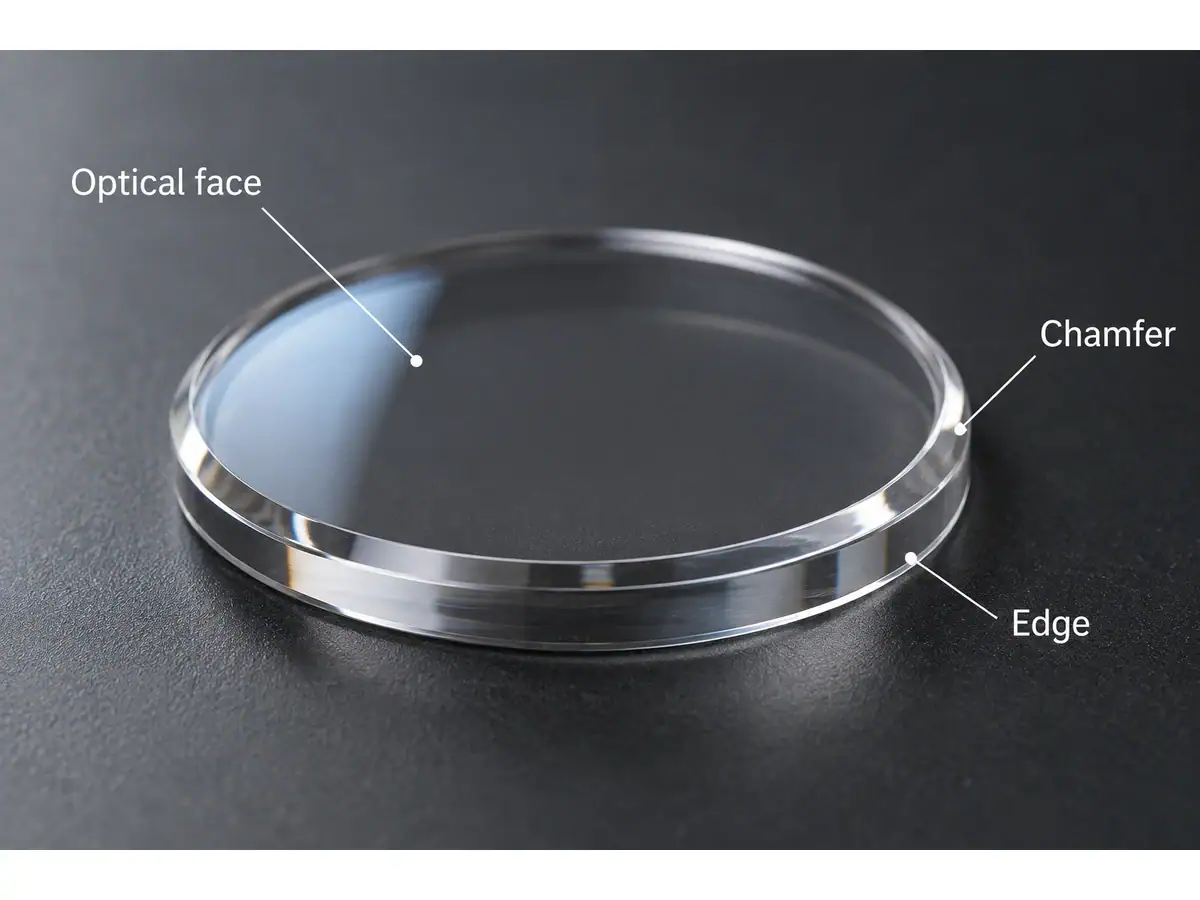
Identify which surfaces are optical, cosmetic, sealing or locating features. A polished edge may have an appearance requirement, while an adjacent seating land must preserve a specified dimension. Blending these regions during polishing can make an attractive part unsuitable for assembly.
Specify the usable aperture, thickness, curvature and edge geometry. If the part will be coated, identify the coating area and permitted handling regions. “Polish all over” is not a sufficient manufacturing instruction.
The watch-glass manufacturing guide provides the application framework. Use it to discuss the route, then confirm the actual drawing and acceptance method before treating the equipment selection as complete.
For watch crystal polishing, keep the distinction between sapphire, mineral glass and any coating stack visible on the job record. The word “crystal” describes the component in watch terminology; it does not fully identify the substrate.
02 — Flat, domed and double-curved parts need different support
A flat watch crystal can be evaluated in terms of face flatness, thickness and the required relationship between its faces. A domed part adds curvature and changing contact geometry. A component with two curved faces needs control of their relationship as well as each individual surface.
Do not assume that a fixture for a flat disc can hold a domed lens without stress or restricted tool access. Thin edges, a steep transition or a finished face used as the locating surface can change the holding problem.
For sapphire, preserve the specified crystal orientation and part reference through cutting and finishing. Orientation is a material input, not a substitute for measuring the finished geometry.
| Part feature | Process question | Inspection question |
|---|---|---|
| Flat optical face | Can the support maintain uniform contact? | Is the defined aperture within the form requirement? |
| Curved face | Can the tool and fixture access the full required region? | Are radius and form evaluated consistently? |
| Chamfer | Is sufficient stock available without entering a functional land? | Are width, angle or radius defined and checked? |
| Polished perimeter | Is the edge tool suitable for the profile? | Is appearance acceptable without losing fit dimensions? |
03 — Build the watch crystal polishing route around handoffs
A typical route can include slicing, generating or face preparation, edging and chamfering, face polishing, edge polishing, cleaning and inspection. The exact order depends on geometry, workholding and which finished surfaces need protection.
Avoid treating this sequence as an unchangeable rule. An edge may need preliminary shaping before face finishing, followed by a controlled final operation. Another part may require a different order to preserve its locating features.
Watch crystal polishing should receive blanks with a defined stock condition. Excessive incoming bow or an undersized edge reserve cannot be corrected by extending polishing time indefinitely. Record where chips first appear so damage from cutting is not confused with later tray handling.
Keep each part or batch traceable through transfers. A tray identification system is useful only if the rejected and reworked parts remain associated with their original process history.
04 — Distinguish edging capability from final acceptance
Vimfun’s Auto-EG-80 automatic profiling edger explicitly lists sapphire watch crystals among its applications. The published page describes automatic loading and unloading, contour grinding and chamfering, with a stated cycle starting around 15 seconds depending on the part.
That figure is a machine-operation reference, not a promised watch crystal polishing cycle or completed-line output. Tooling, material, profile, stock removal and inspection affect the actual result.
The page also lists spindle runout below 0.006 mm. Spindle runout and finished-part dimensional error are different quantities. Do not substitute the machine figure for a part acceptance tolerance.
Use a representative drawing and blank in the trial. Include the most demanding edge transition rather than choosing only the easiest round part from the product family.

05 — Face finish and edge finish are separate operations
Watch crystal polishing must preserve the functional geometry while improving the specified surface. A face-polishing process is not automatically capable of polishing a complicated perimeter. Conversely, an edge-polishing machine does not establish optical face quality.
The EP-220C peripheral polishing page describes edge finishing of flat 2D and 2.5D panels. It specifically distinguishes that role from lens edging and face polishing. Consider it only where the actual workpiece geometry fits that scope.
For a curved optic requiring diameter and bevel generation, use the appropriate lens-edging route instead of assuming a panel-edge polisher is interchangeable. Confirm tooling access and the required corner or radius treatment from the drawing.
Record final dimensions after the finishing operation that can change them. An edge that passed inspection before polishing may no longer meet the fit requirement afterward.
06 — Batch output depends on more than tray capacity
Trays and automatic transfer can reduce repeated handling, but part presentation and locating consistency must be controlled. A tray pocket should protect finished surfaces and avoid contact that produces a new defect during loading.
For watch crystal polishing trials, record loading time, process time, unloading, cleaning and inspection separately. Keep accepted output as the final measure. A large tray can hide a long queue or a difficult recovery procedure when one part is incorrectly seated.
Include changeover between realistic designs. Different diameters, curvature or edge shapes may need fixtures, programs and inspection changes. A short automatic cycle does not eliminate those tasks.
Inspect parts from different positions and times in the batch. A sample taken only at startup may miss tooling drift or a recurring problem associated with one tray location.
07 — Agree the condition required before coating
The coating supplier should define the incoming cleanliness and surface acceptance requirements. Residue, particles and handling marks can affect downstream results even when the part appears clear in ordinary lighting.
Separate surface roughness, form and cosmetic inspection. Do not use a single “optical finish” label to cover all three. Where transmitted performance matters, specify the applicable test rather than assuming a face measurement alone establishes the assembled result.
Watch crystal polishing records should show the last cleaning operation and the protected transfer into the next process. Avoid introducing undocumented wiping or packaging changes after the qualified cleaning route.
Review coating-related rejects with the processing history available. A downstream defect should be investigated across cleaning, handling, substrate condition and coating rather than automatically attributed to polishing.
08 — Release the route using the actual design
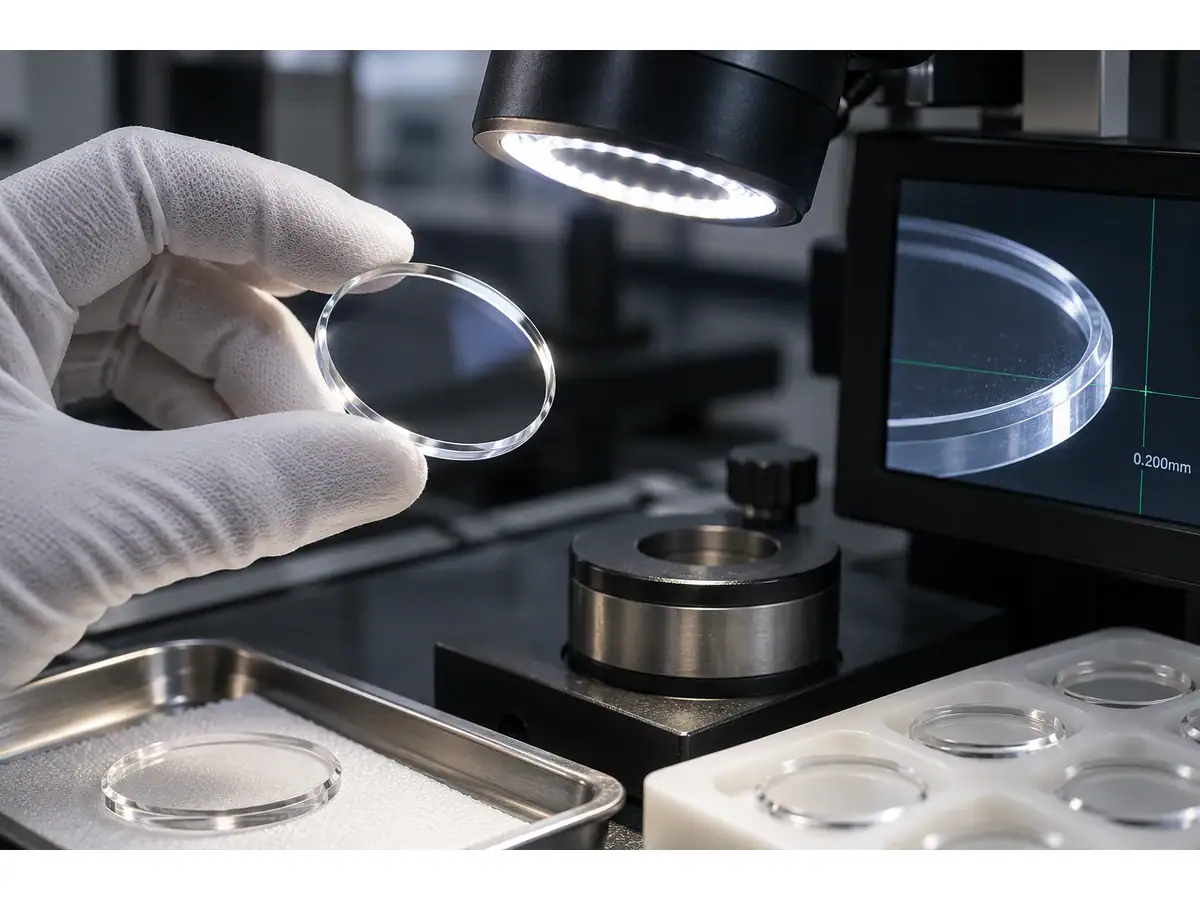
Approve the process using finished parts that meet the drawing, cosmetic standard and agreed inspection conditions. Include case-fit or other assembly checks where they are part of the acceptance scope.
For an application review, send the material, face geometry, edge profile, annual volume and batch mix. Identify whether the request covers edging, face polishing, peripheral polishing or the combined route. That distinction makes a watch crystal polishing proposal technically useful before the first trial begins.