
IR Optics Cutting and Polishing Machine
Two stations carry most of the optical-quality weight on an IR optics line: the front (cutting) and the back (polishing). The IR optics cutting and polishing machine bookend setup from Vimfun pairs closed-loop wire cutting with aspheric polishing on one ISO 10110 tolerance budget — sized for retrofit installs and partial-line upgrades where the middle stations stay as they are.
Why are cutting and polishing the leverage stations on an IR optics line?
Between the front cut and the back polish, an IR optics line adds optical quality, removes material, and burns labor. But not every station contributes equally — and the IR optics cutting and polishing machine pair is where the leverage concentrates.
A typical Ge / ZnSe / Si lens line has five stations: cut → center → grind → polish → coat. Centering is a mechanical adjustment — it locates an existing geometry but doesn't change it. Grinding generates the spherical or aspheric form, but its tolerance budget is set by what cutting delivered upstream. Coating is a chemistry step that depends almost entirely on what polishing delivered. The two stations that **set quality at all five downstream points** are the cut at the front and the polish at the back.
For shops considering an IR optics cutting and polishing machine upgrade, the leverage shows up in three ways. First, every micron of subsurface damage (SSD) left by the cut becomes a micron the polisher must remove — typically at 100× the per-micron cost. Second, every 0.1 mm of edge chip from the cut becomes a centering allowance the operator has to compensate. Third, every nanometer of surface roughness left by the polisher determines whether the AR coating sticks for 6 months or 6 years. None of the middle stations have this kind of compounding effect.
That's why a partial-line upgrade — replacing just the cut and polish stations while keeping existing centering and grinding equipment — often delivers ROI faster than a full-line replacement. You're swapping in the two stations whose quality cascades the furthest, on a line where the other stations were already adequate.
How does a cut shape the polishing burden downstream?
The handoff between cutting and polishing carries four numbers that move directly from one station's output spec to the other's input spec. Picking an IR optics cutting and polishing machine pair without understanding this handoff is how shops end up with cutters too fast for their polishers (or polishers too slow for their cut quality).
- Kerf width ~0.5 mm closed-loop wire vs 5–10 mm core drill. Smaller kerf = less material waste, smaller blanks, less for polishing to remove.
- Edge chipping < 0.1 mm on a closed-loop wire vs 0.3–0.8 mm typical for core drill. Chips become centering allowance, which sets where polishing's reference axis lands.
- Subsurface damage (SSD) 5–15 µm on a clean wire cut vs 30–80 µm on an ID saw. SSD is the polisher's minimum removal depth — every micron costs cycle time and tool wear.
- Surface roughness from cut (Ra) 0.6–1.2 µm on closed-loop wire — fine enough to enter polishing directly, skipping rough lapping in some workflows.
The cleanest cut leaves the smallest polishing burden. That's not a marketing claim — it's the same physics regardless of supplier. The benefit of buying both stations from one supplier is that the output spec of the cut station IS the input spec of the polish station, on one drawing per ISO 10110, with no per-vendor translation. For material-specific behavior — Ge {111} cleavage, ZnSe {110} planes, sapphire's hardness — the parameter sets live in each station's setup.
Three Vimfun cutting machines feed the polish station
Each cutting machine fits a different blank-geometry case. Pick by output shape, not by aspirational features.
SG40 — routine round wafer slicing
The SG40 germanium wafer slicing machine produces round wafers from a Ge or Si ingot at ~0.5 mm kerf, in single or mixed thicknesses per program. Highest-volume of the three cutting machines, and the natural feed for any round-lens polishing workflow. Output Ra 0.6–1.2 µm, SSD 5–15 µm — the cleanest input the polisher can expect.
SGR40 — rotary prism / polygon blanks
The SGR40 germanium lens blank cutting machine adds a rotary worktable for indexed multi-shape cuts — hexagonal blanks, prism windows, polygon housing optics. Same kerf and edge quality as the SG40; the difference is geometry. Polishing on the output side handles flat or shallow-curve faces typical of housing windows.
SGI 40 — free-form contour blanks
The SGI 40 germanium ingot cutting wire saw reads DXF files and cuts arbitrary closed contours — crescents, off-axis shapes, irregular thermal-imaging blanks. The polishing handoff here usually adds an aspheric polishing pass since these blanks often correspond to aspheric or off-axis surfaces.
Send your raw lens specification — material, aperture, surface type, target volume — and we'll come back with the recommended cutting machine plus matching polishing class. Most consultations clarify in 1–2 emails.
One spindle handles aspheric, spherical, and flat
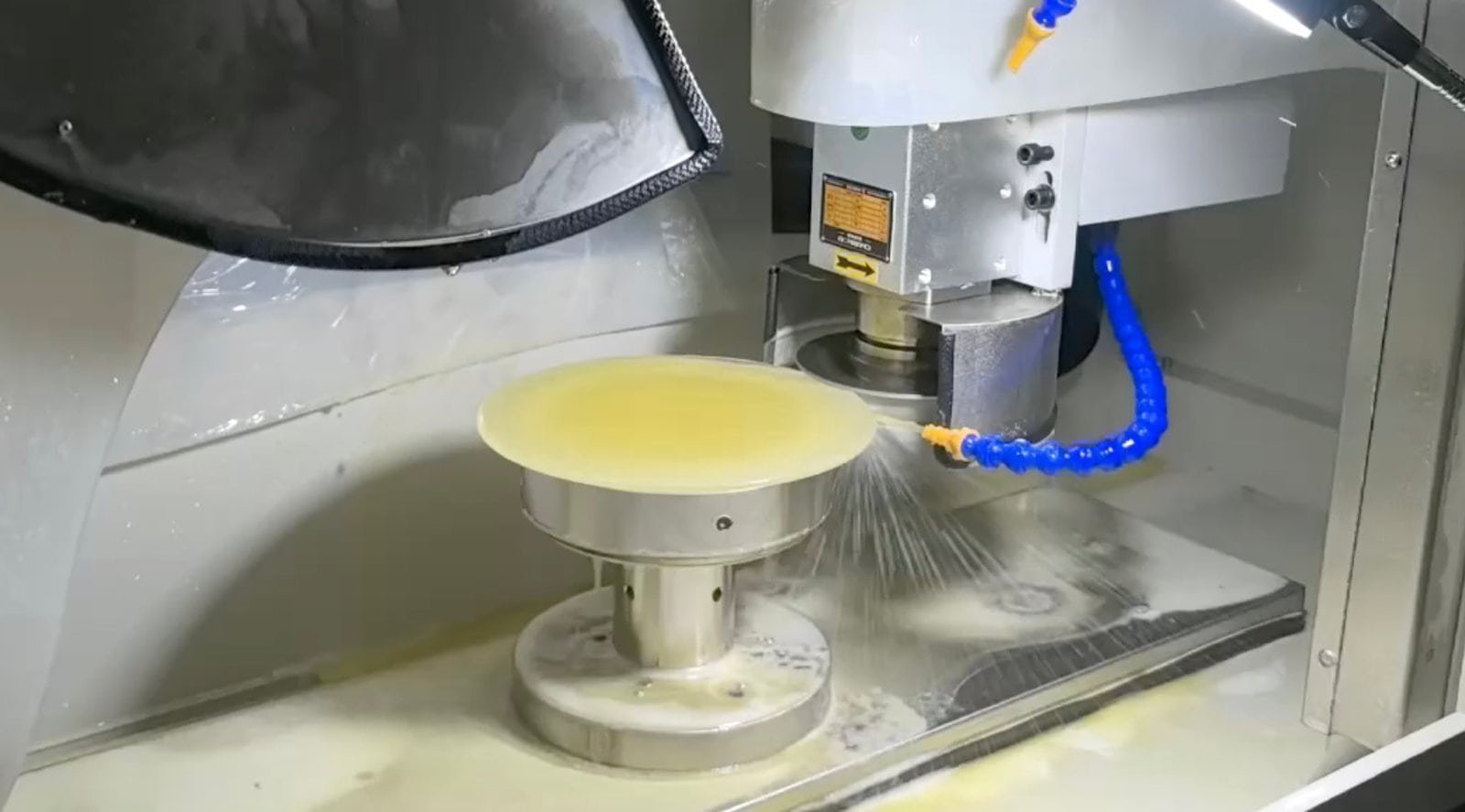
On the polishing end of an IR optics cutting and polishing machine pair, the Vimfun aspheric polisher handles workpieces up to Ø 300 mm. One spindle covers aspheric, spherical, and flat surfaces on convex and concave sides — no tool change required between surface types. Cycle time is about 3 minutes per face for spherical work, 2–3× that for aspheric depending on departure from the best-fit sphere.
- Surface roughness Ra < 5 nm after final polish — fine enough for direct DLC or BBAR deposition
- Form irregularity better than 1λ at 633 nm reference (much looser than visible-spectrum optics)
- Workpiece range Ø ≤ 300 mm, suitable for small thermal-imaging optics through large defense primary optics
- Material support Ge, ZnSe, ZnS, Si, sapphire, BK7, fused silica — material-specific pad and slurry chemistry per part
The polishing station is currently available as part of the IR optics cutting and polishing machine build — it doesn't have a standalone product page yet. Specifications and configuration options are sent with the line proposal. For material chemistry detail on chalcogenide polishing specifically, see the ZnSe / ZnS optics grinding machine page, which covers the same chemistry constraints that flow into polishing.
Vimfun IR optics cutting and polishing machine options — at a glance
Three cutting machines plus the polisher. Cutting machines have product pages; the polisher ships as part of the cut + polish line build.
| Machine | Station | Range | Why it pairs into cut + polish |
|---|---|---|---|
| SG40 | Cut — round wafer slicing | Ø ≤ 200 mm ingots | Highest-volume input to the polisher; clean Ra 0.6–1.2 µm |
| SGR40 | Cut — rotary multi-shape | Ø ≤ 200 mm ingots | Prism / polygon housing blanks for flat-face polish |
| SGI 40 | Cut — DXF free-form | Ø ≤ 185 × L 400 mm | Off-axis / crescent blanks for aspheric polish |
| Aspheric polisher | Polish — asph / sph / flat | Ø ≤ 300 mm | Ra < 5 nm, form < 1λ@633 nm — one spindle (line build) |
For the broader equipment context — centering, grinding, AR coating — see the germanium lens manufacturing equipment hub (5-stage full-line view) or the broader infrared optics manufacturing equipment catalog.
Which Vimfun setup fits your cut-polish scenario?
Three partial-upgrade scenarios cover most cut + polish line consultations. Find yours below.
Scenario A — Aging cutter, polisher still acceptable
You're keeping your existing polishing line and replacing only the cutting station. Most common reason: switching from a core drill or ID saw to closed-loop wire for material savings on Ge. Setup: one of the three Vimfun cutting machines (per your blank geometry) plus a tolerance-handoff review against your existing polisher's input spec. Lead time: 8–10 weeks for the cutter, no polisher-side disruption.
Scenario B — New 2-station bookend installation
Building or significantly modernizing a line and want both cut + polish from one supplier. Setup: cutting machine choice per geometry + aspheric polisher + one ISO 10110 drawing flow connecting them. Lead time: 12–14 weeks for the full pair. The advantage over piecemeal procurement is that the cut output spec IS the polish input spec — no integration debugging at commissioning.
Scenario C — Capacity expansion (add cells)
You already have one cutter + one polisher running and need to add a second cell to handle volume growth. Setup: identical or upgraded versions of your existing machines, with cells running in parallel. Lead time: 8–10 weeks per cell. Often paired with a parallel centering / grinding capacity adjustment.
Defense qualifications, multi-material lines, and aspheric-only production all have their own configurations. Send your project profile via the consultation request.
What goes wrong when cut and polish aren't on the same tolerance budget?
The most common failure mode in multi-vendor IR optics cutting and polishing machine procurement is the spec gap at handoff. Vendor A sells the cutter and lists "edge chipping < 0.3 mm" on its datasheet. Vendor B sells the polisher and assumes "centering allowance < 0.15 mm" as its input. Both look reasonable on paper. In production, the polisher's centering routine fights the cutter's actual edge chip distribution, and shop-floor yield drops 10–20% on lenses near the centering allowance limit.
The single-supplier path eliminates this. Vimfun's cut + polish drawing flow uses one ISO 10110 specification per finished part — surface form, decenter, edge chipping, subsurface damage, surface roughness all live in one tolerance document. Each station verifies the incoming spec at handoff (not at final inspection), and the polisher's removal allowance is sized against the cutter's measured (not advertised) output.
For shops running multi-material lines — Ge for thermal imaging, ZnSe for CO₂ laser optics — this matters even more. Material-specific tolerance flow (chip-allowance differences between Ge {111} and ZnSe {110} cleavage planes, for instance) is one of the routine spec-sheet gotchas that single-supplier procurement removes.
Where two-station IR optics upgrades end up in production
Four production patterns where buying just the cut + polish pair (and keeping the middle stations as-is) makes the cleanest economic case.
Aging Ge thermal-imaging line modernization
Existing centering and grinding equipment works fine; the cutter is 10+ years old and bleeds Ge to wide kerf. Replacing just the cutter + polisher recovers 20–35% of material yield and tightens AR-coating consistency.
Hybrid Ge + chalcogenide line addition
You're adding ZnSe / ZnS handling to an existing Ge line. The current cutter and polisher were tuned for Ge only. Cut + polish replacement covers both materials with parameter-set switching, no second line.
High-volume thermal-imaging capacity expansion
Demand outgrew the existing cell. Add a second SG40 + polisher pair to double cell capacity without touching the centering / grinding side, which usually has more headroom than the bookends.
Defense optics qualification cycles
A new program demands tighter coating durability than the existing polisher's Ra spec supports. Polisher upgrade alone (paired with a matching cutter upgrade for tolerance flow) covers it without re-qualifying the rest of the line.
What does a cutting + polishing upgrade actually cost?
IR optics cutting and polishing machine economics differ from full-line economics in two ways: lower up-front CapEx, but faster payback because you're replacing the highest-leverage stations first. Per-machine list pricing for the cutting side runs $31K–$39K for the SG / SGR / SGI 40 platform; the polisher ships with the cut + polish line package and is priced against your specific configuration (workpiece range, aspheric requirements, monthly volume).
On the material-savings side, a kerf reduction from 5–10 mm core drill to 0.5 mm closed-loop wire saves $200–$600 of germanium per 200 mm ingot, depending on diameter. At 50 ingots/month, that's $10K–$30K of Ge kept every month — by itself enough to retire the cutter CapEx in 8–14 months without counting polishing or downstream gains.
On the polishing side, the savings come from cycle time and yield, not material. A polisher that takes 5 minutes per face on adequate input might take 8 minutes on degraded cut input. Across 1,000 lenses/month, that 3-minute delta is 50 hours of polisher labor per month — directly visible on the OpEx ledger. Combined cut + polish payback typically runs 10–14 months at mid-tier thermal-imaging volume; faster at automotive ADAS volume, slower at defense low-volume work where the case is more about quality compression than throughput.
Who already runs Vimfun cut + polish setups
Reference customers across thermal imaging, infrared sensor manufacturing, and defense optics programs. Selected names below; full reference list on request.
The largest installed cutting footprint is at Sunny Optical Technology Group (HKSE 2382) — 30+ Vimfun cutting machines covering free-form contour, routine slicing, and rod extraction, primarily feeding their thermal-imaging lens lines. Polishing is handled in-house at Sunny, but several smaller Asia-Pacific IR optics customers run combined Vimfun cut + polish setups as their primary lens-line bookends.
Defense and aerospace cut + polish customers operate under NDA and become accessible once your project profile is shared. For the broader infrared optics manufacturing equipment platform — including centering, grinding, and AR coating — see the main hub.
What buyers ask before adding cutting + polishing to an existing line
The questions that come up most often in IR optics cutting and polishing machine consultations. If yours isn't here, send it directly.
Can we use a Vimfun cutter with our existing polishing line?
Yes — Vimfun cutters ship as standalone machines with documented output specs (kerf, edge chipping, SSD, Ra). If your existing polisher's input spec falls inside those numbers, the integration is clean. We run a quick spec compatibility check during the consultation and flag any handoff gaps before quoting.
What if our existing polisher has tighter tolerances than the cut output?
Two paths. Either tighten the cut spec by adjusting wire diameter and parameters (often achievable inside Vimfun cutter's standard range), or add a light grinding / lapping intermediate step. The consultation will recommend the lower-cost path for your specific tolerance gap.
Is the polishing machine sold as a standalone product?
Currently the aspheric polisher ships as part of the IR optics cutting and polishing machine line build, not as a standalone product. A standalone polisher product page is under development. Specifications are sent with line proposals; ask in the consultation for a polisher-specific spec sheet.
What materials does the cut + polish combo handle beyond germanium?
ZnSe, ZnS, silicon, sapphire, BK7, and fused silica — each gets a parameter-set switch (cutting wire grade, polishing pad and slurry chemistry). Hybrid lines that produce both Ge and chalcogenide optics on the same equipment run common — see the G-250 ZnSe / ZnS grinding machine page for chalcogenide-specific process detail.
How does polishing differ for germanium vs ZnSe vs sapphire?
Each material has its own pad / slurry combination, dwell time, and final Ra target. Germanium polishes faster than ZnSe (Mohs ~4 vs ~4.5) but ZnSe is softer chemistry — different slurry pH. Sapphire is hardest (Mohs 9) and slowest, needing diamond slurry. The polisher hardware is common; the recipes differ.
What's the lead time for a cut + polish only install?
12–14 weeks for the full pair, 4–6 weeks on-site for commissioning and operator training. Replacing just the cutter (Scenario A above) ships in 8–10 weeks. For defense or aerospace timelines with qualification testing, add 6–12 weeks.
Do we need a centering machine between cut and polish?
For lens production, yes — centering establishes the optical-axis reference the polisher needs. If you're keeping your existing centering machine in a partial upgrade, the Vimfun cutter's edge-chipping spec is sized to fit standard centering allowances. If you're building new and want the centering machine too, the broader germanium lens manufacturing equipment hub covers the full-line option.
Can the cut go directly to polish, skipping grinding?
For some flat optics (windows, filters), yes — if the cut leaves Ra and SSD inside the polisher's removal budget, intermediate grinding can be skipped. For curved optics (lenses), grinding stays in the workflow because the polisher operates on a pre-generated spherical or aspheric form, not on a flat cut face. Ask in the consultation for your specific part type.
Talk through your IR optics cut-polish line with an engineer
Send us your lens drawing and your current line configuration. We'll come back with a 2-station upgrade proposal that fits your existing centering / grinding equipment and your target volume — typically within one business day.