
Thermal Imaging Lens Manufacturing Equipment
Application-tier thermal imaging lens manufacturing equipment from a single supplier. Different thermal-imaging OEM tiers need different machine setups — a handheld scope line is not an ADAS night-vision line, and neither is a defense thermal optic line. This hub maps the four common tiers to the Vimfun machine setup each one needs.
What does a thermal imaging lens line actually need to produce?
Thermal imaging is not one market — it's four. The lens manufacturing requirements split cleanly across handheld, automotive ADAS, defense, and surveillance, and the equipment configuration follows.
Vimfun thermal imaging lens manufacturing equipment ships as a configurable platform — the same closed-loop wire saws, the same NSK-bearing grinders — but the recommended setup changes meaningfully with the OEM tier. Picking equipment without first picking the tier is how shops end up with the wrong cycle time, the wrong aperture range, or the wrong material chemistry.
Tier 1 — Handheld thermal imagers
Scout cameras, weapon sights, handheld firefighter cams, search-and-rescue thermal binoculars. Lenses are typically Ø 20–60 mm germanium, f/1.0–f/1.4, athermalized two- or three-element groups. Monthly volume per OEM lands between 50 and 300 lenses. Cycle time matters but uniqueness of each shipment doesn't — most jobs are repeat orders of an established part. Setup: SG40 for routine wafer slicing + G-100 for spherical generation + centering / polishing on request.
Tier 2 — Automotive thermal imaging (ADAS night vision)
OEM-supplied ADAS modules from Tier-1 automotive suppliers. Lenses are Ø 25–40 mm germanium (sometimes hybrid with chalcogenide front elements), f/1.0 typical, sealed window assemblies. Monthly volume from 1,000 to 10,000+ at peak — by far the largest-volume tier. Cycle time is the dominant lever. Setup: SG40 (often multiple units in parallel) + G-100 + DLC coating for road-debris resistance. SGR40 added for sealed housing window discs.
Tier 3 — Defense and aerospace thermal optics
Vehicle-mounted thermal sights, aircraft IRST, missile seekers, ground-vehicle situational awareness. Primary optics often Ø 60–200 mm, sometimes free-form (off-axis or crescent shapes for specific FOV geometry), MIL-spec coating durability per MIL-C-48497A. Monthly volume per program runs 10–100 units; lead times longer, qualification rigorous. Setup: SGI 40 for free-form contour cutting + G-250 for large-aperture grinding + program-specific coating chamber.
Tier 4 — Surveillance and industrial thermal
Stationary security cameras, perimeter monitoring, gas detection, predictive-maintenance IR. Lenses Ø 40–80 mm germanium, f/1.2–f/1.6, typically uncooled microbolometer-paired optics. Monthly volume 100–500 per OEM. Similar setup to handheld but with larger aperture range — SG40 + G-100, sometimes G-250 if the primary objective exceeds Ø 100 mm.
Thermal imaging lens manufacturing equipment by tier, aperture, and volume
The matrix below maps the five Vimfun machines that show up most often in thermal-imaging lens lines. Click any model to read its full product page; this hub shows the role each plays in a thermal imaging build.
| Machine | Tier where it dominates | Workpiece range | Why thermal imaging needs it |
|---|---|---|---|
| SG40 | Handheld + ADAS + Surveillance | Ø ≤ 200 mm Ge ingots | High-volume kerf savings on small Ge lens blanks |
| SGR40 | ADAS + sealed-housing optics | Ø ≤ 200 mm Ge ingots | Rotary indexing for prism / polygon housing windows |
| SGI 40 | Defense (free-form) | Ø ≤ 185 × L 400 mm | DXF contour cutting for off-axis / crescent blanks |
| G-100 | Handheld + ADAS + Surveillance | Ø 10–100 mm | Convex / concave spherical generation, 5-min cycle |
| G-250 | Defense (large aperture) | Ø 80–250 mm | Large primary objectives + chalcogenide front elements |
| Centering (C-120L / C-185L) | All tiers | Ø ≤ 185 mm | 20″ decenter — critical for athermal performance |
| Aspheric polisher | All tiers | Ø ≤ 300 mm | Aspheric / spherical surfaces, single spindle (on request) |
| DLC + BBAR chambers | All tiers (DLC on ADAS / defense) | Batch (50+ / load) | LWIR AR transmission > 95% per surface; DLC for road / weather exposure |
For the material-process angle on this same equipment — kerf, yield, full-line tolerance flow on germanium specifically — see the germanium lens manufacturing equipment hub.
Which Vimfun setup fits which thermal imaging OEM scenario?
Three buyer scenarios cover the majority of incoming thermal imaging lens manufacturing equipment consultations. Find yours below — each scenario maps to a recommended starting configuration.
Scenario A — You're scaling a handheld or surveillance product to mid-volume
Monthly volume 100–500 of one or two part numbers. Aperture range Ø 25–60 mm. You need a clean repeatable cycle, not exotic geometry. Start with one SG40 + one G-100, plus a centering machine and a polishing station. Coating can be subcontracted at this volume tier or brought in-house when your AR-quality spec tightens.
Scenario B — You're building a Tier-1 ADAS night-vision line at automotive volume
Monthly volume 1,000–10,000+. Aperture range Ø 25–40 mm. Cycle time and yield consistency are your top KPIs. Multiple SG40 + G-100 pairs in parallel; in-house DLC coating for road-debris resistance; tight process control on each station. The volume case for full-line ownership is strong at this tier — payback often under 12 months.
Scenario C — You're producing defense or aerospace thermal optics with mixed geometry
Monthly volume 10–100 across multiple program SKUs, including some free-form or off-axis shapes. Aperture range Ø 60–200 mm. Start with SGI 40 for contour cutting, G-250 for large-aperture grinding, and program-specific coating qualification per MIL-C-48497A. A working reference: Sunny Optical's free-form crescent thermal-imaging lens is exactly this scenario.
If your shop runs both ADAS and defense thermal imaging optics, the line configurations differ enough that running them on separate cells often beats trying to share a single shared line. Ask in the consultation — we'll model the throughput trade-offs against your actual volume mix.
Why thermal imaging optics are unforgiving — and how the line handles it
Thermal imaging lens assemblies are athermal — they compensate for temperature-driven focal-length shift with intentional element spacing and material selection. That design strategy puts an extra demand on manufacturing: small decenter errors in any one element cascade into focal-plane drift across the operating temperature range. The Vimfun thermal imaging lens manufacturing equipment line is sized around this constraint:
- Centering decenter ≤ 20 arc-seconds — centroscope-verified before grinding, not after
- Form irregularity better than 1 λ at 633 nm — translates to better than λ/4 in the 8–12 µm LWIR band
- Surface roughness Ra < 5 nm — enables direct deposition of multilayer BBAR or hard DLC overcoat
- AR transmission > 95% per surface — at the 8–12 µm band central wavelength
- Edge chipping < 0.1 mm — sets the centering allowance for the next station
None of these specs is exotic on its own — what matters is that they hold across the line, station after station, on a unified ISO 10110 drawing flow. For drawing standards reference see ISO 10110; for material data on the germanium and chalcogenides typical to thermal imaging optics see Crystran's germanium datasheet.
Where Vimfun thermal imaging lines actually end up in production
Four sub-segments inside thermal imaging account for the bulk of installed Vimfun lines. Volume profile, lens geometry, and coating requirements shape the equipment setup differently in each.
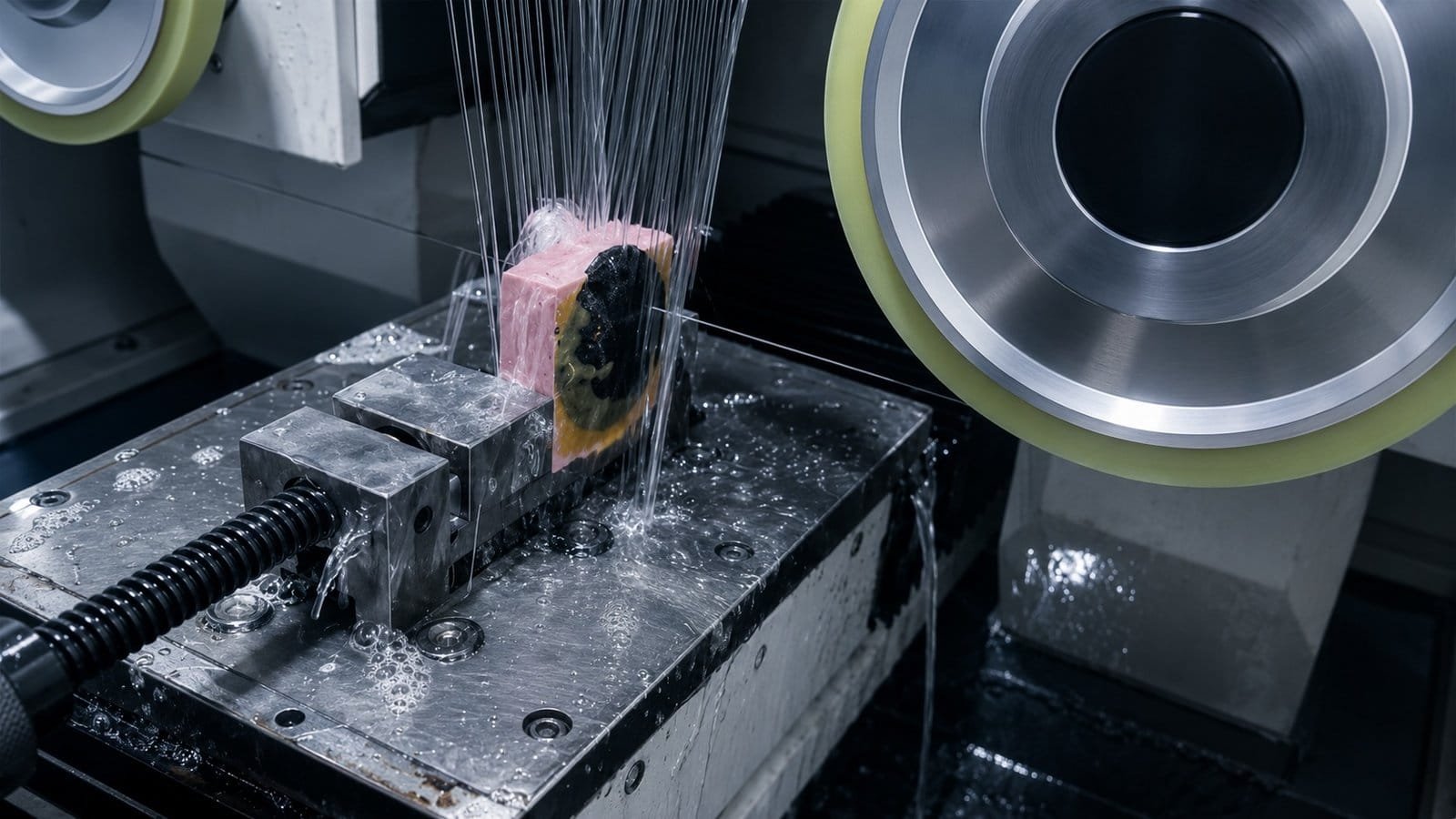
Handheld thermal scopes & weapon sights
Ø 25–50 mm Ge lenses, f/1.0–f/1.2. Volume 50–300/month. Setup: SG40 + G-100. DLC coating on the front-element optic that faces the outside world.
Automotive ADAS night vision
Ø 25–40 mm Ge lenses, f/1.0 typical. Volume 1K–10K+/month. Setup: parallel SG40 + G-100 cells, in-house DLC coating, tight Cpk on every station.
Defense / aerospace thermal optics
Ø 60–200 mm primary optics, sometimes off-axis or crescent. Volume 10–100/month. Setup: SGI 40 + G-250 + MIL-C-48497A coating qualification.
Surveillance & gas-detection thermal
Ø 40–80 mm Ge lenses, f/1.2–f/1.6 uncooled microbolometer optics. Volume 100–500/month. Setup: SG40 + G-100, sometimes G-250 for larger objectives.
What does a thermal imaging lens cost at production volume?
Per-lens cost on a thermal imaging lens manufacturing equipment line is dominated by two things: germanium material at $1,800–$2,400/kg, and station cycle time times labor / overhead burden. The volume tier changes which lever matters most.
For a typical Ø 30 mm handheld scope lens, raw germanium material runs $80–$150 per finished lens — most of that locked up in the blank that comes off the SG40 wafer slicer. Closed-loop wire kerf at ~0.5 mm saves ~$10–$15 of germanium per lens versus a core-drill kerf at 5–10 mm. At 300 lenses/month (handheld), that's $3,000–$4,500 of material kept; at 5,000 lenses/month (ADAS), it's $50,000–$75,000/month.
Cycle time becomes the dominant lever at ADAS volume. A G-100 spherical-generation cycle of ~5 minutes per face means 96 lenses per shift per machine, both faces. A 5,000-lens monthly target needs roughly 2 G-100 units running 2 shifts each. Adding a third G-100 cuts shift count and labor cost — the trade-off shows up directly in payback math.
For defense volume — 10–100 lenses/month, $80–150 of Ge per part, longer SGI 40 contour-cut cycles — the per-lens material economics matter less than program lead-time. A typical defense thermal imaging lens manufacturing equipment line pays back over 18–24 months on volume alone, but the qualification compression and single-supplier responsibility advantage are typically the bigger value than the material savings.
Who already runs Vimfun thermal-imaging lines today
Reference customers across thermal imaging OEMs, automotive ADAS Tier-1 suppliers, and defense thermal optics programs. Selected names below; full reference list on request.
The most visible thermal imaging deployment is at Sunny Optical Technology Group (HKSE 2382) — one of the world's largest optical-component manufacturers, with active thermal-imaging lens programs across handheld and automotive lines. Sunny started with one Vimfun cutting machine for a free-form crescent thermal-imaging lens, then scaled to 30+ Vimfun machines covering routine slicing, free-form contour, and supporting workflows.
Automotive ADAS Tier-1 suppliers and defense thermal optics programs operate under reference NDAs and become accessible once your project profile is shared. For the broader infrared optics manufacturing equipment catalog beyond thermal imaging, see the main hub — material-specific deep dives sit there, and the same machines serve other IR optics applications too.
What do thermal imaging OEMs ask before buying a line?
The questions that come up most often in thermal imaging lens manufacturing equipment consultations. If yours isn't here, send it directly.
What's the typical aperture range across thermal imaging tiers?
Handheld and surveillance: Ø 25–80 mm Ge lenses. ADAS: Ø 25–40 mm (volume-driven, smaller is faster). Defense: Ø 60–200 mm primary optics, sometimes off-axis. The G-100 covers handheld / ADAS / surveillance ranges; G-250 is needed when defense optics exceed Ø 100 mm.
Can the same line handle both germanium and ZnSe lenses (hybrid optics)?
Yes. The Vimfun wire saws and grinders accept both materials with parameter-set changes — different wheel grit, different coolant chemistry for ZnSe's softer {110} cleavage planes. Hybrid Ge/ZnSe assemblies (common in multispectral imaging) run on one platform; see the ZnSe / ZnS grinder for chalcogenide-specific detail.
How does ADAS volume change the equipment configuration?
At ADAS Tier-1 volume — 5,000+ lenses/month — cycle time dominates. The line typically needs multiple SG40 + G-100 cells running in parallel, in-house DLC coating (DLC handles road debris and weather exposure), and tight process Cpk on every station. We size the cell count against your monthly target in the consultation.
What's the qualification process for defense thermal imaging optics?
Defense programs run a multi-stage qualification — first-article inspection on critical dimensions, environmental testing per MIL-STD-810 series, coating durability per MIL-C-48497A (tape-pull, abrasion, humidity, temperature cycling). Vimfun coating chambers ship with documented compliance procedures; program-specific test reports are produced as part of acceptance. Lead time for defense qualification typically adds 6–12 weeks on top of routine commissioning.
Does the line support athermal multi-element lens assemblies?
The equipment produces the individual elements to the tolerances athermal assemblies need (decenter ≤ 20″, form ≤ 1λ at 633 nm, edge chipping < 0.1 mm). Assembly itself happens downstream of the Vimfun line — typically in cleanroom benches at the lens-house customer. We can recommend assembly-fixture suppliers if you don't already have a chosen partner.
What coating types work for outdoor thermal imaging environment exposure?
DLC (diamond-like carbon) is the default for any optic facing the outdoor environment — road debris on ADAS, abrasive sand on defense vehicles, weather on surveillance cameras. DLC trades ~2–3% AR transmission per surface for hard scratch resistance. Multi-layer BBAR is used for protected internal optics where the transmission max matters more than the durability. Most thermal imaging assemblies use DLC on the front element and BBAR on the internal optics.
How fast can a single SG40 + G-100 pair produce thermal imaging lenses?
Ballpark: SG40 slicing at 10–20 mm/min on Ge produces 30–50 blanks/hour from a typical 200 mm-long ingot, depending on lens thickness. G-100 cycle is ~5 minutes per face. Together, a single SG40 + G-100 pair sustains roughly 50–80 finished lens-faces per shift (one face at a time). For 300 lenses/month, one pair plus one centering and one polishing station is typically enough; for ADAS volume, multiply.
What's the lead time for a complete thermal imaging lens manufacturing equipment line?
12–16 weeks ship for a complete line, plus 4–6 weeks on-site for installation, commissioning, and operator training. Individual machines ship faster — 8–10 weeks each. Defense-program timelines add 6–12 weeks for qualification and acceptance testing. Expedited build is available with surcharges; ask in the consultation if your program needs accelerated delivery.
Talk through your thermal imaging line with an engineer
Send us your lens drawing, target monthly volume, and OEM tier (handheld / ADAS / defense / surveillance). We'll come back with a thermal-imaging-specific equipment proposal — typically within one business day.