
Infrared Optics Production Line
A complete infrared optics production line from one supplier — five stations, one purchase order, one tolerance budget, one technical owner from ingot to AR-coated lens. Built for plant managers procuring new IR optics capacity who'd rather not coordinate six vendors across an 18-month commissioning window.
Why buy an infrared optics line as a single turnkey package?
Three structural advantages over multi-vendor procurement — none of which show up on the equipment price comparison, but all of which dominate the actual project economics.
The traditional way to build a new infrared optics production line is to RFQ each station separately — cutting from one supplier, centering from another, grinding from a third, polishing and coating from two more. Each vendor delivers a working machine on its own datasheet. The integration burden — making them produce one finished lens that meets one drawing — falls on the customer's engineering team. This pattern works, but it's slow and adds cost in places that don't appear on any single supplier's quote.
A turnkey infrared optics production line collapses that integration burden onto the supplier. One PO covers all five stations. One technical owner takes the design responsibility from raw ingot input to AR-coated lens output. One tolerance flow document — not five — governs the spec at every station. Whether you're a plant manager building a new IR optics capability or expanding an existing facility, this single change usually compresses the project by 4–6 months and removes the highest-risk part of the schedule: integration debugging at commissioning.
The Vimfun infrared optics production line ships from a single point of manufacture, with one set of installation engineers, one operator-training curriculum, and one warranty contract. The total CapEx is comparable to the equivalent multi-vendor sum; the project-management cost and timeline are not.
What's inside a complete Vimfun production line?
A turnkey IR optics line covers five physical stations plus the integration documentation that ties them together. Equipment is sized and configured against your specific product mix (material, aperture range, monthly volume) — the description below is the standard composition.
- Station 1 — Cutting Closed-loop wire saw. One of three platforms depending on blank geometry: SG40, SGR40, or SGI 40.
- Station 2 — Centering C-120L or C-185L mechanical centering with centroscope optical-axis verification. Decenter ≤ 20 arc-seconds.
- Station 3 — Grinding G-100 (Ø 10–100 mm) or G-250 (Ø 80–250 mm) spherical / aspheric generation.
- Station 4 — Polishing Aspheric polisher up to Ø 300 mm. One spindle handles aspheric, spherical, and flat. Ra < 5 nm.
- Station 5 — AR coating DLC for exposed optics, BBAR for protected. 8–12 µm LWIR standard; SWIR / MWIR custom.
- Integration package One ISO 10110 drawing flow across all stations, factory acceptance test (FAT) procedure, on-site installation, operator training, and one-year parts + engineering warranty.
For the material-process angle on the same equipment, see the germanium lens manufacturing equipment hub. For partial-line / 2-station upgrades (cutting + polishing only), see the IR optics cutting and polishing machine hub.
Vimfun infrared optics production line — equipment lineup
The standard turnkey configuration. Each Vimfun infrared optics production line is sized against your actual product mix; the table below shows what's in the base bill of materials.
| Station | Machine | Range | Role in line |
|---|---|---|---|
| 1 — Cut | SG40 / SGR40 / SGI 40 | Ø ≤ 200 mm ingots | Closed-loop wire cutting, ~0.4 mm kerf |
| 2 — Center | C-120L / C-185L | Ø ≤ 185 mm | Centroscope decenter ≤ 20″ |
| 3 — Grind | G-100 / G-250 | Ø 10–250 mm | Spherical / aspheric generation |
| 4 — Polish | Aspheric polisher | Ø ≤ 300 mm | Ra < 5 nm, form < 1λ@633 nm |
| 5 — Coat | DLC + BBAR chambers | Batch 50+ / load | LWIR std, SWIR / MWIR custom |
| 0 — Integration | Documentation + FAT | — | ISO 10110 flow, training, 1-yr warranty |
Which buyer scenarios fit a turnkey line?
Four common project profiles where turnkey procurement beats piecemeal — and one where it doesn't.
Scenario A — New IR optics facility (greenfield)
You're standing up IR optics manufacturing capability for the first time. No existing equipment to integrate around. The turnkey case is strongest here: one supplier owns the full line design, your team learns one set of controllers and procedures. Typical use: defense / aerospace OEMs adding internal IR optics capability, or thermal-imaging OEMs moving from outsourced lenses to in-house production.
Scenario B — Expansion of existing IR optics line
You already produce IR optics but want to double capacity or add a parallel cell. Turnkey-as-a-cell makes sense: drop in a complete second line that doesn't need to interface with the existing one. Use the existing line for current production while the new cell is commissioned independently.
Scenario C — Generational replacement
Your existing IR optics line is 15+ years old, vendor support has lapsed, and qualification refresh is approaching anyway. Full-line replacement on a single PO often comes out faster and cleaner than piecemeal upgrades that fight legacy integration.
Scenario D — Defense or aerospace program-driven build
A new program demands IR optics capability with specific qualification testing per MIL-C-48497A and program-specific tolerances. Turnkey procurement aligns with how defense PMOs prefer to contract: single technical responsibility, single acceptance test, single point of contact for program reviews.
If you have an existing IR optics line with good centering / grinding equipment that's still under warranty, the partial-line upgrade (cutting + polishing only) on the cut + polish hub usually saves money. Turnkey makes sense when integration burden is high; if your line is already integrated and working, replacing only the lagging stations is more efficient.
What does site readiness look like for an integrated line?
A complete IR optics production line has predictable facility requirements. The list below is a planning starting point; Vimfun's site survey produces a customer-specific facility checklist as part of the proposal.
- Footprint A 5-station line occupies roughly 80–120 m² of shop floor, depending on aperture range and whether centering and coating are co-located with the cut / grind / polish cells.
- Power 220–380 V three-phase, total draw 15–25 kW depending on configuration. Coating chambers and large grinders carry the heaviest individual loads.
- Utilities Filtered compressed air (6 bar), DI water for coolant systems, exhaust ventilation rated for mineral-oil mist recovery on the cutters.
- Foundations Standard industrial floor adequate; precision grinders and polishers prefer isolation pads under the spindle housings (Vimfun ships pad specifications with the line).
- Environment Climate-controlled (18–25 °C, < 60% RH) for the polishing and coating cells. Cutting and grinding tolerate wider environmental ranges.
- Cleanroom Not required for the manufacturing stages, but recommended for the coating cell. Many customers run polish + coat in a Class 100,000 ISO 8 zone; not mandatory.
Pre-installation site readiness review typically runs 6–8 weeks ahead of equipment arrival. The team identifies utility tie-in points, floor preparation needs, and any building permits required. For multi-month qualification programs, this overlap is what keeps the on-site phase short.
How does commissioning work on a Vimfun turnkey delivery?
The on-site phase of an infrared optics production line install is roughly 4–6 weeks for a complete line. Below is the standard sequence; defense and aerospace programs add qualification testing on top.
Week 1 — Receipt & placement
Crates arrive on site, equipment is positioned per the pre-approved floor plan, utility connections completed. Vimfun installation engineer on site from day one.
Week 2 — Station-by-station calibration
Each machine powered up, axes calibrated, controllers configured. Vimfun engineer validates each station against factory acceptance test data — same as ran at the Vimfun facility before ship.
Week 3 — Line integration & first article
End-to-end test on customer-supplied material. First finished lens produced on the line by Vimfun engineer; tolerance flow verified against ISO 10110 drawing.
Weeks 4–6 — Operator training & site acceptance
Customer operators run the line under Vimfun supervision. Final site acceptance test produces a customer-witnessed batch. Warranty starts on acceptance signature.
What does a complete production line typically cost?
Turnkey infrared optics production line CapEx is configuration-specific. The cutting and grinding side is anchored by published machine pricing ($31K–$39K for the SG / SGR / SGI 40 platform; G-100 / G-250 priced against volume and material mix). Centering, polishing, and coating ship at line-specific pricing based on aperture range, monthly volume, and qualification requirements.
For ROI, the dominant levers are material savings on germanium and integration timeline compression. Closed-loop wire cutting saves $200–$600 of Ge per ingot vs core-drill methods; at 50 ingots/month that's $120K–$360K of germanium kept annually. The integration compression — 16–20 weeks turnkey vs 6–12 months multi-vendor — represents working-capital savings on a $30K+ per-ingot inventory that's hard to quantify cleanly but real on the project's P&L.
Combined payback at mid-tier production volume runs 12–18 months. Faster (under 12) at automotive ADAS thermal imaging volume; slower (18–24+) at low-volume defense work where the case is qualification compression and lead-time reduction rather than per-ingot material savings.
Who's already running a Vimfun turnkey IR optics line?
Two reference deployments worth specifically calling out — one full-line turnkey, one mass-installed cutting-side fleet.
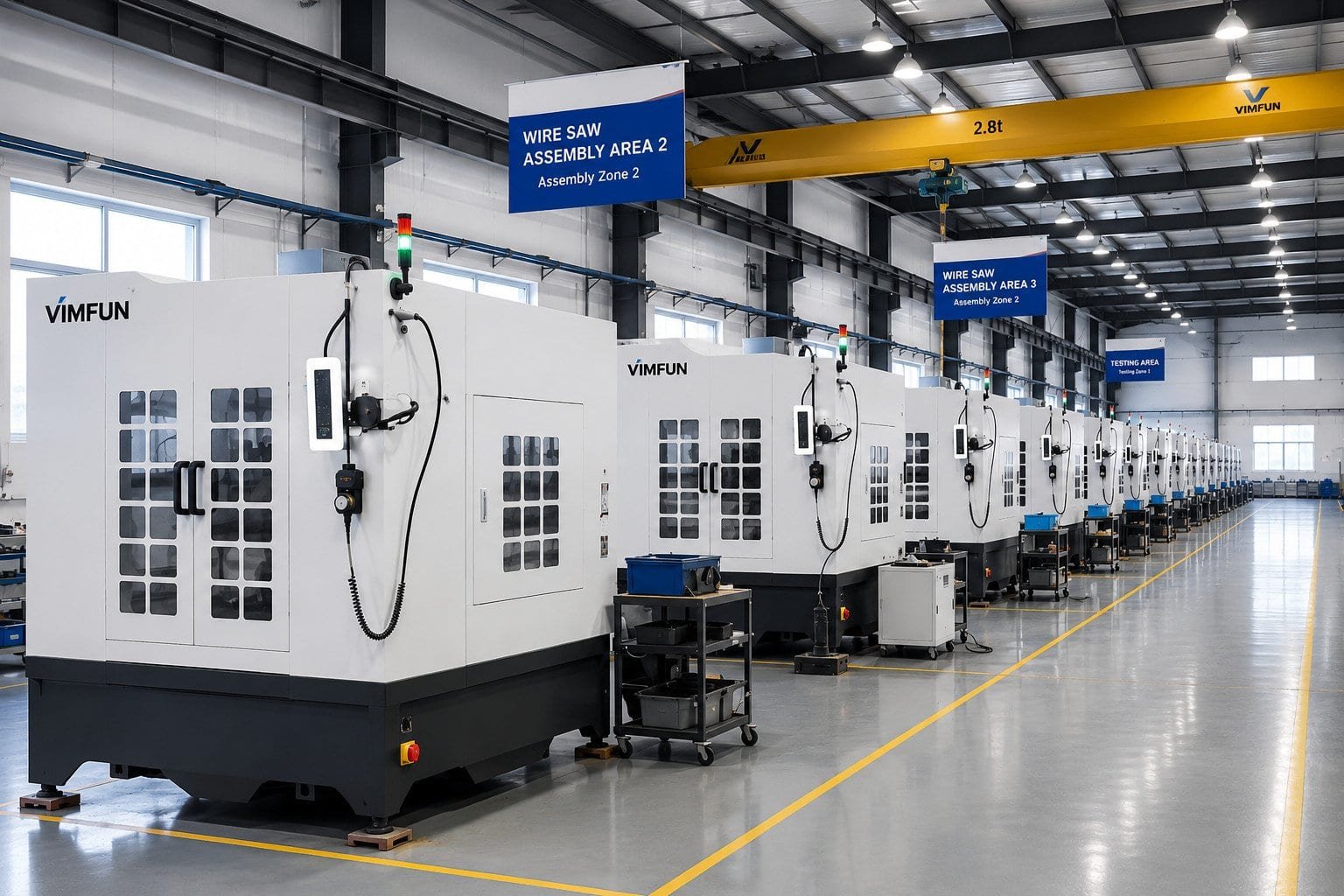
Turkish defense / thermal-imaging OEM — full turnkey deployment
A major Turkish thermal-imaging OEM purchased the complete 5-station IR optics production line in a single procurement event. Cutting, centering, grinding, polishing, and AR coating all from Vimfun, configured for both spherical and aspheric production, with mixed Ge and chalcogenide material capability. The customer prioritized three things explicitly: supply-chain consolidation (replacing several European vendors with one source), raw-material utilization (kerf savings at scale on imported germanium), and single-supplier technical responsibility — useful for the defense audit trail on program-relevant optics. Per-station price wasn't the top decision driver; integration burden was.
Sunny Optical — 30+ Vimfun cutting-side machines
Not strictly a turnkey deployment in the sense above — Sunny Optical Technology Group (HKSE 2382) handles its own centering / grinding / polishing in-house. But their 30+ Vimfun cutting machines across multiple sites demonstrate the platform's installed reliability and capacity for scale, with consistent ~30% yield improvement reported across the lens lines that switched to Vimfun closed-loop cutting.
For the broader infrared optics manufacturing equipment catalog and other reference customers across non-turnkey deployments, see the main hub.
What buyers ask before committing to a turnkey package?
The questions that come up most often in infrared optics production line procurement conversations. If yours isn't here, send it directly.
What's the typical project timeline from PO to first-article cut?
16–20 weeks total: 12–16 weeks ship from Vimfun + 4–6 weeks on-site commissioning and operator training. Defense or aerospace programs that require qualification testing per MIL-C-48497A add 6–12 weeks on top of that. Expedited builds with surcharges are available for high-priority programs.
How is integration risk handled — what if a station's output doesn't meet the next station's input?
That's what single-supplier turnkey eliminates by design. All five stations are specified against one ISO 10110 drawing flow, and the factory acceptance test (FAT) at the Vimfun facility validates the full station-to-station flow on a representative finished lens before crates leave the factory. On-site, the same FAT procedure runs once during commissioning to confirm shipping didn't affect calibration.
Can I start with part of the line and add the rest later?
Yes — many customers start with the cutting + grinding stations (where the kerf-savings and yield ROI are strongest) and add centering, polishing, and coating in a second phase. This isn't technically a "turnkey" delivery; it's phased procurement. Lead times and integration overhead are different from the full-turnkey case. The cut + polish hub covers partial-line patterns.
Do you handle defense or aerospace qualification testing?
Yes. The aspheric polisher and coating chambers ship with documented MIL-C-48497A compliance procedures, and program-specific testing is built into the FAT procedure. Vimfun supplies the test reports as part of the acceptance package; the customer's program office reviews and signs off. We don't directly hold US defense certifications; integration with US program requirements happens through your prime contractor's normal process.
What if we have specific material requirements outside Ge / ZnSe / Si / sapphire?
Send a sample of your material with target finished spec. Vimfun engineering runs a sample cut on the relevant cutting platform and configures the rest of the line against the measured behavior. Standard turnaround for sample evaluation is 2–3 weeks; no cost on first samples. Custom material configurations carry the same single-supplier turnkey delivery model.
How does training work — what do operators need to learn?
Operator training is built into the on-site phase, typically one shift per machine type. Five-station line training runs about 2–3 weeks of overlap with commissioning. All controllers ship with English HMI and a handheld controller; documentation is English standard. Refresher / new-operator training is available remotely after the initial site phase.
What's covered under the warranty and ongoing support?
One year on parts and engineering support from acceptance signature, with extension contracts available for years 2+. Remote process support is included with the standard warranty — phone / email response on production issues, parameter optimization, troubleshooting. On-site service visits beyond commissioning are scoped per-incident.
Can we visit a working installation before committing?
Reference visits are arranged when the customer's project profile justifies it and the reference customer is willing. For defense / aerospace prospects, reference visits typically happen under NDA after initial scoping. The Turkish full-turnkey deployment is one option; specific reference selection depends on your geography, application, and security profile.
Talk through your turnkey project with an engineer
Send us your facility size, target monthly volume, material mix, and project timeline. We'll reply with a turnkey infrared optics production line proposal — equipment configuration, site readiness checklist, commissioning timeline, and total project cost — typically within one business day.