Automotive thermal imaging systems require IR lens blanks cut to tighter dimensional tolerances than standard industrial optics — because a lens that passes incoming inspection can still fail after 3,000 hours of road vibration and thermal cycling. The manufacturing equipment used to produce these lenses determines whether they meet automotive qualification from the first prototype or require months of rework.
This page covers what makes automotive thermal imaging lens equipment different from standard IR optics machinery, how to select the right cutting and polishing machines for ADAS-grade lenses, and what production line configuration supports scaling from prototype quantities to Tier-1 supply volumes.
What Is Automotive Thermal Imaging Lens Equipment?
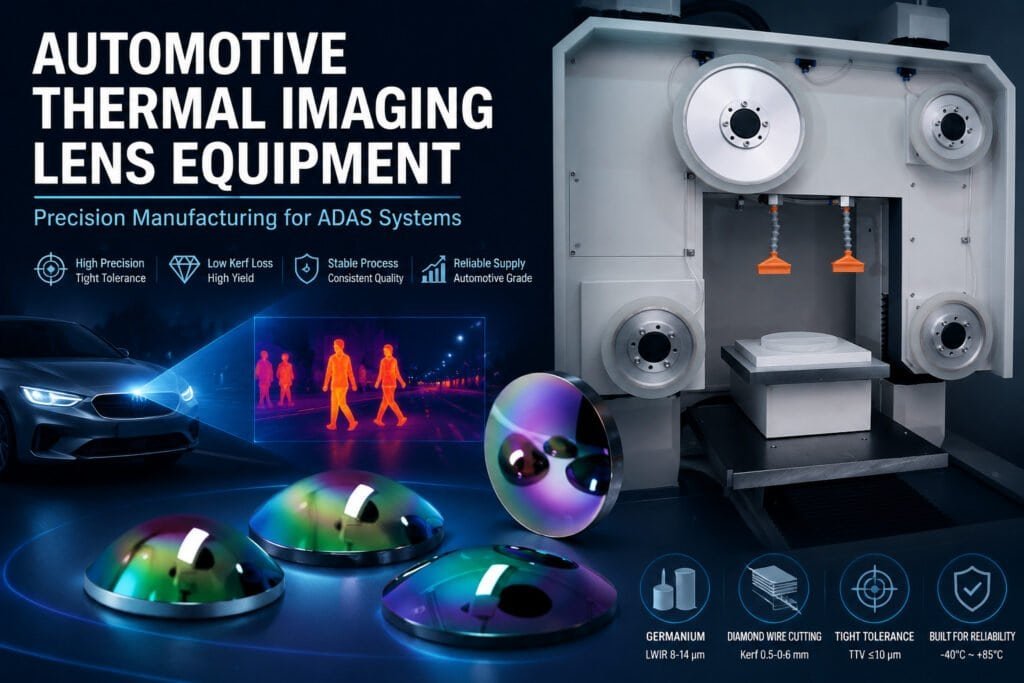
Automotive thermal imaging lens equipment refers to the specialized cutting, grinding, and polishing machines used to manufacture infrared lenses for vehicle-mounted thermal cameras. These cameras — primarily deployed in advanced driver assistance systems (ADAS) as defined in SAE J3016 — capture long-wave infrared (LWIR, 8–14 μm) radiation to detect pedestrians, animals, and road hazards in low-visibility conditions. Because automotive applications impose specific environmental and reliability requirements beyond standard IR optics, the manufacturing equipment must hold tighter process controls and deliver repeatable blank geometry at production volumes.
Why Automotive ADAS Sets Tighter Manufacturing Requirements
Standard IR optics for industrial cameras or research instruments are qualified against optical performance benchmarks: transmission, wavefront error, surface roughness. Automotive thermal lenses carry those same optical requirements — and add a mechanical durability layer that directly traces back to how the lens blank was cut and processed.
Temperature cycling: Automotive thermal cameras typically operate across −40°C to +85°C or beyond, depending on installation position. Residual stress from improper cutting propagates into surface deformation under thermal load. A germanium blank with high subsurface damage — the kind produced by ID saw cutting — may pass optical inspection at room temperature and drift out of specification after 200 thermal cycles. ISO 16750-4 defines the climatic load profiles that automotive components must survive; lens blanks entering this supply chain must be manufactured with those end-use stresses in mind.
Vibration and shock: ADAS functions depend on sensor consistency at road frequencies. IR lenses in automotive assemblies are subjected to continuous low-amplitude vibration and occasional shock inputs. Edge chips introduced during centering and chamfering — the primary cosmetic defect source when blank cutting is aggressive — can propagate under cyclic loading.
Sealing interface tolerances: Many automotive thermal modules are sealed to IP67 or IP69K. Lens-to-housing interfaces are bonded or press-fit. Diameter tolerance on the finished lens blank directly determines whether the seal holds. Diameter runout on the centering spindle, cutting wire tension stability, and coolant management all affect final blank diameter consistency.
The result: automotive lens procurement teams specify tighter TTV, diameter tolerance, and edge quality than general IR optics buyers — and those requirements must be designed into the manufacturing process at the cutting stage, not compensated later in polishing.
Germanium vs ZnSe: Material Selection for Automotive Thermal Imaging Lenses
Most automotive LWIR cameras use germanium (Ge) lenses. A smaller number of MWIR systems (3–5 μm) — for specialized high-end ADAS functions — use zinc selenide (ZnSe) or chalcogenide glass. The material choice determines which cutting and polishing equipment you need.
| Property | Germanium (Ge) | Zinc Selenide (ZnSe) |
|---|---|---|
| Primary ADAS band | LWIR (8–14 μm) | MWIR (3–5 μm) |
| Hardness (Knoop) | ~780 KHN | ~120 KHN |
| Fracture behavior | Brittle, cleaves on {111} planes | Brittle, softer — sensitive to wire overtension |
| Cutting wire diameter | 0.3–0.5 mm | 0.3–0.4 mm, lower tension required |
| Kerf loss (diamond wire) | 0.5–0.6 mm | 0.5–0.6 mm |
| Polishing chemistry | Cerium oxide or bromine-methanol | Cerium oxide, oxide-based slurry |
| Automotive prevalence | Dominant (LWIR majority) | Niche (MWIR / specialized) |
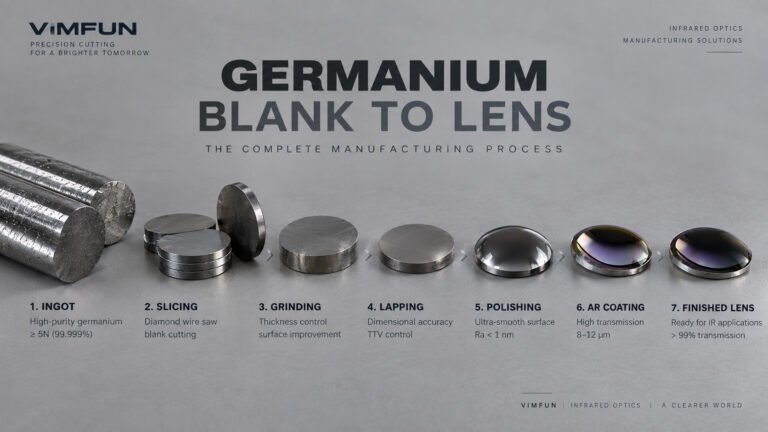
For LWIR automotive thermal imaging — the majority of passenger vehicle ADAS applications — germanium is the primary lens material. Equipment selection should prioritize the germanium processing workflow: wire saw cutting, spindle centering, cup wheel surface generation, and final polishing.
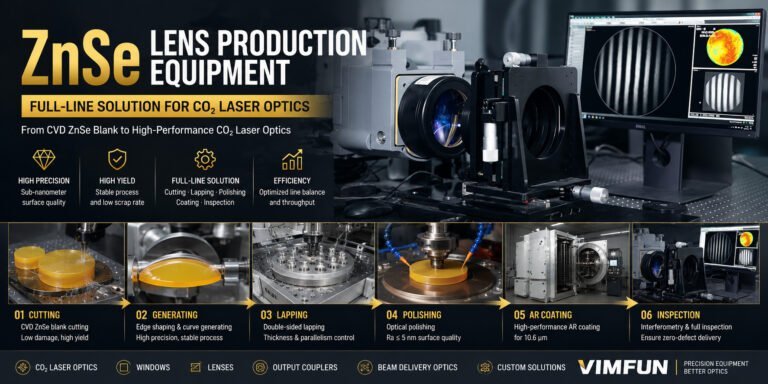
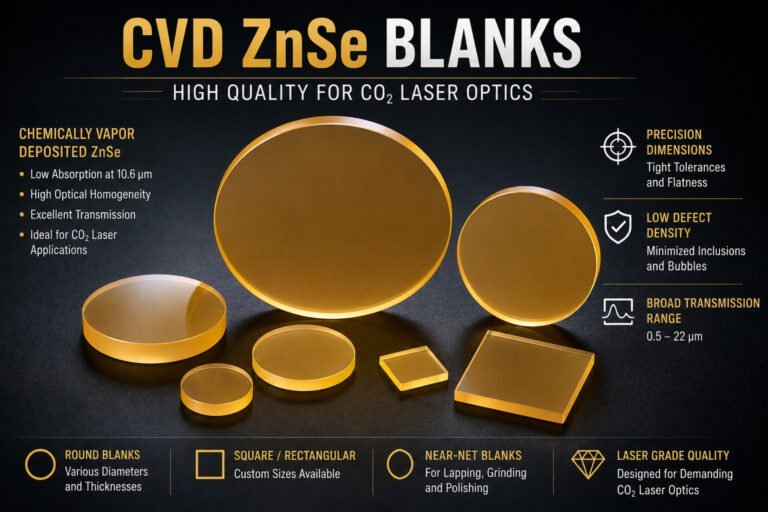
For operations that supply both LWIR and MWIR systems, ZnSe capability on the same cutting platform is achievable with wire tension and coolant parameter adjustments. See our germanium lens cutting machine guide for Ge-specific parameters, and ZnSe lens cutting machine for MWIR line configuration.
Key Machine Parameters for Automotive-Grade IR Lens Production
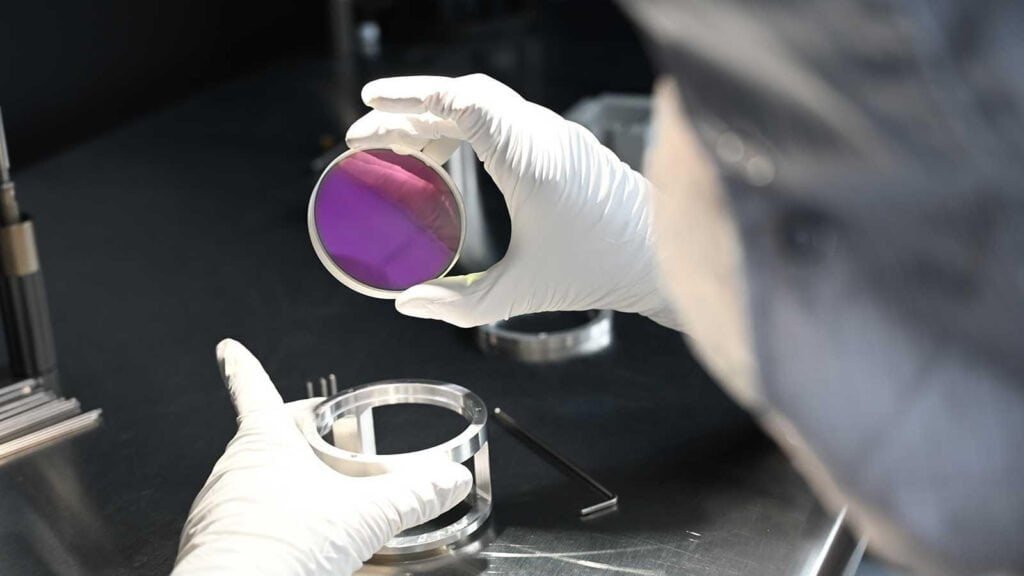
Output quality for automotive thermal lenses traces directly to four equipment parameters. Each one affects a different downstream qualification checkpoint.
| Parameter | Standard IR Optics | Automotive ADAS Target | Equipment Factor |
|---|---|---|---|
| Kerf loss | 0.5–0.6 mm | 0.5–0.6 mm | Wire diameter; drives material yield per ingot |
| TTV after cutting | 8–15 μm (Φ50 mm) | ≤ 10 μm (Φ50 mm) | Wire tension stability, feed rate control |
| Ra after cutting | 0.6–1.2 μm | 0.6–1.0 μm | Wire grit, coolant flow, bow control |
| Diameter tolerance after centering | ±0.05 mm | ±0.02 mm | Spindle concentricity, optical centering accuracy |
| Edge chip depth | < 0.5 mm | < 0.2 mm | Chamfer geometry, wheel dress frequency |
| Ra after polishing | < 5 nm | < 5 nm | Slurry chemistry, pad hardness, cycle time |
TTV (total thickness variation) is the parameter most directly affected by cutting equipment choice. A diamond wire saw with closed-loop wire tension control holds TTV within 8–10 μm on Φ50 mm germanium blanks in sustained production. An ID saw running the same material typically delivers 15–25 μm TTV, requiring additional lapping time before surface generation — adding cycle time and increasing subsurface damage risk.
For automotive qualification, the TTV target must be specified at the cutting stage, not treated as a grinding correction. Our wire saw vs ID saw for germanium comparison covers the process trade-offs in detail.
How to Configure Automotive Thermal Imaging Lens Equipment by Volume
Automotive thermal imaging lens supply follows three production tiers, each requiring a different equipment configuration.
Step 1 — Prototype and qualification (< 500 lenses/year)
At prototype scale, a single diamond wire saw handles blank generation for most development programs. The priority is blank consistency: TTV, Ra, and diameter repeatability matter more than throughput. A single-wire saw combined with one centering spindle and one surface generator supports full optical prototyping. Key actions:
- Establish baseline wire tension and feed rate parameters for the specific germanium ingot grade
- Document surface finish after each process step to build the quality data package for automotive qualification submission
- Run thermal cycling tests on representative blanks cut from each ingot batch
Step 2 — Pre-production (500–5,000 lenses/year)
At this volume, throughput becomes a constraint. A multi-wire saw running 4–8 wires simultaneously increases blank output per cycle. Automated wafer transfer between cutting and centering reduces handling damage. Inline thickness measurement after cutting enables immediate process adjustments rather than end-of-batch rejects.
Step 3 — Series production (5,000+ lenses/year)
Full automotive series production for Tier-1 supply requires matched throughput across all stages. Cutting capacity must not bottleneck grinding; grinding must not bottleneck polishing. Line design starts at polishing — the longest cycle time per piece — and works backward to size cutting and grinding capacity. For a complete five-stage production line overview covering blank cutting through final inspection, see our IR lens production line configuration guide.
Automotive Thermal Imaging Lens Equipment: What Our Machines Cover
Our cutting and polishing equipment supports IR lens manufacturers at each stage of the automotive supply chain, from qualification programs to Tier-1 volume production:
Diamond wire saw (SGR 40 / SG 40)
- Cutting kerf: 0.5–0.6 mm
- TTV: ≤ 10 μm on Φ50 mm germanium in closed-loop tension mode
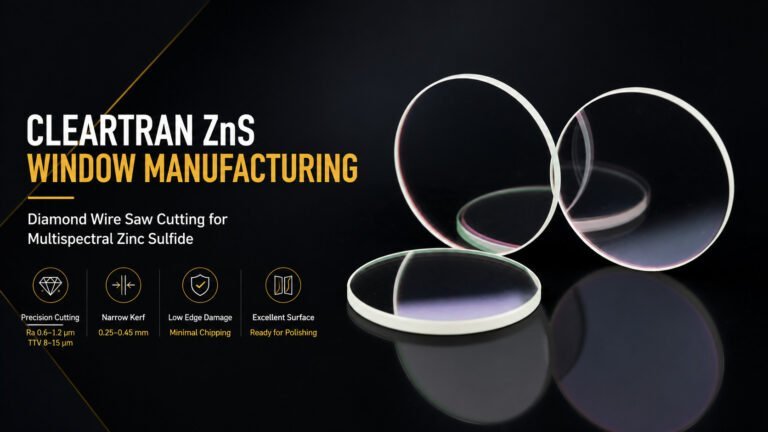
- Compatible materials: Ge, ZnSe, ZnS, Si — parameter-adjusted per material
Centering spindle
- Optical centering to ±0.02 mm diameter tolerance
- Edge chamfer control to ±0.1 mm depth
- Cycle time for Φ50 mm lens: 1–3 minutes
Surface generator (G100)
- Cup wheel surface generation for spherical germanium surfaces
- Ra 0.6–1.2 μm after generation, TTV maintained from cutting stage
Polishing system
- Final Ra < 5 nm
- Slurry-compatible: cerium oxide and bromine-methanol for Ge; oxide-based for ZnSe
For specifications matched to your automotive lens program — including prototype quantities and series volume configurations — contact us at daria@endlesswiresaw.com or visit our infrared optics manufacturing equipment page.
FAQ
Can standard IR optics cutting equipment be used for automotive thermal lenses?
Standard IR optics equipment can produce automotive-grade blanks if it meets TTV, diameter tolerance, and edge quality specifications. The key difference is process documentation: automotive qualification requires statistical evidence of consistency across batches, not just passing individual inspections. Equipment that meets automotive output specs but lacks data logging and process traceability will not support qualification submission.
What is the typical cutting cycle time for an automotive-grade germanium lens blank?
On a single-wire diamond wire saw, a Φ50 mm germanium blank takes approximately 40–60 minutes to cut, including wire tension stabilization and coolant equilibration. Multi-wire systems running 4 wires simultaneously reduce effective cycle time per blank to 10–15 minutes in sustained production.
Does the same machine handle both LWIR germanium and MWIR ZnSe lenses?
Yes, with parameter adjustments. The same diamond wire saw platform handles both materials by adjusting wire tension (lower for ZnSe, which is significantly softer than Ge), feed rate, and coolant chemistry. A separate polishing setup is recommended when running both materials at volume, to prevent cross-contamination of slurry chemistry between germanium and ZnSe workflows.