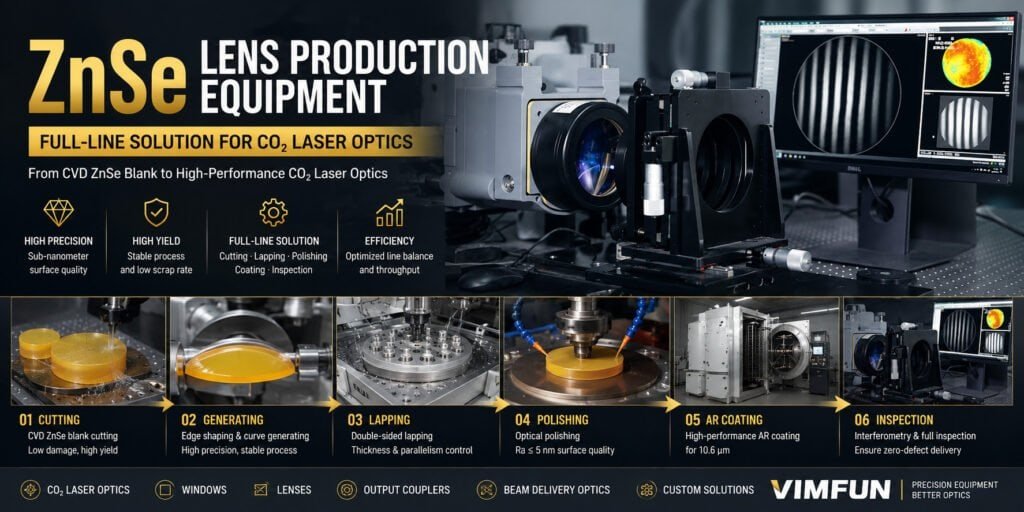
Choosing ZnSe lens production equipment is a full-line decision, not a single-machine decision. A CVD ZnSe boule enters the factory as an expensive, soft, selenium-bearing block; it leaves as a coated CO2 laser lens with 10.6 µm transmission, low absorption, and controlled edge quality. Everything between those two states is a chain — cutting, generating, lapping, polishing, AR coating, inspection — and any weak station drags the whole yield down.
This guide is for engineers and procurement leads planning a new ZnSe line or upgrading an existing one. It focuses on how the stations fit together, where the yield and cost pressure sit, and how to avoid the two most common line-planning mistakes: buying a strong cutter with an underpowered polishing loop, or copying a germanium line and assuming ZnSe will behave the same way.
For a single-step deep dive on cutting, see CVD ZnSe blank cutting. For the specific slicing machine, see ZnSe lens cutting machine. This page stays at line level.
Why ZnSe Needs a Dedicated Line, Not a Reused Germanium Line
Germanium and ZnSe are both infrared materials but they machine very differently. If you carry over germanium fixturing, coolant, and polishing recipes to ZnSe, you will lose blanks in the first month.
| Property | Germanium | CVD ZnSe | Line Impact |
|---|---|---|---|
| Knoop hardness | ~800 kg/mm² | 105–120 kg/mm² | ZnSe scratches from contaminants that Ge tolerates |
| Density | 5.32 g/cm³ | 5.27 g/cm³ | Similar handling weight, not similar handling force |
| Bulk absorption @ 10.6 µm | Not primary | < 0.0005 cm⁻¹ (laser grade) | ZnSe absorption sensitive to subsurface damage |
| Toxicity concern | Low | Selenium dust/slurry | Requires wet cutting + filtered coolant + waste stream |
| Transmission band | 2–14 µm | 0.5–22 µm | ZnSe often inspected with visible alignment beams |
Sources: Coherent ZnSe material data, Edmund Optics ZnSe specifications, CDC/NIOSH Pocket Guide for selenium (TWA 0.2 mg/m³).
The practical consequence: a ZnSe line needs softer clamping, cleaner coolant, sealed slurry handling, and a polishing loop that removes subsurface damage without introducing new absorption. Reusing a germanium fixture library is one of the fastest ways to lose CVD material.
The Six Core Stations of a ZnSe Lens Production Line
A working ZnSe lens production line has six process stations plus inspection and material handling. Each station has a specific yield role. Skipping or under-specifying any one of them costs you finished lenses, not just work-in-progress.
Station 1: Blank Cutting
The cutter’s job is to produce dimensionally stable blanks with low subsurface damage and no exit-side chipping. On a ZnSe line this usually means a diamond wire saw with soft fixturing, wet cutting, and a sacrificial exit-support plate. For method-level detail see CVD ZnSe blank cutting.
Line-planning notes:
- Kerf loss matters — CVD ZnSe stock is expensive, so wire kerf and utilization drive material cost per lens
- Slurry handling matters — selenium-bearing waste must be captured, not left to dry
- Cycle time is rarely the bottleneck at this station; damage floor is
Station 2: Edging and Curve Generating
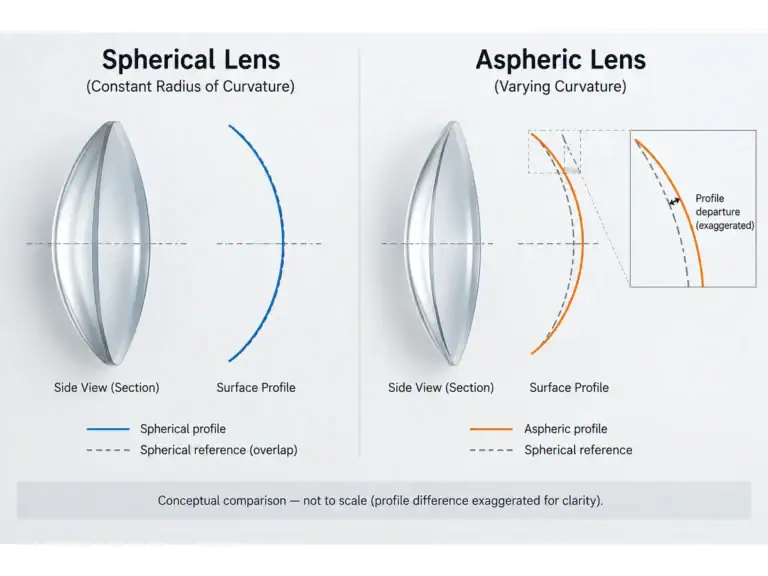
Once a blank is cut, it needs an outside diameter tolerance and, for lens elements, a generated curve. Generating produces the near-net radius before fine grinding and polishing.
Line-planning notes:
- Match the generator’s spindle stability to the smallest radius you plan to run
- Do not undersize this station; a slow generator becomes the WIP bottleneck ahead of lapping
- Fixture concentricity here determines edge chip risk downstream
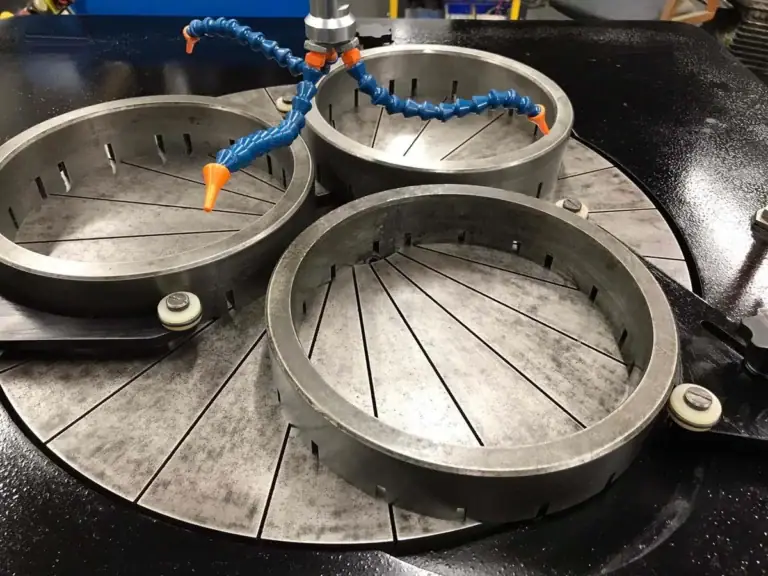
Station 3: Double-Sided Lapping
Lapping controls parallelism, thickness, and TTV. It is also the step where prior cutting damage becomes visible — if the lapper cannot remove the saw marks, the cutting station is out of spec. See ZnSe window double-sided lapping for the process specifics.
Line-planning notes:
- Choose plate size for your largest planned blank plus a margin
- Slurry chemistry for ZnSe is not identical to Ge or fused silica
- This is often the highest per-part cycle time; plan two lappers if throughput matters
Station 4: Polishing
Polishing removes remaining subsurface damage and brings the surface roughness into the CO2-laser-acceptable range, typically Ra 1–5 nm depending on grade. See zinc selenide optics polishing for equipment-level detail.
Line-planning notes:
- Polishing loops are usually the source of finished-lens yield surprises
- ZnSe is soft — over-polishing changes wedge and radius, so process control matters more than headline pressure
- Cleanliness discipline between lap and polish is a line-level policy, not a station-level fix
Station 5: AR Coating Preparation and Coating
CO2 laser lenses almost always ship with AR coatings. The coating station itself is often subcontracted, but the line must deliver coating-ready parts with the surface cleanliness and inspection records the coater requires.
Line-planning notes:
- If coating is in-house, coordinate coating chamber throughput with polishing output
- If coating is outsourced, plan a clean-room-adjacent handoff, not a bench handoff
- Full production-chain context is on the ZnSe CO2 laser optics manufacturing page
Station 6: Inspection and QC
Inspection is not a “last step.” It is a set of checks spread across the line: incoming CVD material, post-cut blanks, post-lap surface, post-polish surface, and pre-shipment optical and coating verification.
Line-planning notes:
- Do not centralize all inspection at the end; late-stage rejects are the most expensive rejects
- Interferometry, roughness measurement, and visual-under-magnification each have a slot in the line
- Data capture at inspection stations lets you close yield-loss loops faster
Line Capacity Planning
Line capacity is set by the slowest station under the actual product mix, not by the fastest machine’s brochure number. A common planning error is sizing the cutter for peak throughput and letting the lapping/polishing pair become a permanent WIP queue.
| Product Mix | Typical Bottleneck | Planning Response |
|---|---|---|
| High-volume CO2 laser windows | Polishing loop | Two polishers, one lapper |
| Mixed windows + focus lenses | Curve generating and radius verification | Dedicated generator, faster radius metrology |
| Custom low-volume high-precision | Inspection and rework | Larger inspection area, longer QC cycles budgeted |
| Pilot line or R&D | Fixturing changeover | Modular fixtures, quick-change plates |
A defensible planning approach is to model each station’s cycle time for the actual annual demand and lens mix, then match plates, spindles, and operator count to the constraining station.
Utilities, Cleanliness, and Waste Handling
ZnSe lens production equipment specification is not complete without the facility side. These are the utility items that quietly determine whether the line runs at nameplate:
- Wet cutting and coolant filtration. Selenium-bearing slurry needs continuous filtration and sealed collection. Dry residue is a health and yield problem.
- Cleanliness zoning. Cutting, lapping, and polishing are not the same cleanliness class. Do not run them in one open bay.
- Compressed air and DI water quality. Contaminants in air or rinse water become scratches in polishing.
- Waste stream. Selenium waste handling follows local regulation; the CDC/NIOSH Pocket Guide is a baseline reference, not a compliance document.
- Operator PPE and training. Soft, selenium-bearing material is not treated like fused silica.
Under-investing here shows up as unexplained polishing rejects six months after commissioning.
Common Line-Planning Mistakes
Mistake 1: Buying the Strongest Cutter First
The cutter is the most visible machine, so it often gets the first budget. But if the polishing loop is undersized, cut blanks pile up as WIP and the line’s real throughput is set by polishing. A balanced line is cheaper than a heroic cutter feeding a slow polisher.
Mistake 2: Copying a Germanium Line 1:1
Germanium fixture designs, coolant recipes, and clamping forces do not carry over to ZnSe. Even the polishing slurry chemistry needs review. A ZnSe line borrows the layout logic from a Ge line, not the process parameters.
Mistake 3: Skipping Mid-Line Inspection
If the only inspection is at final QC, every reject wasted all upstream cost. Inspection after cutting and after lapping catches problems where they are still cheap to fix.
Mistake 4: Treating Coating as an Afterthought
If AR coating is outsourced without a clean handoff protocol, coating-related rejects get blamed on polishing. Define the coating-ready criteria and the handoff cleanliness class before the line goes live.
Mistake 5: Under-Budgeting Slurry and Waste Handling
Selenium waste handling is not a nice-to-have. Skipping it makes the line non-compliant and, in practice, makes cleanup a monthly emergency.
How ZnSe Production Equipment Selection Differs from Related Pages
To keep this page focused on line-level procurement, it deliberately does not repeat what other pages cover:
| Page | Question It Answers |
|---|---|
| This page — ZnSe lens production equipment | How should a full ZnSe line be planned, sized, and integrated? |
| ZnSe lens cutting machine | Which cutting machine and configuration should be used for ZnSe? |
| CVD ZnSe blank cutting | How should the raw CVD material be cut before downstream processing? |
| ZnSe window double sided lapping | How should ZnSe windows be lapped to thickness and parallelism? |
| zinc selenide optics polishing | How should ZnSe be polished for CO2 laser-grade surface quality? |
| ZnSe CO2 laser optics manufacturing | What does the end-to-end process chain look like? |
| IR lens production line | General IR-line layout across germanium, ZnSe, ZnS, and silicon |
If you arrived here looking for a single-machine spec, use the cutting or polishing pages above. If you are planning a full line, this page is the right entry point.
Procurement Checklist for ZnSe Lens Production Equipment
Before requesting quotations, prepare the following. It shortens the vendor cycle and gives you comparable bids:
- Annual production volume and lens/window mix
- Largest and smallest lens diameter and thickness planned
- Material grades in use (standard CVD, laser-grade CVD, multispectral ZnSe)
- Existing facility utilities (air, DI water, drainage, clean-room class)
- Selenium waste handling capability and local regulation
- In-house vs. outsourced AR coating decision
- Inspection method requirements (interferometry, roughness, visual)
- Budget split between capex, tooling, and first-year consumables
- Ramp-up schedule and pilot-run expectations
- Existing staff experience with IR optics
A vendor who receives all ten items can quote a matched line. A vendor who only gets “we want a ZnSe line” will quote whichever machine has the highest margin and leave the integration problem to you.
How Vimfun Supports ZnSe Line Planning
Vimfun supplies the core process stations for ZnSe lens production and can help evaluate line balance, station sizing, and integration:
- ZnSe lens cutting machine — low-force diamond wire slicing for CVD ZnSe
- ZnSe window double sided lapping — thickness and parallelism control
- zinc selenide optics polishing — CO2 laser-grade surface preparation
- ZnSe CO2 laser optics manufacturing — end-to-end process integration reference
- Infrared optics manufacturing equipment — multi-material line planning (Ge, ZnSe, ZnS, Si)
If you are planning a new ZnSe line or upgrading an existing one, send us your product mix, annual volume, and current bottleneck. We can review the station balance and identify where extra capacity, tighter fixturing, or a cleanliness upgrade will move yield the fastest — before you commit capex.