A ZnSe lens cutting machine is precision cutting equipment designed to slice CVD-grown zinc selenide blanks into lens substrates for CO₂ laser optics, thermal imaging systems, and FLIR applications. ZnSe is the dominant material for 10.6 μm CO₂ laser focusing lenses and windows because of its broad infrared transmission range (0.5–22 μm) and low absorption at laser wavelengths — but it is also soft, brittle, and toxic when machined improperly. Choosing the right ZnSe lens cutting machine determines whether you get clean, crack-free substrates or expensive scrap with hazardous selenium dust.
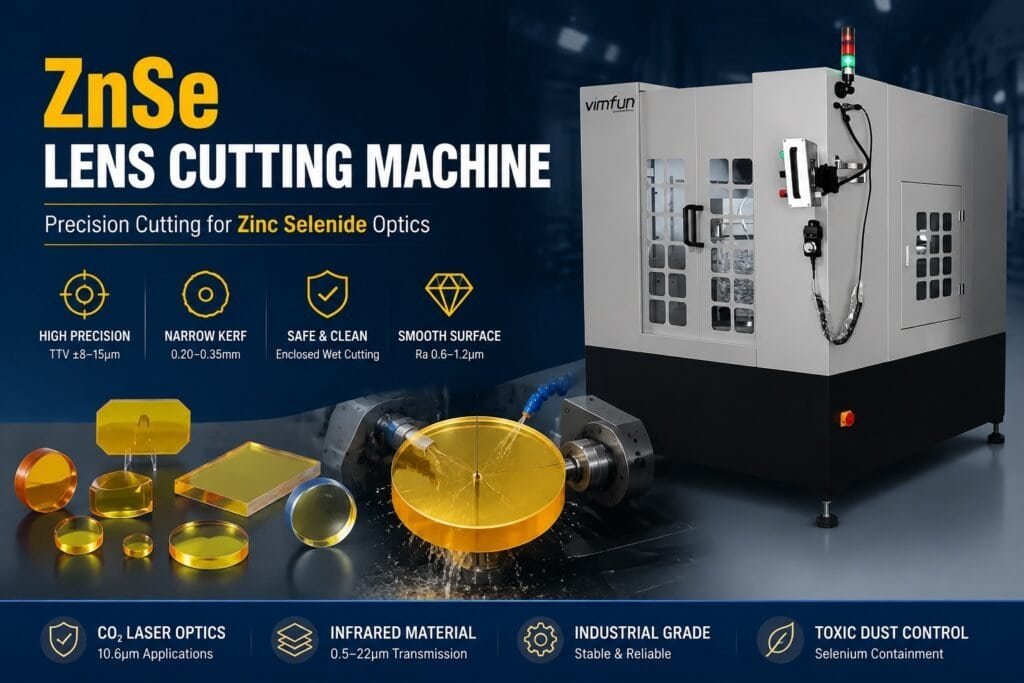
What Is a ZnSe Lens Cutting Machine?
A ZnSe lens cutting machine is a diamond-abrasive cutting system specifically configured to slice zinc selenide blanks — typically CVD-grown boules or pre-shaped cylinders — into flat substrates ready for subsequent grinding and polishing. Unlike general-purpose optical cutting equipment, a ZnSe lens cutting machine must account for the material’s unique combination of properties:
- Softness: ZnSe has a Knoop hardness of approximately 120 — significantly softer than germanium (~780) or silicon (~1,150). This means the cutting element penetrates easily but also generates deep subsurface damage if force or feed rate is excessive.
- Brittleness: Despite being soft, ZnSe is brittle. It fractures along cleavage planes under impact or uneven stress, producing chips and cracks that propagate into the substrate.
- Toxicity: Zinc selenide contains selenium, a regulated toxic element. Cutting, grinding, and polishing ZnSe produce fine particulate dust that is hazardous by inhalation and skin contact. The cutting machine must incorporate enclosed cutting chambers and wet-cutting processes to contain selenium-bearing particles.
- Broad IR transmission: ZnSe transmits from visible (0.5 μm) through far-infrared (22 μm), making it irreplaceable for CO₂ laser optics (10.6 μm) and multi-band thermal imaging. Any subsurface damage from cutting degrades transmission and increases scatter — defects invisible to the eye can render a lens optically unusable.
ZnSe Lens Cutting Machine — Key Parameters
| Parameter | Diamond Wire Saw | ID (Inner Diameter) Saw | Annular Saw |
|---|---|---|---|
| Kerf width | 0.20–0.35 mm | 0.3–0.8 mm | 0.8–1.5 mm |
| Cutting accuracy (TTV) | 8–15 μm (Φ50 mm) | 5–10 μm | 10–20 μm |
| Surface roughness (Ra) | 0.6–1.2 μm | 0.4–0.8 μm | 1.5–3.0 μm |
| Max blank diameter | Model-dependent | Limited by blade ID | Up to 200 mm |
| Subsurface damage depth | 15–40 μm | 10–30 μm | 40–80 μm |
| Coolant type | Water-based (enclosed) | Water-based (enclosed) | Water-based (enclosed) |
| Selenium dust containment | Wet cutting + enclosed chamber | Wet cutting + enclosed chamber | Wet cutting + enclosed chamber |
| Best application | Production slicing, kerf-sensitive work | High-precision single cuts | Large blanks, rough shaping |
Note: All ZnSe cutting methods require enclosed wet-cutting environments to manage selenium-containing dust and slurry. Dry cutting of ZnSe is not acceptable from both quality and safety perspectives.
For a detailed comparison of wire saw versus ID saw technologies across all IR materials, see our wire saw vs ID saw comparison guide.

How to Set Up a ZnSe Lens Cutting Machine for Optimal Results
Step 1: Select the Right Diamond Abrasive for ZnSe
ZnSe’s low hardness (Knoop ~120) means the diamond grit size must be matched carefully. Grit that is too coarse cuts fast but creates deep subsurface damage that requires extensive lapping to remove — negating any time saved. Grit that is too fine reduces cutting speed to impractical levels.
For diamond wire cutting of ZnSe, use wire with diamond grit in the 20–40 μm range for production slicing. For ID saw blades, select diamond concentration and grit size recommended by the blade manufacturer for soft crystalline materials (similar to CdTe or GaAs recommendations, not germanium recommendations — germanium is much harder).
Step 2: Set Feed Rate Below the Fracture Threshold
ZnSe’s combination of softness and brittleness creates a narrow optimal feed rate window. Too fast → cleavage fractures and edge chipping. Too slow → excessive heat buildup from friction (even with coolant), which can cause thermal stress cracking.
Start at 30–50% of the feed rate you would use for germanium on the same machine. Run test cuts and inspect edge quality under magnification before increasing speed. The target is a clean cut edge with no visible chipping at 10× magnification.
Step 3: Configure Coolant for Selenium Containment
Coolant serves dual purposes on a ZnSe lens cutting machine: thermal management and hazardous dust suppression. Use water-based coolant delivered at sufficient flow to keep the entire cutting zone submerged. The coolant system must include:
- Filtration to capture selenium-bearing particles before recirculation
- Enclosed collection for spent coolant and cutting slurry — this is hazardous waste requiring proper disposal per local environmental regulations
- Splash containment around the cutting chamber to prevent selenium-contaminated mist from escaping
The U.S. Occupational Safety and Health Administration (OSHA) sets a permissible exposure limit (PEL) of 0.2 mg/m³ for selenium compounds. Proper wet cutting with enclosed chambers keeps airborne levels well below this threshold.
Step 4: Secure the Blank with Uniform, Low-Stress Fixturing
ZnSe blanks must be mounted with uniform support to prevent bending stress during cutting. Use wax or adhesive mounting on a flat reference surface rather than mechanical clamping, which creates point loads on the soft material. For cylindrical blanks, V-block fixtures with soft contact surfaces (PTFE or rubber-lined) distribute clamping force evenly.
Uneven fixturing is the leading cause of cracked ZnSe blanks during cutting — the material fractures before the operator realizes the mounting was misaligned.
Step 5: Inspect Cut Surfaces Before Proceeding to Grinding
After cutting, inspect every substrate for:
- Edge chipping — chips larger than 0.3 mm typically cannot be removed by subsequent grinding without reducing the clear aperture below specification
- Surface cracks — use cross-polarized light to detect subsurface cracks invisible in normal lighting
- TTV — measure total thickness variation to confirm it falls within the lapping allowance for your downstream process
Catching defects at the cutting stage prevents wasting grinding and polishing time on substrates that are already scrap.
ZnSe Lens Cutting Machine Troubleshooting
Edge Chipping on Every Cut — What to Do?
Reduce feed rate by 20–30% and check diamond grit condition. On diamond wire, edge chipping usually means the wire is either worn (exposed metal core contacting the workpiece) or the grit is too coarse for ZnSe. Also verify coolant is reaching both the entry and exit sides of the cut — chipping is often worse on the exit side where the wire or blade breaks through unsupported material. Adding a sacrificial backing plate (soft graphite or wax block) behind the ZnSe blank supports the exit edge and dramatically reduces breakout chipping.
Surface Roughness Worse Than Expected After Cutting?
If Ra exceeds 1.5 μm on diamond wire cuts, check wire tension and speed. Low tension causes wire deflection, producing a wavy cut surface. Also verify that coolant is not carrying re-deposited cutting debris back into the cut zone — contaminated coolant acts like loose abrasive and scratches the freshly cut surface. Filter or replace coolant and re-run a test cut.
For operations where as-cut surface quality is critical, consider whether an ID saw would better suit your tolerance requirements — ID saws typically achieve finer Ra on ZnSe than wire saws, though at higher kerf cost. See our germanium kerf loss reduction guide for kerf optimization principles that apply to ZnSe as well.
Blanks Cracking During Cutting — Not at the Cut Line?
Cracks appearing away from the cutting zone indicate fixturing problems or pre-existing material defects. Check adhesive bond uniformity — air bubbles under the blank create unsupported spans that flex and crack when cutting force is applied. For CVD ZnSe, also inspect the blank for growth defects (voids, inclusions) that act as stress concentrators. Request the supplier’s quality certificate showing void density and inclusion count for each boule.
Selenium Exposure Concerns — How to Verify Containment?
Conduct air quality monitoring near the cutting machine during operation. Use personal air sampling badges (NIOSH Method 7300 for selenium) to measure operator exposure. If readings approach 50% of the OSHA PEL (0.1 mg/m³), improve ventilation or coolant flow before levels reach the action threshold. Document all monitoring results — this protects both worker health and your facility’s regulatory compliance.
ZnSe vs Germanium Lens Cutting: How They Compare
| Factor | ZnSe Cutting | Germanium Cutting |
|---|---|---|
| Knoop hardness | ~120 (soft) | ~780 (hard) |
| Fracture toughness | Low | Low (~0.6 MPa·m^0.5) |
| Optimal feed rate | Low (30–50% of Ge rate) | Baseline |
| Kerf loss sensitivity | Moderate ($800–1,200/kg) | Very high ($7,000–9,000/kg) |
| Subsurface damage risk | High (soft → deep damage at low force) | Moderate (hard → shallower damage) |
| Thermal sensitivity | Moderate (stable to ~300°C) | High (bandgap shift above 100°C) |
| Toxicity | ⚠️ Selenium — hazardous dust | Non-toxic (standard PPE) |
| Primary application | CO₂ laser lenses/windows (10.6 μm) | Thermal imaging lenses (8–14 μm) |
| Post-cut processing | Grinding → polishing → AR coating | Grinding → polishing → AR coating |
| Coolant containment | Enclosed + hazardous waste disposal | Standard filtration |
Key takeaway: ZnSe is easier to cut (softer material, lower force needed) but harder to cut well — the softness means damage penetrates deeper, and selenium toxicity adds environmental and safety requirements that germanium does not have. A germanium lens cutting machine can often process ZnSe with parameter adjustments, but the coolant and dust containment systems must be upgraded.
For a comprehensive overview of cutting equipment across all infrared optical materials, see our infrared optics manufacturing equipment hub page.
How Diamond Wire Cutting Technology Benefits ZnSe Lens Production
Diamond wire cutting has become the preferred method for ZnSe lens substrate production in operations where material utilization and throughput matter. Here’s why:
Narrow kerf reduces material waste. Diamond wire with 0.20–0.35 mm diameter removes 50–75% less material per cut compared to annular saws (0.8–1.5 mm kerf). For ZnSe blanks, this translates to additional substrates from every boule — significant savings when processing CVD ZnSe at $800–1,200/kg.
Low cutting force minimizes subsurface damage. The thin wire contact area generates lower peak force than blade-based methods, producing shallower subsurface damage on soft ZnSe. Shallower damage means less material must be removed during grinding and double-sided lapping, further improving material utilization and reducing processing time.
Enclosed wet-cutting environment controls selenium dust. Diamond wire saws operate in enclosed cutting chambers with continuous coolant flow — the same configuration required for selenium containment. This makes diamond wire cutting naturally compatible with ZnSe safety requirements without significant additional engineering.
Consistent cut quality across production runs. Controlled wire tension and speed produce repeatable TTV and surface roughness from the first cut to the last. This consistency reduces the inspection burden and ensures downstream grinding and polishing processes receive substrates within specification.
Our diamond wire cutting systems are configured for the full range of infrared optical materials — germanium, ZnSe, ZnS, and chalcogenide glasses. Contact our engineering team with your ZnSe blank dimensions, target substrate thickness, and production volume for a specific equipment recommendation with test cut data.
For parts that move from cutting into final finishing, review our zinc selenide optics polishing process notes to keep ZnSe surface damage, slurry behavior, and post-cut stock allowance under control.