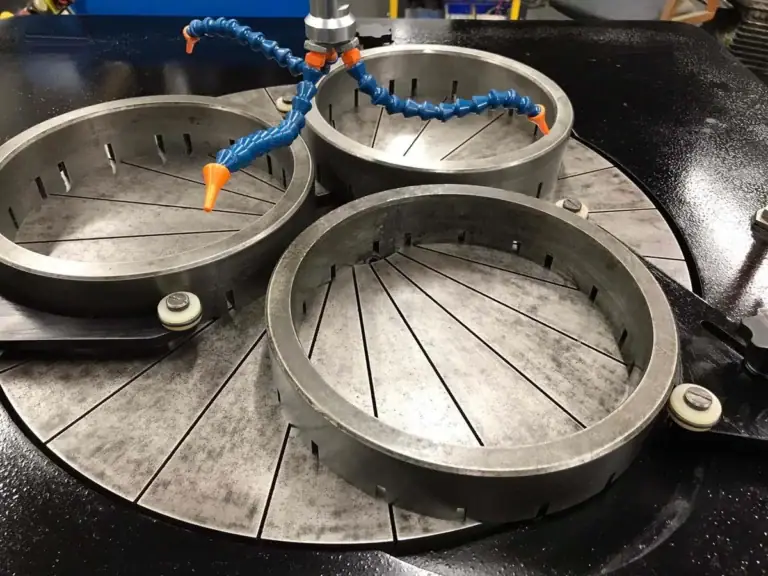
CVD ZnSe blank cutting is the first yield-critical machining step in zinc selenide optics production. Before a CO2 laser lens can be ground, polished, coated, and inspected, the CVD-grown material must be cut into stable discs, windows, or near-net blanks without edge chipping, hidden cracks, deep subsurface damage, or selenium-contaminated dry dust.
This guide focuses specifically on the blank-cutting stage: how to inspect incoming CVD ZnSe, choose a low-force cutting method, control coolant and fixturing, and hand off the blank to downstream ZnSe window double sided lapping or zinc selenide optics polishing. For full equipment selection across the material family, see the ZnSe lens cutting machine guide.
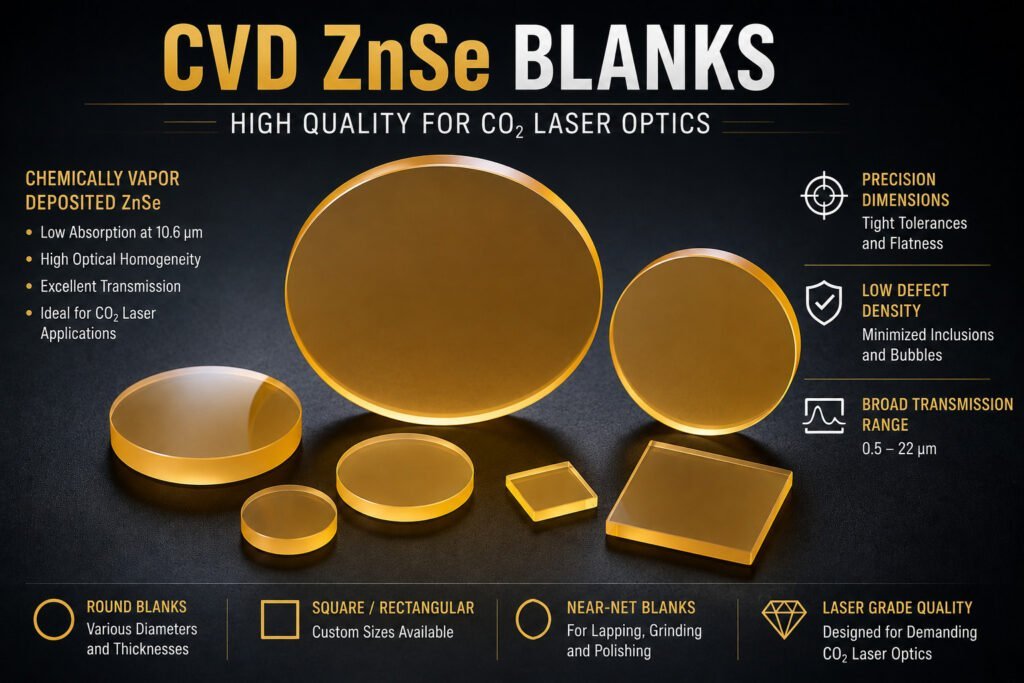
What Is CVD ZnSe Blank Cutting?
CVD ZnSe blank cutting is the process of slicing or contour-cutting chemical-vapor-deposited zinc selenide stock into optical blanks for CO2 laser lenses, protective windows, output couplers, beam delivery components, and infrared imaging optics.
The input is usually one of three material forms:
- Cylindrical CVD ZnSe boule or core-drilled rod
- Rectangular or square sheet stock
- Near-net block prepared for later generating, edging, or lapping
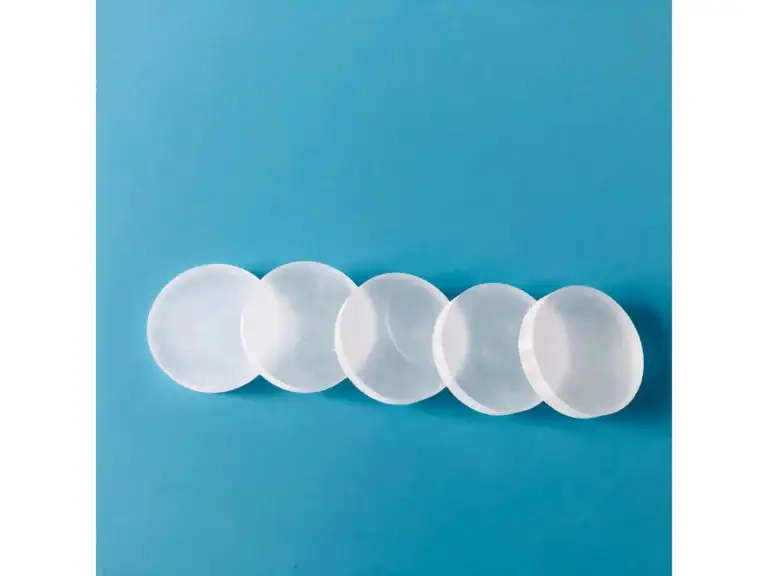
The output is not a finished optic. It is a controlled blank with enough stock allowance for grinding, lapping, and polishing. A good blank-cutting operation produces parts that are flat enough to fixture, free from visible breakout, and consistent enough that downstream processing does not waste time correcting preventable cutting defects.
CVD ZnSe is not handled like ordinary optical glass. Coherent lists CVD ZnSe with low bulk absorption at 10.6 µm, high optical homogeneity, and mechanical softness; Edmund Optics also notes that ZnSe is relatively soft, with Knoop hardness around 120 kg/mm2. Those properties make it valuable for CO2 laser transmission optics, but they also make CVD ZnSe blank cutting sensitive to force, heat, mounting stress, and contamination.
Why CVD ZnSe Blanks Need a Different Cutting Window
The cutting method must respect four material constraints.
| Material Factor | Typical Reference Value | Cutting Implication |
|---|---|---|
| Knoop hardness | 105-120 kg/mm2 | Low force is required; excessive pressure creates deep scratches and subsurface damage |
| Bulk absorption at 10.6 µm | < 0.0005 cm-1 for high-grade CVD ZnSe | Cutting damage must be removed before coating, or local absorption can increase |
| Transmission range | about 0.5-22 µm depending on grade and thickness | Edge defects and scatter can affect both IR use and visible alignment-beam inspection |
| Selenium content | selenium-bearing dust/slurry | Wet cutting, enclosure, filtration, and waste handling are process requirements |
Sources for these boundaries include Coherent’s ZnSe material-property data, Edmund Optics’ ZnSe product specifications, Hellma Materials’ CVD ZnSe optical-material page, and the CDC/NIOSH selenium exposure guide.
In practice, CVD ZnSe is easy to scratch but not forgiving. The tool can enter the material with little resistance, yet the blank can chip or crack if the fixture bends it, if the feed rate is too aggressive, or if exit-side support is weak. This is why the blank-cutting step should be set up as a controlled optical process, not as a general saw-cutting job.
CVD ZnSe Blank Cutting Workflow
Step 1: Inspect and Map the Incoming Blank
Before cutting starts, inspect the CVD ZnSe stock for inclusions, bubbles, chips, growth bands, edge cracks, and surface contamination. Coherent notes that ZnSe substrates can be supplied as sheet material, core-drilled blanks, edged blanks, or generated lens blanks, including substrates up to 300 mm. The inspection method should match the supplied form.
For cylindrical stock, mark:
- Growth direction and usable clear aperture
- Existing edge chips and handling marks
- Saw-entry and saw-exit orientation
- Minimum stock allowance for lapping or generating
For rectangular sheet stock, also mark the nesting layout so that each blank keeps enough edge allowance for beveling and final dimensioning.
Do not start CVD ZnSe blank cutting from a purely nominal drawing. The actual material quality map should drive where the cut lines go, especially on expensive laser-grade material.
Step 2: Choose the Cutting Method
The main options are diamond wire cutting, ID saw cutting, and annular or peripheral blade cutting.
| Method | Best Use | Main Advantage | Main Risk |
|---|---|---|---|
| Diamond wire saw | Multiple discs, large blanks, kerf-sensitive production | Low cutting force and narrow kerf | Wire bow, exit chipping, slow setup if fixturing is poor |
| ID saw | High-precision single discs and thin sections | Stable geometry and fine surface potential | Higher blade cost and diameter constraints |
| Annular/peripheral blade | Rough shaping and non-critical stock removal | Simple setup for some block forms | Wider kerf and higher breakout risk |
For most CVD ZnSe blank cutting jobs, a diamond wire saw is the practical choice when material utilization and low cutting force matter. ID saws still make sense for certain thin discs or tight-thickness work, but the higher kerf and tool geometry must be justified by the downstream tolerance requirement.
The broader optical-equipment role of cutting, lapping, polishing, and inspection is covered in the infrared optics manufacturing equipment hub.
Step 3: Mount the Blank Without Bending It
Fixturing is the most common hidden failure point in CVD ZnSe blank cutting. Because ZnSe is soft and brittle, point loads from clamps can create cracks away from the cut line. A blank may survive the cut and then fail during lapping because the crack was already seeded during mounting.
Recommended mounting principles:
- Use full-area wax, low-stress adhesive, or conformal support when possible
- Avoid hard metal point contact on the ZnSe surface
- Support the exit side with a sacrificial backing plate where breakout is likely
- Keep the reference face clean, flat, and free of trapped chips
- Use low clamping force and verify that the blank does not rock before cutting
For round blanks, a V-block or cradle fixture should distribute force over a wide contact area. For rectangular pieces, support both sides of the cut so the offcut does not sag and tear the exit edge.
Step 4: Control Feed, Wire Tension, and Coolant
CVD ZnSe blank cutting should start with conservative parameters and then be tuned from test cuts. The goal is a stable cut with no audible chatter, no visible exit breakout, and no heat accumulation at the cutting interface.
| Parameter | Practical Starting Point | Adjustment Rule |
|---|---|---|
| Feed rate | Lower than germanium on the same machine | Reduce if edge chipping, chatter, or exit cracks appear |
| Wire tension | Stable but not excessive | Increase slightly if wire bow causes taper; reduce if cracking increases |
| Coolant | Continuous water-based wet cutting | Increase flow if slurry builds up or surface scratches worsen |
| Abrasive size | Fine to medium diamond for production slicing | Use finer grit when downstream stock allowance is limited |
| Exit support | Sacrificial backing or full support | Add support when chips appear at breakthrough |
Avoid dry cutting. ZnSe contains selenium, and the CDC/NIOSH Pocket Guide lists selenium exposure limits at a time-weighted average of 0.2 mg/m3. Wet cutting, enclosure, local collection, and filtered coolant are the baseline controls for selenium-bearing particles.
Step 5: Clean and Quarantine Cutting Slurry
The coolant system is part of the quality system. If particles remain in circulation, they can scratch the cut surface and contaminate later lapping steps. If slurry is handled casually, the process becomes a health and waste-management problem.
For CVD ZnSe blank cutting, the machine should include:
- Enclosed cutting zone
- Continuous coolant delivery to both entry and exit side
- Filtration suitable for fine selenium-bearing particles
- Sealed slurry collection
- Documented waste handling according to local rules
- Routine cleaning between material grades
Do not let ZnSe slurry dry on tables, fixtures, machine doors, or floor drains. Dried residue can become airborne during cleaning and defeat the purpose of wet cutting.
Step 6: Inspect the Cut Blank Before It Enters Lapping
After cutting, the blank should be checked before it is released to grinding, lapping, or polishing. This is cheaper than discovering the problem after several more process steps.
Inspection points:
- Edge chipping at both entry and exit sides
- Hairline cracks under magnification or polarized inspection
- Thickness variation and wedge
- Surface scratches, chatter marks, and wire-bow pattern
- Cleanliness after slurry removal
- Remaining stock allowance for downstream operations
A blank with visible breakout can sometimes still be used if the chip sits outside the final clear aperture. A blank with internal cracks or deep chatter marks should not be passed forward simply because the external dimensions are correct.
Common CVD ZnSe Blank Cutting Defects
Exit-Side Chipping
Exit-side chipping usually means the material was unsupported when the wire or blade broke through. Reduce feed rate near the end of the cut, add a sacrificial backing plate, and make sure coolant still reaches the exit side. If the same chip pattern repeats, inspect the fixture rather than only changing the wire.
Wavy Cut Surface
A wavy surface often comes from wire bow, low tension, or uneven feed. Increase tension within the machine’s safe range, shorten the unsupported span, and confirm that the workpiece is not moving in the fixture. Do not compensate by adding more lapping stock unless the cause is fixed; that just moves the cost downstream.
Fine Scratches Across the Blank
Fine scratches can come from contaminated coolant or reused fixtures. ZnSe is soft, so small hard particles can mark the surface quickly. Replace or filter coolant, clean the fixture contact area, and inspect the abrasive condition before repeating the cut.
Cracks Away from the Cut Line
Cracks away from the cut line usually point to mounting stress, pre-existing material defects, or thermal shock. Check adhesive coverage, clamping force, and coolant temperature. If cracks align with growth features or inclusions, quarantine the material lot and request the supplier’s inspection certificate.
Lapping Cannot Remove Saw Marks
If saw marks remain after normal ZnSe window double sided lapping, the cutting stage probably produced damage deeper than the expected stock allowance. Reduce abrasive aggressiveness, lower feed rate, and verify that the cutting process is not vibrating.
Cutting Allowance and Downstream Handoff
CVD ZnSe blank cutting should be specified together with the next process step. A blank for double-sided lapping has different needs from a blank going to curve generating or edging.
| Downstream Step | What Cutting Must Deliver | Why It Matters |
|---|---|---|
| Double-sided lapping | Stable thickness, low wedge, clean faces | Lapping controls parallelism but should not rescue severe saw error |
| Curve generating | Enough edge and thickness stock | Lens radius generation needs safe material allowance |
| Polishing | Low subsurface damage from prior steps | Polishing removes limited material and cannot fix deep cracks |
| AR coating | Clean, defect-free pre-polish surface | Coating can amplify contamination and scatter problems |
For CO2 laser optics, the entire chain from CVD blank to coated component is described on the ZnSe CO2 laser optics manufacturing page. The short version is simple: blank cutting sets the damage floor for everything that follows.
When the blank moves into polishing, review the material-specific controls for particles, mist, slurry, and maintenance in our ZnSe polishing dust, mist and slurry handling guide.
CVD ZnSe Blank Cutting vs General ZnSe Lens Cutting
These two pages should not compete.
| Page | Search Intent | Main Question Answered |
|---|---|---|
| CVD ZnSe blank cutting | Process and quality control for raw CVD material | How should CVD ZnSe stock be cut before downstream optics processing? |
| ZnSe lens cutting machine | Equipment selection and operating setup | What machine and cutting configuration should be used for ZnSe lens production? |
| ZnSe CO2 laser optics manufacturing | Full production chain | How does ZnSe become a finished CO2 laser optic? |
This CVD ZnSe blank cutting page is narrower. It is for engineers who already know they must process CVD ZnSe and need to prevent cracking, chipping, slurry problems, and downstream yield loss at the first machining step.
Specification Checklist for CVD ZnSe Blank Cutting
Before requesting a cutting trial or production quote, prepare the following information:
- Material form: boule, rod, sheet, block, or supplier-prepared blank
- Material grade: standard CVD, laser-grade CVD, or multispectral ZnSe
- Maximum blank size and minimum clear aperture
- Target cut thickness and allowed stock for lapping or generating
- Edge-chip allowance inside and outside the final aperture
- Required inspection method after cutting
- Coolant and selenium-waste handling requirements
- Downstream route: lapping, generating, polishing, coating, or assembly
- Annual volume and batch size
This information lets the cutting process be configured around the final optic, not just around the first saw operation.
How Vimfun Supports CVD ZnSe Blank Cutting
Vimfun supports CVD ZnSe blank cutting as part of a complete infrared optics production workflow. For ZnSe manufacturers, the usual equipment path includes:
- ZnSe lens cutting machine for low-force slicing of CVD ZnSe rods, sheets, or blocks
- ZnSe window double sided lapping equipment for thickness, parallelism, and pre-polish control
- zinc selenide optics polishing equipment for laser-grade surface preparation
- ZnSe CO2 laser optics manufacturing process integration for cutting, lapping, polishing, coating preparation, and QC
- infrared optics manufacturing equipment for facilities that also process germanium, ZnS, silicon, and other IR materials
If your current ZnSe process loses blanks to exit chipping, hidden cracks, or unstable downstream lapping results, send us the material form, target geometry, and defect photos. We can review the cutting route and recommend fixture, wire, coolant, and inspection changes before you commit to full production.