
Automatic Lens Profiling Edger Auto-EG-80
A fully automatic vertical automatic lens profiling edger that grinds the outer edge and chamfer of round and shaped optical parts up to Ø80 mm, with dual rough-and-fine wheels and vacuum pick-and-place. 15-second cycle, glass to sapphire.
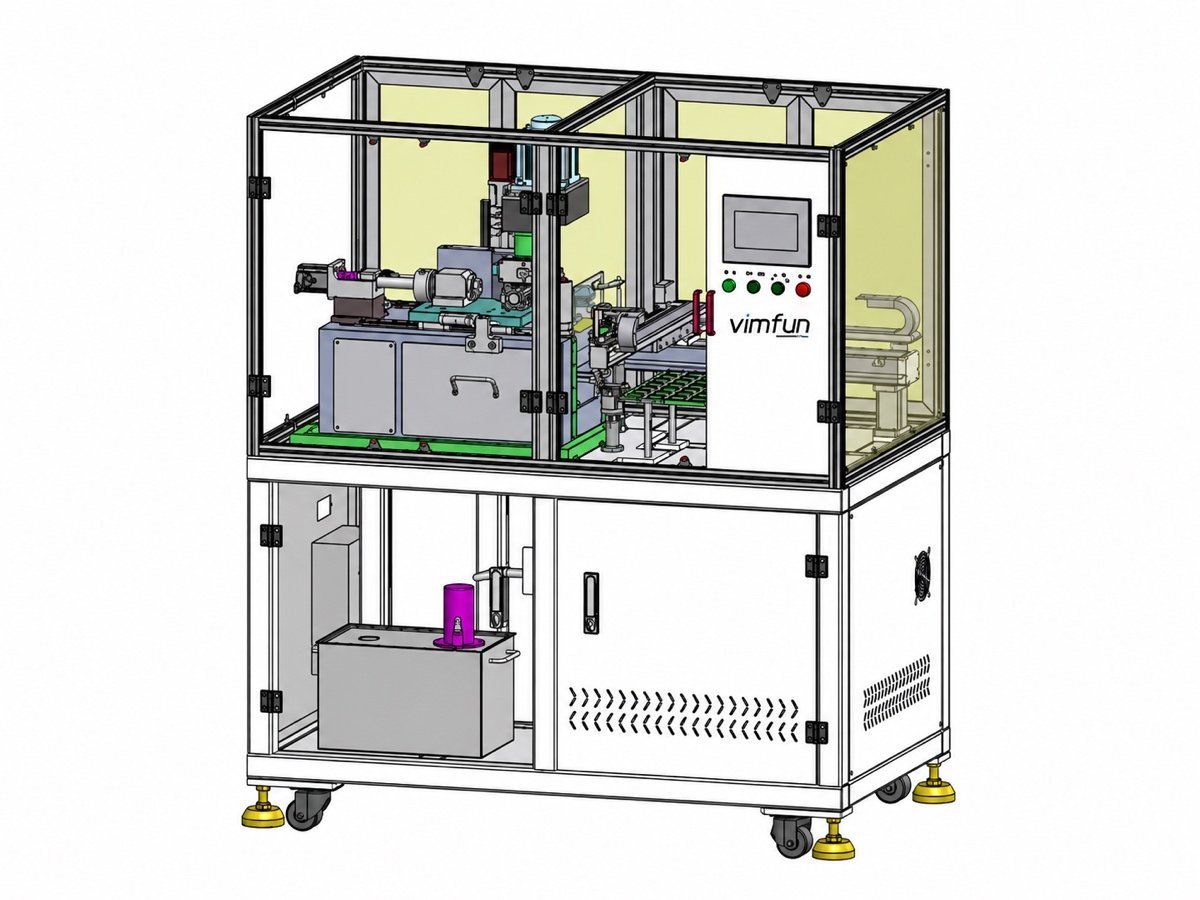
What this machine makes, and what happens before and after it
By the time a part reaches the edger, its faces are already generated and polished. What is still rough is the rim. An automatic lens profiling edger owns that step: it grinds the outer diameter and the chamfer to the drawing, so the part is round to its optical axis and safe to handle, coat and assemble. It shapes the edge, not the face.
Upstream is the polishing stage; downstream is coating and assembly. What this machine sets is the outer diameter, the concentricity to the optical axis, and the protective chamfer — the three things that decide whether a finished lens or window drops into its mount.
This is precision optical edging. It is not for architectural glass and not for ophthalmic Rx labs — those need flat-glass seaming lines and prescription-lens edgers, which are different machines entirely.
How does an automatic lens profiling edger hold a shape?
Two ways, depending on the part: a diameter set by a micrometer for round parts, and a profile template followed 1:1 for shaped ones. A dual wheel does the rough and the fine cut in one pass.
An automatic lens profiling edger does not compute the edge — it copies it. The finished outline is cut into a template mounted on the same axis as the part, and a follower rides that template while the grinding wheel shapes the workpiece edge in a one-to-one relationship. Whatever the template is, the part becomes. For a plain round part there is no template: a micrometer sets the diameter directly and the part is ground to it.
Two things make the cut fast and clean:
- Dual wheel — a rough and a fine grinding section on one Ø160 mm wheel take the coarse stock and the finishing pass in a single cycle
- Servo Z lift, 40 mm — the part is raised and lowered under servo control to place an accurate chamfer on the edge, feed accuracy 0.01 mm
- Micrometer for round, template for shaped — the same machine does circular windows to a diameter and profiled covers to an outline
- <0.006 mm spindle and work-axis runout — the concentricity the downstream mount depends on
Because it copies rather than computes, an automatic lens profiling edger changes from one shaped part to another by changing the template, not by re-teaching the machine.
For shaped parts, the template is part of the tooling. Send the outline drawing with the enquiry and we make the template to it; then every part off the machine is that outline, to 1:1.
Four things the machine does while nobody is watching
The Auto-EG-80 is the fully automatic version of the edger. Each of these replaces a hand an operator would otherwise use part by part.
Loads and unloads itself
An X/Y/Z module with a vacuum chuck picks each part, presents it to the wheel and returns it — no hand feeding between parts, so a 15-second cycle runs unattended.
Measures round parts as it goes
For circular parts a micrometer controls the diameter in process, so the outer size holds part to part without an operator gauging each one.
Chamfers on a servo lift
The 40 mm Z lift is servo-driven, so the chamfer is placed to 0.01 mm rather than by feel — the same edge on every part.
Runs wet and sealed
The whole cut happens in an acrylic, water-tight enclosed chamber, so slurry stays in the machine and the shop floor stays dry.
Which materials and parts can it handle?
| Item | Capability |
|---|---|
| Edge types | Outer diameter and chamfer, round and profiled |
| Part diameter | Ø5 – Ø80 mm (shaped parts by diagonal) |
| Round parts | Diameter set by micrometer |
| Shaped parts | Profile template followed 1:1 |
| Materials | Glass, ceramic, sapphire, quartz and crystal |
| Typical parts | Display and TV cover glass, sapphire watch crystals, camera windows, small lenses, ceramic components |
| Cycle time | 15 s and up, by part |
| Feed accuracy | 0.01 mm |
If your parts carry an ISO 10110 edge and chamfer callout, send the drawing with the enquiry. On an automatic lens profiling edger the diameter tolerance, the concentricity to the optical axis and the chamfer size are what decide the setup — not the material.
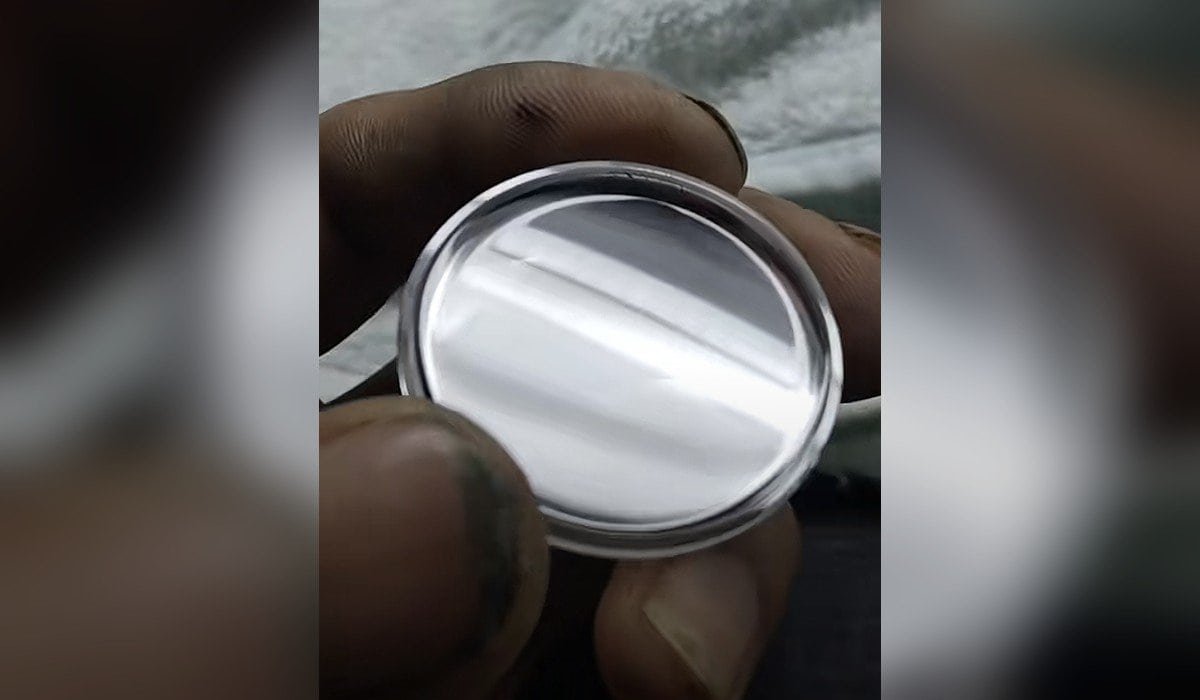
Technical specifications
The manual EG-80 shares the dual-wheel profiling geometry with hand loading; the Auto-EG-80 adds the X/Y/Z vacuum handling for unattended runs.
| Part diameter | Ø5 – Ø80 mm (shaped by diagonal) |
| Grinding spindle speed | 3,600 rpm max |
| Work-axis speed | 100 rpm max |
| Cycle time | 15 s – ∞ |
| Z lift travel | 40 mm, servo |
| Spindle runout (radial / axial) | < 0.006 mm |
| Work-axis runout | < 0.006 mm |
| Feed accuracy | 0.01 mm |
| Grinding wheel | Ø160 × Ø30 × 20 mm, dual rough / fine |
| Spindle motor | 1.3 kW |
| Work-axis motor | 400 W |
| Traverse motor | 400 W |
| Total installed power | 2.2 kW |
| Overall dimensions (L × W × H) | 1500 × 850 × 1700 mm |
| Total weight | approx. 500 kg |
| Machining chamber | Acrylic, water-tight enclosed |
| Base construction | Headstock and base cast as one |
The dual grinding wheel is a consumable chosen for the material; profile templates are tooling made to each shaped part. Both are quoted separately — send the part and we specify them.
Main assemblies and what each one is for
This is the vocabulary your operator and our service engineer will share on the shop floor.
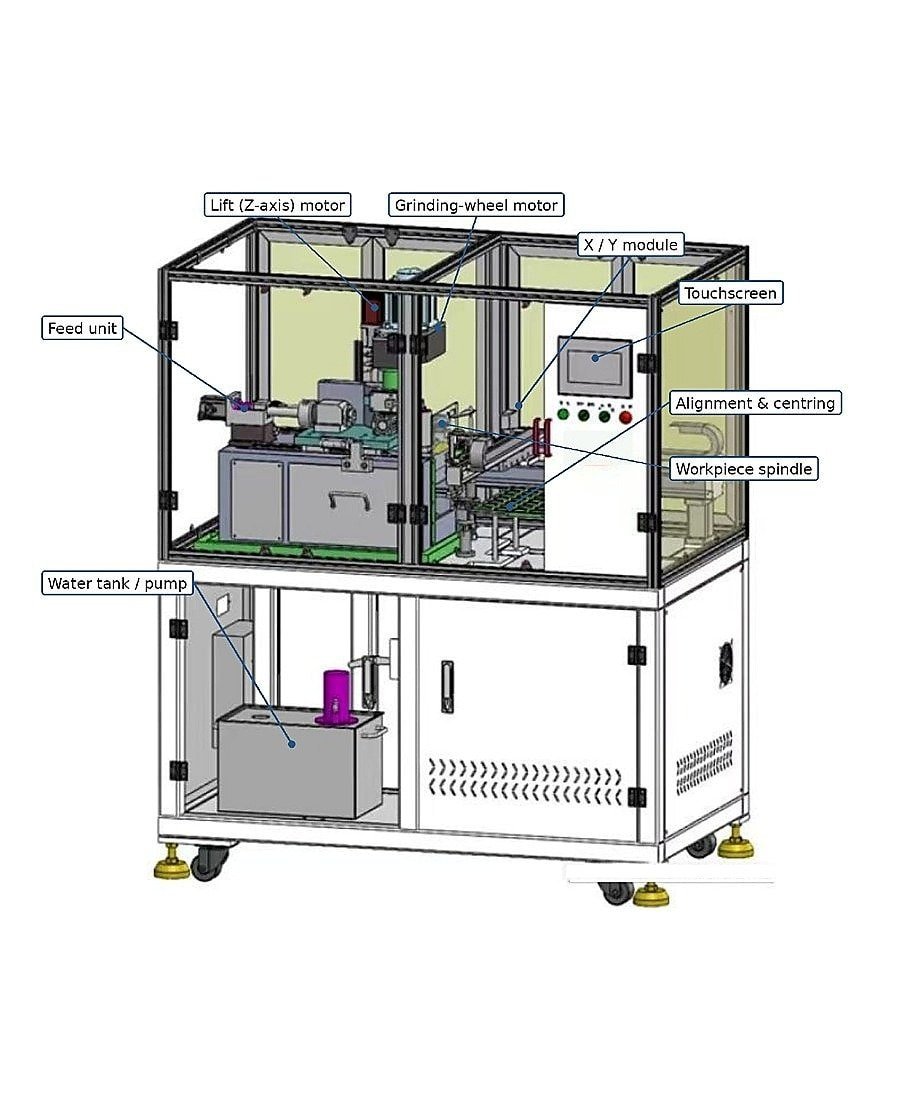
| Assembly | Function |
|---|---|
| Grinding spindle | Carries the Ø160 mm dual rough / fine wheel at up to 3,600 rpm, runout < 0.006 mm |
| Work axis | Turns the part against the wheel at up to 100 rpm, runout < 0.006 mm |
| X / Y / Z vacuum handler | Picks, presents and returns each part with a vacuum chuck; the servo Z lift places the chamfer |
| Profile / micrometer unit | Template follower for shaped parts; micrometer diameter control for round parts |
| Enclosed wet chamber | Acrylic water-tight enclosure keeping slurry in the machine |
| One-piece cast base | Headstock and base cast together for rigidity under the grinding load |
| Operator controls | Cycle, diameter and chamfer settings within reach of the working position |
Utilities, environment and safety
Electrical supply, compressed air, coolant, floor loading and the ambient conditions the machine is to run in are confirmed with us for each order, together with the safety and protective arrangement supplied with it. These figures depend on the voltage and frequency of your site, the material you are running and the destination market, so we do not publish a single set of them here.
Send us the site conditions with your enquiry and we will return the utility and environmental requirements in writing, before the order is placed.
An automatic lens profiling edger holds diameter and chamfer well once set, but a new shaped part needs its template made and proved first. That template work is part of commissioning, and the reason we ask for your parts and outline drawing before quoting.
What happens after the machine is installed?
The same terms apply to every machine we ship, wherever in the world it goes.
| Warranty period | 12 months from final acceptance |
| Response during warranty | Response within 8 hours · solution proposed within 24 hours · issue resolved within 48 hours, including procurement, installation and commissioning of parts |
| After the warranty period | Service and spare parts available for the life of the machine |
| Certification | CE |
Specifications are subject to change as a result of design upgrades. Minor differences may occur at certain parts. For a binding specification, refer to the order confirmation.
See the machine running
The Auto-EG-80 edging a batch of cover glass, and the vacuum handler loading and unloading between cycles.
01 — Dual-wheel edging cycle, cover glass
02 — Vacuum pick-and-place loading and unloading
Send one drawing and a few parts
An automatic lens profiling edger is easy to specify badly from a datasheet. Send us one part drawing — diameter or outline, chamfer, material and the tolerance you have to hold — together with a few of your own parts. We run them, return them, and send the process sheet with the quotation.
For shaped parts we quote the template with the machine, so you can see the outline on your own glass before you commit.
12-month warranty · free trial run on customer-supplied material
Optics customers include Edmund Optics and Coherent
Related equipment and reading:
- Convex lens polishing machine FP-4L — the polishing stage upstream
- CNC optical curve generator Auto-SG-50 — where the radius is cut
- Concave lens polishing machine FP-4U — the concave polishing counterpart
- Optical lens fabrication line — how the stations connect