
ZnSe ZnS Optics Grinding Machine
A large-aperture ZnSe ZnS optics grinding machine for chalcogenide IR work — CO₂ laser windows, multispectral meniscus lenses, large-aperture thermal-imaging primaries. Wheel grit, coolant pH, and infeed cadence tuned to the {110} cleavage plane these materials love to chip on.
A large-aperture spherical grinder built for chalcogenide work
Cast-iron base, NSK-bearing spindle, integrated centroscope — the same precision frame as the smaller G-100, scaled to Ø 80–250 mm and tuned for the softer chalcogenide materials its bigger optics tend to be made of.
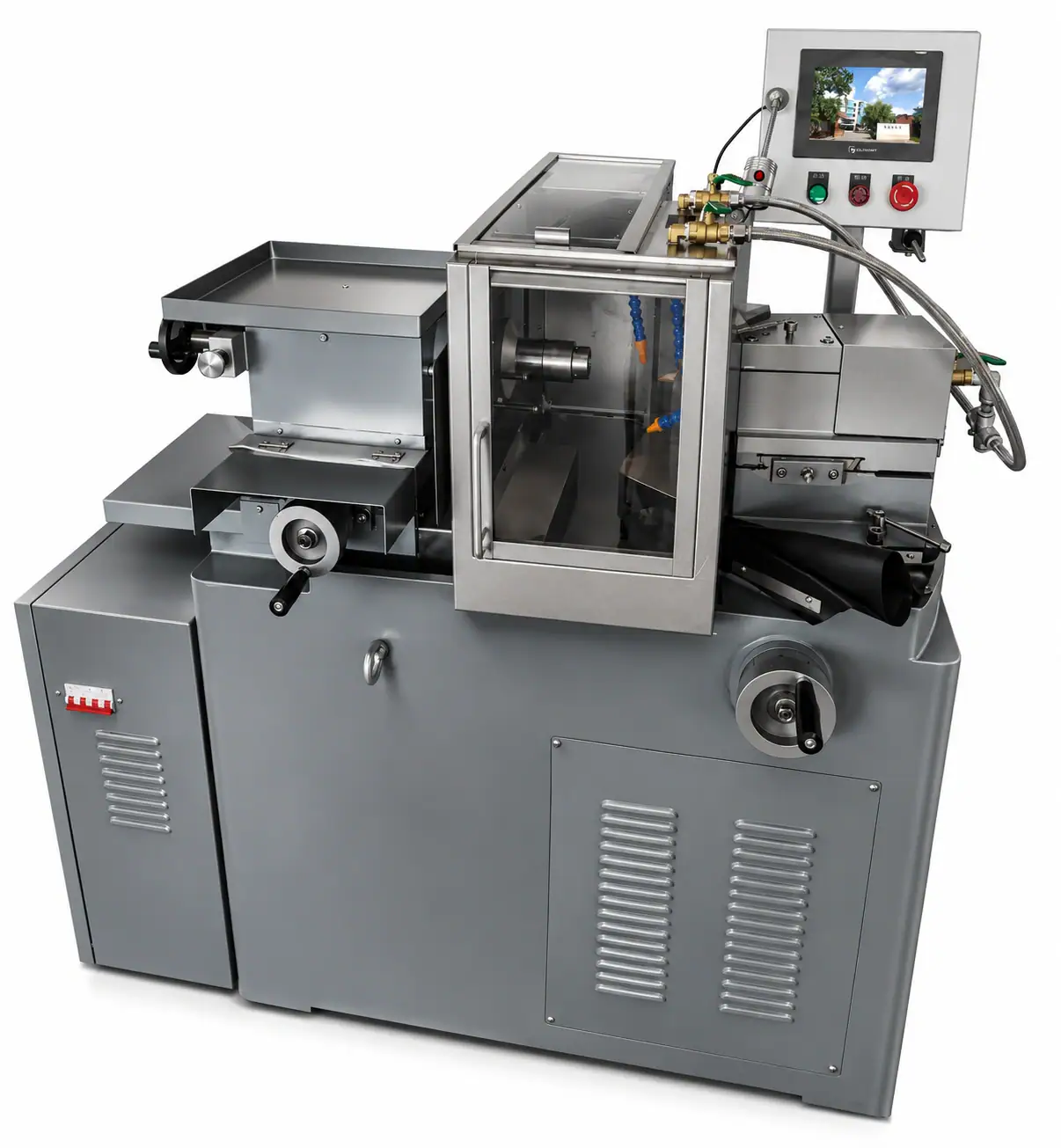
The G-250 ZnSe ZnS optics grinding machine is a scaled-up sibling of the smaller G-100, sharing the same NSK precision bearings, ±3 µm spindle vibration, and PLC + servo control philosophy. What differs is the frame mass and the wheel-spindle geometry, sized for the larger workpieces — Ø 80–250 mm — that show up in CO₂ laser optics, large multispectral primaries, and defense-grade thermal-imaging objectives. The coolant tank ships sized for water-soluble emulsion calibrated to ZnSe-safe pH.
- Workpiece range Ø 80–250 mm · thickness ≤ 45 mm
- Positioning accuracy ±0.003 mm
- Spindle runout radial & axial within 0.005 mm
- Spindle vibration ≤ ±3 µm displacement — critical on Mohs 4–4.5 materials
- Bearings NSK 7203C / 7005AC P4 mechanical · natural air cooling
- Control PLC + servo · English HMI · handheld controller
- Coolant water-soluble emulsion · pH near 7 (chalcogenide-safe)
What the ZnSe ZnS optics grinding machine does differently
The G-250 frame and spindle are the same precision family as the smaller models. The differences that matter for ZnSe and ZnS work live in the wheel, the coolant, and the infeed cadence — and in the workpiece range that fits a CO₂ laser window.
Ø 80–250 mm large-aperture range
Built for the optics ZnSe and ZnS actually get used in — CO₂ laser windows and meniscus lenses, large multispectral primaries, defense-grade thermal-imaging objectives. Small-aperture chalcogenide work belongs on the G-100.
Wheel grit calibrated for chalcogenides
350–400 grit electroplated nickel-bond on a #45 steel base — same wheel system as the smaller G-series, but with a lighter dressing routine. ZnSe is Mohs 4–4.5; a wheel that's worked fine on germanium will pluck a chip off ZnSe if it's running too hot.
Coolant pH near 7
ZnSe is sensitive to alkaline coolant — pH above 9 visibly clouds the surface and ruins the subsurface for polishing. The G-250 ships with a near-neutral water-soluble emulsion and a pH meter for verification at each fill.
≤ ±3 µm spindle vibration
The number that bounds edge chipping on soft chalcogenides. NSK precision bearings, a heavy cast-iron base, and natural air cooling keep the spindle inside ±3 µm displacement — enough to hold edge chip under 0.2 mm on ZnSe.
≤ 20″ centering on large aperture
An extended centroscope arm reaches Ø 250 mm workpieces and reads optical-axis runout the same way it does on a 60 mm thermal-imaging lens — to within 20 arc-seconds. Form on the finished part is bounded by centering, not by spindle drift.
Wheel-approach offset programmable
The wrong wheel approach angle on a {110}-cleaving material tears the cleavage plane at the edge. The G-250's PLC lets you offset the approach per material — we ship it pre-set for ZnSe and ZnS, with profiles editable through the HMI.
See the G-250 grind a concave surface
A short clip of the G-250 generating a concave surface on a chalcogenide blank — wheel approach calibrated to the {110} cleavage, water-soluble emulsion at chalcogenide-safe pH, edge chipping held inside the centering allowance.
▸ Cycle — concave surface grind on a chalcogenide blank
Want to see your specific lens drawing run? When you request a sample grind, we record the run on your blank and send it with the metrology report.
Why edge chipping is the line item on ZnSe and ZnS work
Germanium grinding worries about subsurface damage and form. A ZnSe ZnS optics grinding machine has a different priority list: edge chipping first, everything else second. The reason is mechanical: both materials are Mohs 4–4.5 (softer than germanium at 6–6.5), and both cleave readily on the {110} plane. A wheel approach that produces a clean edge on Ge — same wheel, same coolant — will pluck a 0.3–0.5 mm chip off a ZnSe edge if the approach angle isn't offset to the cleavage.
At ZnSe spot price of $400–$600/kg and ZnS standard at $80–$150/kg, the material itself is a quarter of what germanium runs. But the cost stack on a chipped lens is bigger than the material line. A Ø 150 mm ZnSe CO₂ laser window blank carries ~$200 of raw material plus the cost of the cutting, centering, and any prior grinding passes that got it to the G-250. A chip that exceeds the 0.2 mm centering allowance either gets re-fixtured for a second grinding pass (eating polishing margin) or scrapped. A 5% chip rate across a 100-part run is $1,000+ of scrap plus rework time the schedule never accounted for.
The G-250 ZnSe ZnS optics grinding machine controls that loss at the wheel — calibrated approach angle per material, near-neutral pH coolant, slower infeed than the same machine running germanium. The numbers we hold are < 0.2 mm edge chip and ±0.005 mm form. The full chalcogenide material properties are in Crystran's ZnSe datasheet and Crystran's multispectral ZnS datasheet.
Wheel, coolant, and approach — calibrated for chalcogenides
Wheel grit and bond selection
Standard wheel for the G-250 ZnSe ZnS optics grinding machine is a 350–400 grit electroplated nickel-bond cup on a #45 steel base — same family as we recommend for germanium, but with a different dressing cadence. ZnSe loads the wheel faster than Ge does because the swarf is softer; we re-dress every 30–40 parts on a Ø 100 mm ZnSe lens, against ~80–100 parts on equivalent germanium work. For multispectral ZnS, dress between every part group — the CVD grain structure varies enough that a "settled" wheel reads as a "new" wheel on the next batch.
Coolant pH and concentration
ZnSe is the material the coolant has to be right for. Plain water leaves a chalky surface visible to the naked eye; alkaline coolant (pH > 9) clouds the subsurface in a way the polisher can't recover. We ship the G-250 with a water-soluble emulsion calibrated to pH 6.8–7.4 at 5–8% concentration. The supplied pH meter sits next to the coolant tank, and the operator checks at every fill. ZnS is more forgiving on pH but reacts the same way to wrong concentration — too dilute and the wheel runs hot, too concentrated and the cleanup pass leaves residue.
If your shop is on a shared coolant loop with a CNC mill or a glass grinder, that coolant is almost certainly too alkaline for ZnSe (mill coolants run pH 9–10 for rust prevention). Either dedicate a coolant circuit to the G-250 or accept that you'll be re-polishing every ZnSe lens to recover surface clarity. We don't share coolant loops — and we mention it on day one because customers have walked into this exact problem more than once.
How does bonded-grit grinding compare to traditional ZnSe lapping?
Optical shops still hand-lap ZnSe lenses with loose abrasive on a cast-iron plate — the traditional approach for soft brittle materials. It works, and a skilled operator can produce a clean edge. The trade is throughput, repeatability, and operator dependency. Bonded-grit grinding on a G-250 ZnSe ZnS optics grinding machine hits the same edge-chipping floor with form repeatability you can verify on a test plate, not on the operator's last good day.
| Approach | Form tolerance | Edge chip | Cycle / face | Operator skill |
|---|---|---|---|---|
| Hand lapping (cast iron + slurry) | varies by operator | < 0.1 mm if good | hours | high |
| Full CNC freeform grinder | ±0.005 mm | < 0.2 mm | 2–3 min | CNC programmer |
| G-250 bonded-grit (this page) | ±0.005 mm | < 0.2 mm | 1–2 min | PLC + handheld |
The honest tradeoff: hand lapping wins on edge-chip floor when an experienced operator runs it (the slurry's not a solid cutting tool — there's nothing to gouge). The G-250 wins on throughput, repeatability, and not depending on one operator's career. If you only grind ZnSe in batches of three a quarter, hand-lap. If you grind ZnSe weekly at production volume, you want a bonded-grit machine sized to the aperture you're running. For finished-lens tolerance frameworks see ISO 10110.
The G-250 is a spherical generator, not a freeform grinder. For aspheres with significant sag departure from best-fit sphere, a full CNC freeform machine fits the job better. We'll tell you on the drawing review which one applies; sending us your finished-lens drawing is the fastest way to find out.
Built for chalcogenide IR work at large aperture
What the G-250 ZnSe ZnS optics grinding machine commits to on a CO₂ laser window or a large multispectral primary — the numbers that bound edge chipping, form, and the handoff to polishing.
G-250 technical specifications
Standard-configuration specs for the G-250 ZnSe ZnS optics grinding machine. The base precision numbers come from the G-series platform; the workpiece range, wheel sizing, and shipped coolant set this one apart for chalcogenide work.
| Workpiece diameter | Ø 80 – 250 mm |
| Workpiece thickness | ≤ 45 mm |
| Surface types | convex · concave · flat (same spindle) |
| Axis positioning accuracy | ±0.003 mm |
| Spindle radial / axial runout | within 0.005 mm |
| Spindle vibration (displacement) | ≤ ±3 µm |
| Surface form after grinding | within 0.005 mm |
| Centering tolerance (centroscope) | ≤ 20″ arc-seconds |
| Diameter tolerance | ±0.01 mm |
| Roundness | ≤ 0.01 mm |
| Edge chipping (ZnSe / ZnS) | < 0.2 mm |
| Shipped wheel | 350–400 grit electroplated nickel-bond on #45 steel base |
| Re-dress cadence (ZnSe Ø 100 mm) | every 30–40 parts |
| Coolant | water-soluble emulsion · pH 6.8–7.4 · 5–8% concentration |
| pH verification | pH meter included at coolant tank |
| Bearings | NSK 7203C / 7005AC P4 — mechanical, natural air-cooled |
| Linear guides | 4-direction equal-load preload precision rail |
| Ball screws | single-nut un-flanged rolled C7 preload |
| Control | PLC + servo · English HMI · handheld controller |
| Wheel-approach offset | programmable per material profile via HMI |
| Drawing standard | ISO 10110 |
| Service life (well-maintained, dedicated coolant loop) | 20–30 years |
Tolerances on the ground part flow to centering and polishing per ISO 10110. The chalcogenide-specific bits — coolant pH, wheel re-dress cadence — are what differentiate this G-250 datasheet from a generic spherical grinder spec sheet.

ZnSe and ZnS — the two materials this page exists for
The G-250 ZnSe ZnS optics grinding machine will grind Ge, Si, sapphire, and optical glass too — same machine family as the G-100. But this page is specifically about chalcogenides, because that's where the wheel choice, coolant chemistry, and approach-angle calibration matter most. Here's the practical material data the shop floor actually needs:
- Zinc selenide (ZnSe) — Mohs 4–4.5, cleaves on {110}. Spot price $400–$600/kg. CO₂ laser windows (10.6 µm), MWIR / LWIR thermal-imaging meniscus lenses, broadband 0.6–18 µm transmission. Sensitive to alkaline coolant; needs pH 6.8–7.4 and 5–8% emulsion concentration.
- Zinc sulfide (ZnS) — standard / FLIR grade — Mohs ~3, polycrystalline CVD. Spot price $80–$150/kg. MWIR / LWIR thermal-imaging optics in lower-cost assemblies. More forgiving than ZnSe on coolant pH but reacts the same way to wrong concentration.
- Zinc sulfide (ZnS) — multispectral — Mohs ~4, hot-isostatically-pressed CVD with extended transmission to visible. Spot price $200–$400/kg. Defense and surveillance multispectral imaging. Dress the wheel between part groups — the grain structure varies enough across batches that a settled wheel reads as new on the next batch.
For Ge, Si, sapphire, BK7 work in the same Ø 80–250 mm range, the G-250 will run them — wheel choice and infeed change. For Ø 10–100 mm small-aperture work in any of these materials including ZnSe and ZnS, go to the G-100 page.
Where does the G-250 fit in a chalcogenide IR line?
The G-250 ZnSe ZnS optics grinding machine sits between the cutting station and the polisher, same as the smaller sibling, but the upstream and downstream specifics shift with the material. ZnSe blanks usually come in CVD-grown form (rectangular slabs or large-aperture pre-pressed discs) rather than the cast ingots used for Ge. Centering is done on this machine before grinding starts; the ground surface then handsoff to a polisher tuned for chalcogenide slurry.
For the broader IR-optics manufacturing workflow — slicing, centering, grinding, polishing, AR coating — the germanium lens manufacturing page lays out the same five-stage process the chalcogenide line follows, with material substitutions. The full equipment range is at the infrared optics manufacturing equipment hub.
For small-aperture chalcogenide work (Ø 10–100 mm) — typical of handheld thermal-imaging modules, sensor optics, and small CO₂ laser optics — the G-100 infrared optics grinding machine is the right frame, not the G-250. Same coolant-pH and wheel-approach logic applies; just sized for the smaller aperture. For non-chalcogenide work in this Ø 80–250 mm range (large germanium primary lenses, large sapphire windows), the G-250 still applies — drop the chalcogenide-specific coolant and adjust wheel grit.
Get a sample grind on your own ZnSe blank
Pick the G-250 ZnSe ZnS optics grinding machine if you're running CO₂ laser windows, multispectral primaries, or large-aperture thermal-imaging objectives in production, and you want a spherical generator that ships with coolant chemistry and wheel-approach logic already calibrated for chalcogenides. Send us your finished-lens drawing and a ZnSe or ZnS blank; we'll grind a proof part and return it with a metrology report before you commit.
Vimfun · ISO 9001 · CE compliant · shipped to 20+ countries
Optics customers include Edmund Optics and Coherent.
Tel +1 (408) 571-8651 · daria@endlesswiresaw.com