
Concave Lens Polishing Machine FP-4U
A four-spindle upper-swing concave lens polishing machine that fine-grinds and polishes small lenses on a spherical-centre swing, R1–R20 mm, up to Ø30 mm. The upper swing is what makes it suit concave surfaces.
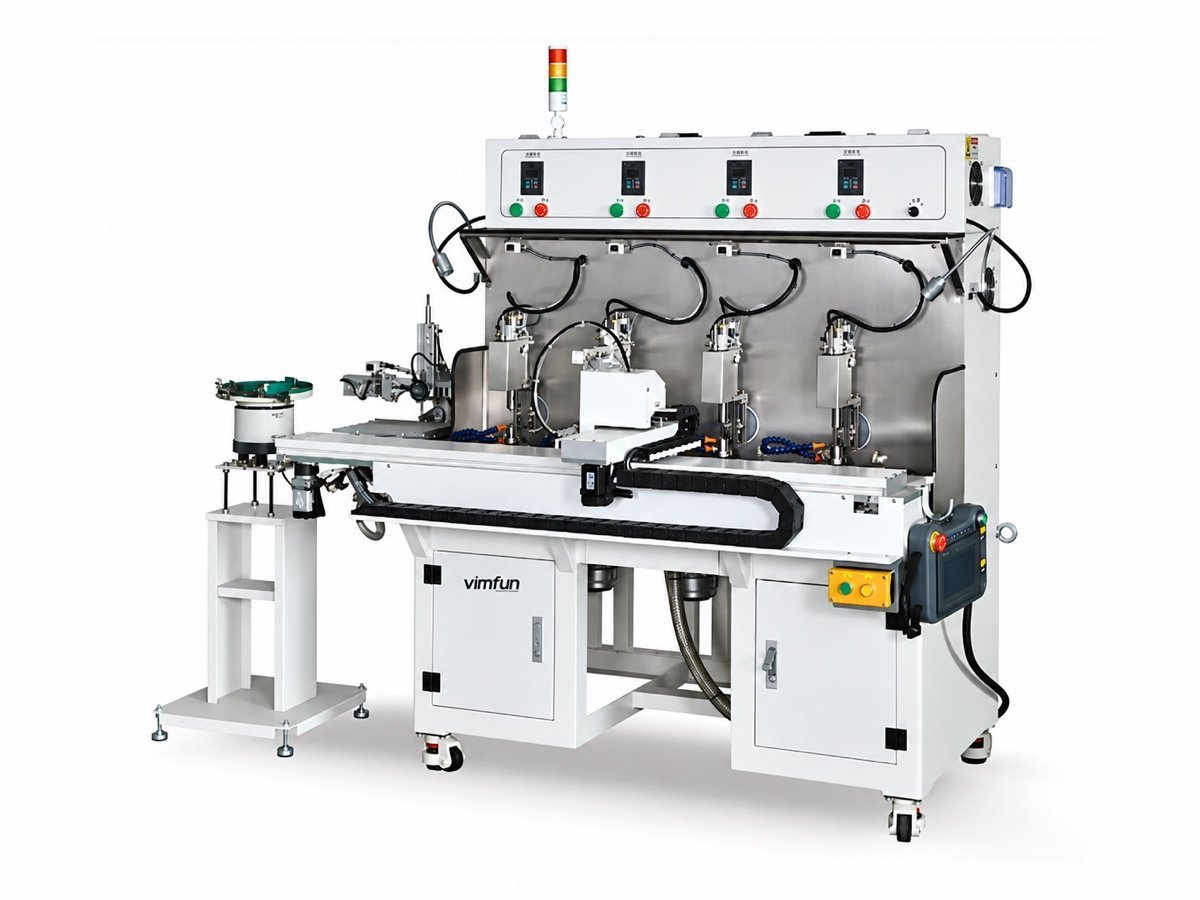
What this machine makes, and what happens before and after it
A lens leaves the curve generator with its radius cut but its surface still grey and rough. Fine grinding and polishing is the stage that turns that generated surface into an optical one. A concave lens polishing machine owns that stage for concave elements: it removes the subsurface damage the generator left and brings the surface up to a polish, without re-cutting the radius.
Upstream is the curve generator that cut the radius; downstream is centring and edging. What this machine controls is form and finish — the shape stays what the generator set, the surface becomes what the customer can coat.
Upper-swing machines like the FP-4U suit concave surfaces. For convex lenses you want the lower-swing version, the FP-4L convex lens polishing machine. Getting this pairing right before you buy is the single most important choice on this class of machine.
How does a concave lens polishing machine set a radius?
Not by cutting. The radius is already there. This machine holds it while it polishes — and it does that by swinging the lens about the centre of its own sphere.
The principle is quasi-spherical-centre grinding. The lens is held so that the centre of its spherical surface stays fixed in space — the machine’s spherical-centre height is 70 mm — and a swing arm rocks it back and forth along a centripetal arc while the spindle turns it under a lap. Because every point of the swing passes through the same sphere centre, the surface converges on one radius rather than wandering.
Two settings do the shaping, and both are on the machine, not in a program:
- Swing range — the arc the arm sweeps, adjustable from −10° to +60°; it governs how far across the face the lap works
- Swing speed — 0–60 oscillations per minute, stepless; with the 450–3000 rpm spindle it sets how the form comes in
- Spring pressure — adjustable at each head, so a thin or brittle lens is not overloaded
- Upper swing — the arm carries the work from above, which is what makes the geometry suit concave faces
Four spindles run under one swing frame, so a concave lens polishing machine of this size finishes four lenses per cycle to the same form. On the polishing configuration a 1 kW heater warms the slurry, which keeps the polish rate steady.
You are buying a form-holding machine, not a radius-cutting one. The lap tools and the swing settings are matched to your radius and material — send the lens drawing and a few parts and we work the settings out on your glass, not on a chart.
Four spindles, one form
The FP-4U carries four work spindles under a single swing arm. That is what makes this concave lens polishing machine a small-batch machine rather than a one-off bench.
Four lenses to one setting
All four spindles share the swing frame and the swing program, so the four parts in a cycle come out to the same radius and finish. You set once and run four.
Spring pressure at each head
Down-force is set by an adjustable spring on each spindle, not a fixed weight. A thin concave lens can be run light; a thicker one can take more, without changing tools.
Servo swing that a robot can reach
The swing axis is servo-controlled and its tilt is freely adjustable, which leaves room to add a handling arm later if you move from bench loading to automated loading.
Fine-grind and polish in one family
The machine is built in a fine-grinding and a polishing configuration; the polishing build adds the slurry heater. The workflow and the operator’s controls stay the same across both.
Which materials and geometries can it handle?
| Item | Capability |
|---|---|
| Surface type | Concave spherical surfaces (upper-swing geometry) |
| Radius range | R1 – R20 mm |
| Workpiece diameter | Up to Ø30 mm |
| Workpieces per cycle | 4 — one per spindle |
| Process | Fine grinding and polishing (two build configurations) |
| Materials | Optical lenses — send your material for a free trial run; suitability confirmed on your own parts |
| Pressure control | Adjustable spring pressure at each head |
| Spherical-centre height | 70 mm |
If your drawings are dimensioned to the ISO 10110 framework, send one with the enquiry. On a concave lens polishing machine the radius and the surface-quality grade you have to hold are what decide the tools and the swing program — see the material data on optical substrates if you are choosing glass.
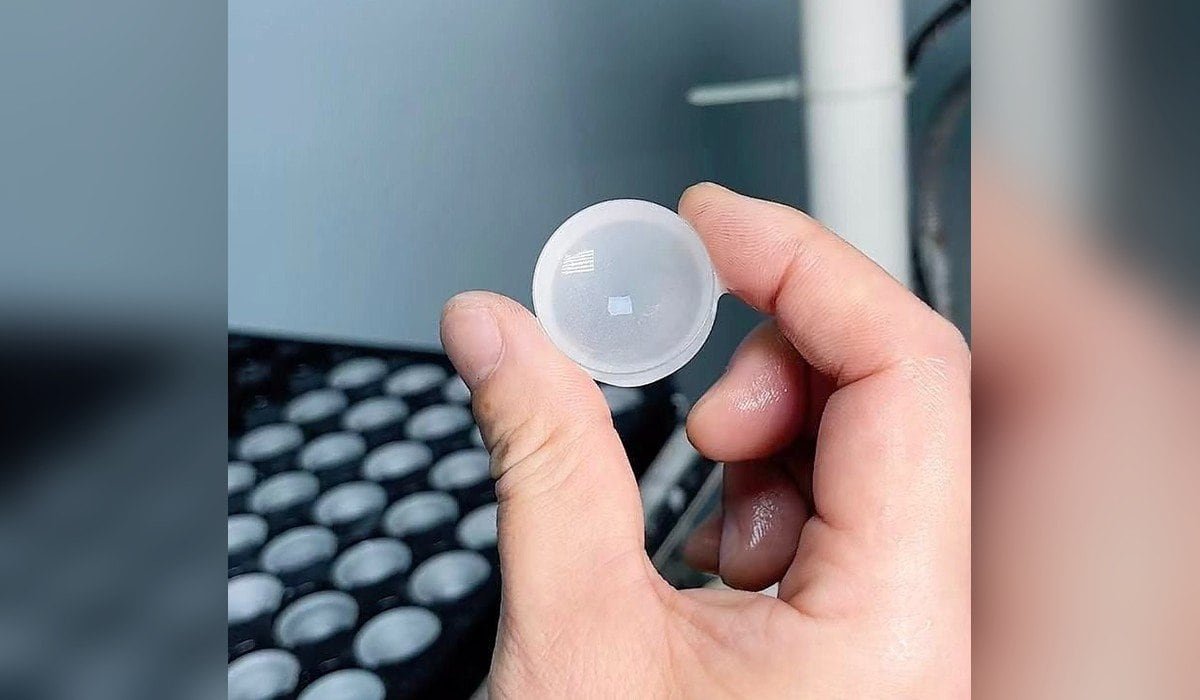
Technical specifications
The lower-swing FP-4L is the convex counterpart; the six-spindle FP-6U adds independent per-axis control for mixed small batches.
| Process | Fine grinding / polishing |
| Workpiece form | Single part per spindle, quasi-spherical-centre |
| Curvature range | R1 – R20 mm |
| Workpiece diameter | Ø30 mm max |
| Number of spindles | 4 |
| Spindle connection thread | M16 × 1 |
| Spindle positioning bore | Ø18 (0 to +0.02) mm |
| Spindle speed | 450 – 3,000 rpm |
| Swing rate | 0 – 60 CPM, stepless |
| Swing range | −10° (left) to +60° (right) |
| Quasi-spherical-centre height | 70 mm |
| Pressure | Adjustable spring pressure |
| Spindle motor | 4 × 120 W |
| Swing motor | Stepper |
| Coolant pump | 90 W |
| Slurry heater (polishing build) | 1 kW |
| Total installed power | 1.5 kW (+ 1 kW heater) |
On a concave lens polishing machine the lap tools, polishing pads and slurry are process consumables chosen for the radius and the material. They are quoted separately — tell us the lens and we will specify them.
Main assemblies and what each one is for
Seven sub-assemblies make up this concave lens polishing machine. This is the vocabulary your operator and our service engineer will share on the shop floor.
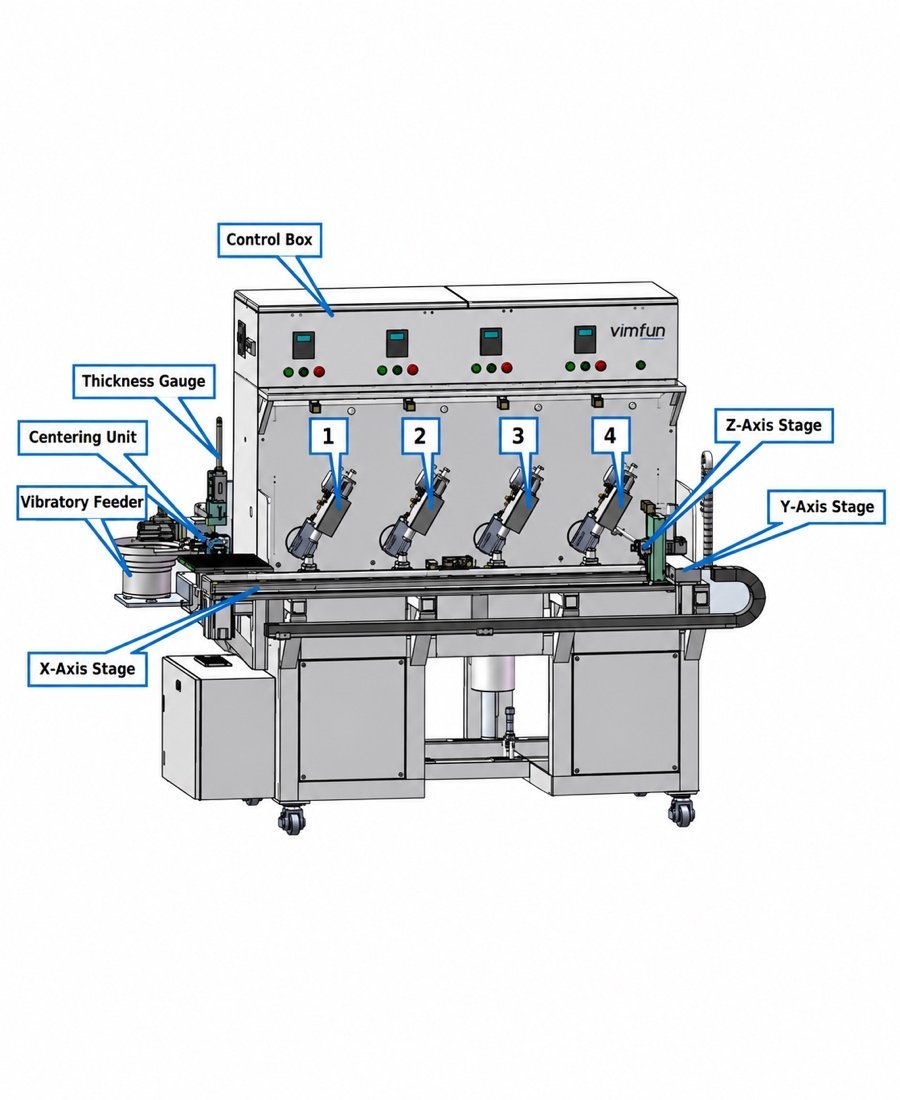
| Assembly | Function |
|---|---|
| Swing frame | Servo-driven upper swing carrying all four heads along the centripetal arc that sets the form |
| Work spindles ×4 | Turn the lens under the lap at 450–3,000 rpm; M16×1 connection, Ø18 positioning bore |
| Spring-pressure heads | Set adjustable down-force per spindle so thin or brittle lenses are not overloaded |
| Spherical-centre mechanism | Holds the sphere centre fixed at 70 mm height so the swing converges on one radius |
| Lap plates | Grinding or polishing tools matched to the radius and material |
| Slurry / coolant system | Circulating supply; the polishing build adds a 1 kW heater to hold the polish rate |
| Operator controls | Swing range, swing speed, spindle speed and pressure within reach of the working position |
Utilities, environment and safety
Electrical supply, compressed air, coolant, floor loading and the ambient conditions the machine is to run in are confirmed with us for each order, together with the safety and protective arrangement supplied with it. These figures depend on the voltage and frequency of your site, the material you are running and the destination market, so we do not publish a single set of them here.
Send us the site conditions with your enquiry and we will return the utility and environmental requirements in writing, before the order is placed.
The form on a concave lens polishing machine is set by the swing program, and getting range, speed and pressure right for a new radius takes trial parts, not a manual. This is the main thing we work out with you during commissioning, and the reason we ask for your lenses before quoting.
What happens after the machine is installed?
The same terms apply to every machine we ship, wherever in the world it goes.
| Warranty period | 12 months from final acceptance |
| Response during warranty | Response within 8 hours · solution proposed within 24 hours · issue resolved within 48 hours, including procurement, installation and commissioning of parts |
| After the warranty period | Service and spare parts available for the life of the machine |
| Certification | CE |
Specifications are subject to change as a result of design upgrades. Minor differences may occur at certain parts. For a binding specification, refer to the order confirmation.
See the machine running
The FP-4U polishing four concave lenses on the spherical-centre swing, and an operator setting the swing range and pressure.
01 — Four-spindle polishing cycle, concave lenses
02 — Swing range, speed and spring-pressure setup
Send one drawing and a few lenses
A concave lens polishing machine is easy to specify badly from a datasheet. Send us one element drawing — diameter, radius, material and the surface-quality grade you have to hold — together with a few of your own lenses. We run them, return them, and send the process sheet with the quotation.
If your parts are convex, we will point you to the lower-swing FP-4L instead of quoting the wrong machine.
12-month warranty · free trial run on customer-supplied material
Optics customers include Edmund Optics and Coherent
Related equipment and reading:
- Convex lens polishing machine FP-4L — the lower-swing version for convex lenses
- CNC optical curve generator Auto-SG-50 — the generating stage upstream
- Automatic lens profiling edger Auto-EG-80 — the centring and edging stage downstream
- Optical lens fabrication line — how the stations connect