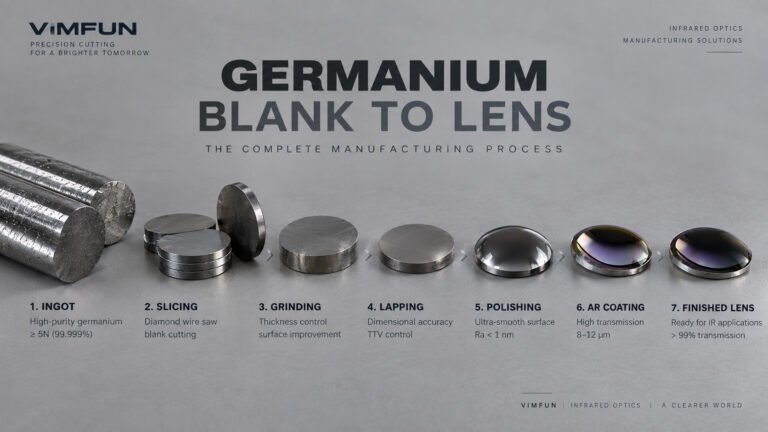
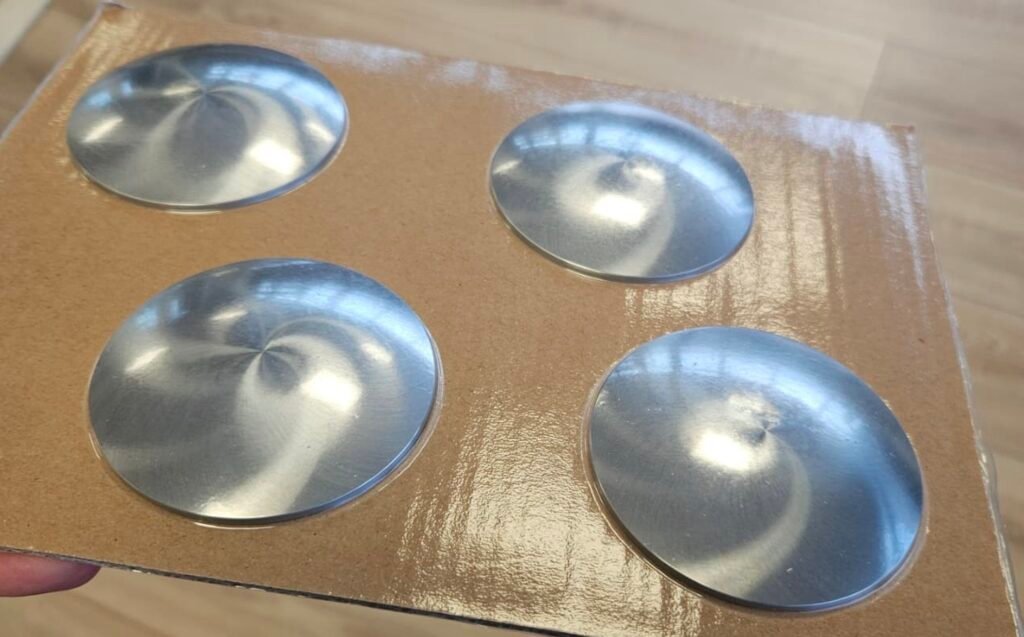
After cutting and centering, a germanium blank is flat — a disc with parallel surfaces, correct diameter, and clean edges. But a flat disc is not a lens. The grinding stage generates the curvature — spherical or aspherical — that gives the lens its optical function.
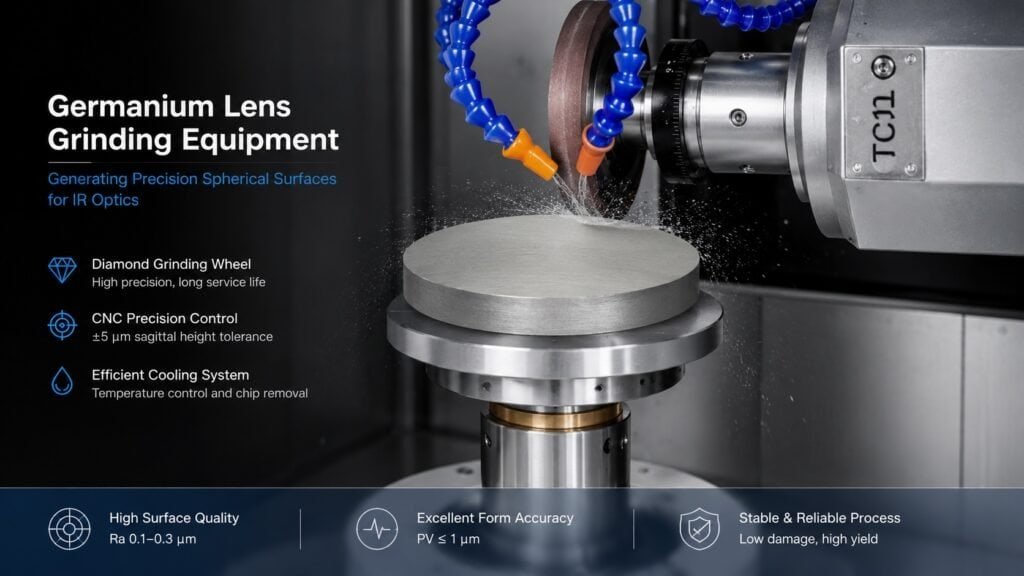
Germanium lens grinding equipment shapes each face of the blank to the designed radius of curvature while maintaining surface quality good enough for the polishing stage that follows. Get grinding right, and polishing is fast and predictable. Get it wrong, and you’re either grinding away material you can’t afford to lose, or sending subsurface damage forward that polishing can’t remove.
Where Germanium Lens Grinding Fits in the Production Line
Grinding is stage 4 in the infrared optics manufacturing workflow:
| Stage | Equipment | What It Does | Output |
|---|---|---|---|
| 1 | Wire saw (SGI 40) — contour cutting | Extracts preform from ingot | Shaped preform |
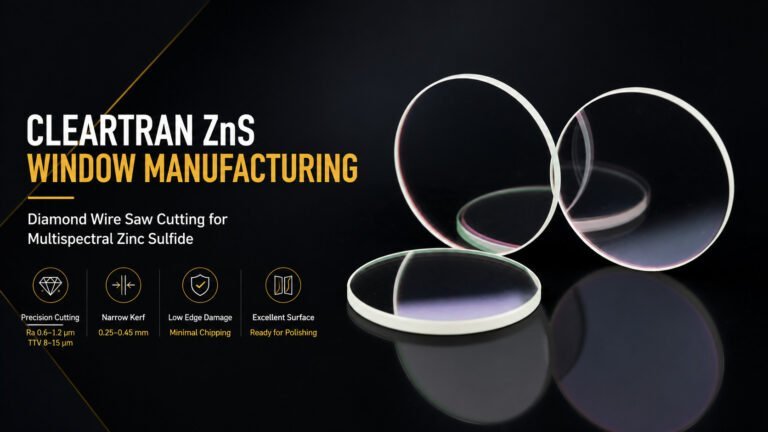
| 2 | Wire saw (SGI 40) — slicing | Cuts preform into blanks | Flat disc, Ra 0.6–1.2 μm |
| 3 | Centering machine (C-120L) | Edges, centers, chamfers | Round blank, ≤ 5 μm roundness |
| 4 | Spherical grinder (G-100 / G-250) | Generates lens curvature | Curved surfaces, Ra 0.1–0.3 μm |
| 5 | Polishing machine | Final surface finish | Ra < 5 nm, ready for AR coating |
The grinding stage converts a flat blank into a lens shape. For a Φ50 mm double-convex germanium lens, grinding takes approximately 5 minutes per face — 10 minutes total — making it one of the faster stages. But the dimensional precision required is high: sagittal height tolerance of ±5 μm and surface form accuracy that determines downstream polishing success.
Why Germanium Requires Specialized Grinding Equipment
Germanium is not glass. Three material properties make germanium lens grinding fundamentally different from grinding conventional optical glass:
Brittleness and Subsurface Damage
Germanium is a crystalline semiconductor with a diamond cubic structure. When ground with excessive force, cracks propagate along crystal planes — not randomly as in amorphous glass. These subsurface cracks extend deeper than the visible grinding marks and create a damaged layer that the polishing stage must remove entirely.
The challenge: if the grinding process introduces 15–20 μm of subsurface damage, polishing must remove at least that much material across the entire lens surface. On a $120–$180 blank (at $1,800–$2,400/kg for optical-grade germanium), every extra micron of material removal costs real money and adds cycle time.
Softness Relative to Optical Glass
Germanium (Knoop hardness ~780) is softer than most optical glasses used in visible optics (typically 400–600 Knoop). This means it grinds faster — but also means it’s easier to over-grind or introduce form errors from uncontrolled material removal.
The grinding wheel cuts into germanium more aggressively at the same infeed rate used for glass. Without proper adjustment, the result is deeper subsurface damage, higher surface roughness, and poor form accuracy.
Thermal Sensitivity
Germanium has a thermal conductivity of ~60 W/m·K and a coefficient of thermal expansion of 5.9 × 10⁻⁶/°C. During grinding, friction generates heat at the wheel-lens interface. If the lens heats unevenly, it expands asymmetrically — and the grinding wheel generates a curve on the thermally distorted lens. When the lens cools to room temperature, the ground surface doesn’t match the intended radius.
This effect is measurable on germanium lenses above Φ40 mm and becomes significant above Φ100 mm.
What to Look for in Germanium Lens Grinding Equipment
Diamond Grinding Wheel Specifications
Germanium lens grinding uses bonded diamond wheels — typically resin-bonded for finish grinding and metal-bonded for rough generation. The key specifications:
| Parameter | Rough Generation | Finish Grinding |
|---|---|---|
| Diamond grit size | D46–D91 (coarser) | D7–D25 (finer) |
| Bond type | Metal (bronze) | Resin |
| Concentration | 75–100% | 50–75% |
| Wheel speed | 2,000–4,000 RPM | 3,000–5,000 RPM |
| Infeed rate | 5–15 μm/pass | 1–5 μm/pass |
For germanium, finer grit wheels are preferred even in the rough stage compared to glass grinding. The reason is subsurface damage control — a D91 wheel on germanium creates a deeper damage layer than the same wheel on BK7 glass, simply because germanium’s crystal structure propagates cracks more efficiently.
Spindle Rigidity and Vibration Control
Spindle runout directly transfers to the ground surface as form error. For germanium lens grinding equipment, the spindle TIR (Total Indicated Runout) should be ≤ 1 μm. Higher runout means the grinding wheel contacts the lens at slightly different positions each revolution, creating a rippled surface that’s visible as waviness after polishing.
Air-bearing spindles provide the best runout performance but require clean, dry compressed air and careful maintenance. Precision roller-bearing spindles are more robust for production environments and can achieve ≤ 2 μm runout with proper preload.
Coolant System
Grinding coolant for germanium serves three functions:
- Temperature control — prevents thermal distortion during grinding
- Chip flushing — removes ground germanium particles from the grinding zone
- Lubrication — reduces friction between wheel and lens
For germanium, water-soluble coolants are standard. Unlike the mineral oil used in wire cutting, grinding coolant must be transparent and low-viscosity to allow clear visibility of the grinding process and efficient chip removal.
Coolant filtration matters. Germanium grinding produces fine metallic particles (germanium is a metalloid). If these particles recirculate in the coolant and re-enter the grinding zone, they scratch the surface being ground. A 5-μm filtration system is minimum; 1-μm is preferred for finish grinding.
CNC vs. Manual Grinding
For production volumes above 50 lenses per day, CNC grinding is essential. Modern germanium lens grinding equipment uses CNC control for:
- Automated infeed with programmable depth per pass
- Spindle speed adjustment based on position (slower at center, faster at edge)
- Automatic dressing cycles for the grinding wheel
- Tool change between rough and finish wheels
For R&D or small batches (< 20 lenses/day), skilled operators on manual machines can achieve equivalent quality — but cycle time and consistency suffer.
Germanium Lens Grinding Equipment: Process Parameters
Based on production data for Φ50 mm germanium lenses:
| Parameter | Value | Notes |
|---|---|---|
| Rough generation time | ~3 min/face | Removing bulk material to near-net radius |
| Finish grinding time | ~2 min/face | Final form + surface quality |
| Total grinding time | ~10 min/lens | Both faces of a double-convex lens |
| Stock removal (rough) | 0.3–0.8 mm/face | Depends on blank thickness tolerance |
| Stock removal (finish) | 20–50 μm/face | Final form correction |
| Surface after rough | Ra 0.5–1.0 μm | — |
| Surface after finish | Ra 0.1–0.3 μm | Ready for polishing |
| Form accuracy (PV) | ≤ 1 μm | Spherical deviation |
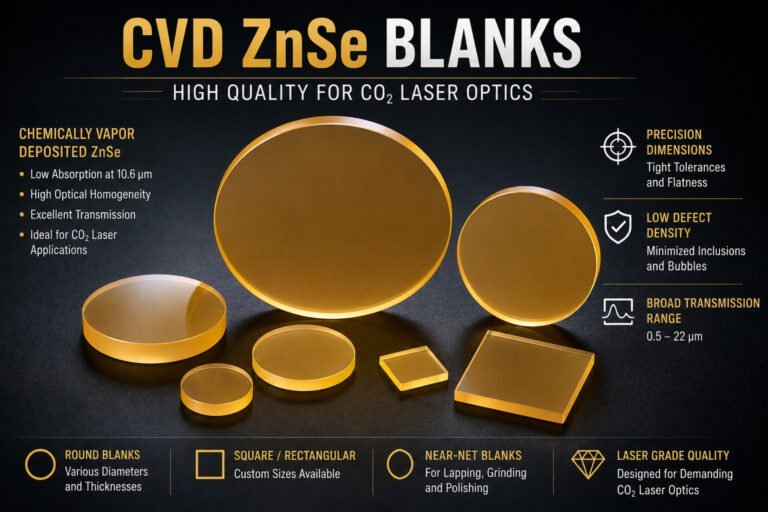
The transition from rough to finish grinding is critical. Switching too early wastes finish-grinding time (and wheel life) on bulk removal. Switching too late means the rough-ground surface quality is worse than necessary, requiring more finish-grinding passes to reach the target Ra. For ZnSe optics processed through the same workflow, polishing requirements differ significantly from germanium due to lower hardness — refer to the ZnSe optics polishing guide for material-specific adjustments.
Quality Metrics After Grinding
These specifications determine whether the ground lens is ready for polishing:
| Metric | Target | Why It Matters |
|---|---|---|
| Surface roughness Ra | 0.1–0.3 μm | Starting point for polishing — lower is better |
| Subsurface damage depth | < 5 μm | Must be removed during polishing |
| Radius of curvature | ±0.1% of design | Optical function depends on precise radius |
| Sagittal height | ±5 μm | Stack-up tolerance for multi-element assemblies |
| Form error (PV) | ≤ 1 μm | Determines final lens figure quality |
| Edge condition | No chips > 0.05 mm | Edge chips propagate during polishing |
If any metric fails after grinding, the corrective action depends on the failure:
- High Ra → add finish-grinding passes (recoverable)
- Deep subsurface damage → may require returning to rough grinding (costly in material)
- Wrong radius → regrind (only possible if sufficient material remains)
- Edge chipping → reject (not recoverable in grinding or polishing)
Matching Grinding Equipment to Your Production Scale
Low Volume (< 50 lenses/day)
A single G-100 class grinder handles both rough and finish grinding with wheel changes between stages. Manual or semi-CNC operation is adequate. Investment: comparable to mid-range optical grinding machines from manufacturers like OptiPro or Satisloh.
Medium Volume (50–200 lenses/day)
Dedicated rough and finish grinding stations eliminate wheel change time and improve throughput. CNC control becomes essential for consistency across shifts. Two G-100 machines — one rough, one finish — can process 100–150 Φ50 mm lenses per 8-hour shift.
High Volume (200+ lenses/day)
Automated loading/unloading, in-process measurement, and adaptive grinding parameters. Consider the G-250 for larger lens diameters (up to Φ250 mm) or multiple G-100 stations in a cell layout with robotic transfer.
Connecting Grinding to the Complete IR Lens Line
Germanium lens grinding equipment doesn’t exist in isolation. Its performance depends on what comes before, and determines what happens after:
Upstream impact: The quality of the cut blank directly affects grinding. A blank with Ra 0.6 μm from diamond wire cutting needs less rough grinding than a blank at Ra 1.5 μm from a poor cut. Less rough grinding = less subsurface damage = faster polishing.
Downstream impact: Grinding determines how much work the polishing stage must do. A well-ground lens at Ra 0.15 μm with < 5 μm subsurface damage polishes to Ra < 5 nm in approximately 3 minutes per face. A poorly ground lens at Ra 0.5 μm with 20 μm subsurface damage takes 2–3x longer and has higher reject rates.
This is why manufacturers who control the complete chain — from cutting through grinding to polishing — consistently achieve better yields than those who outsource individual stages.
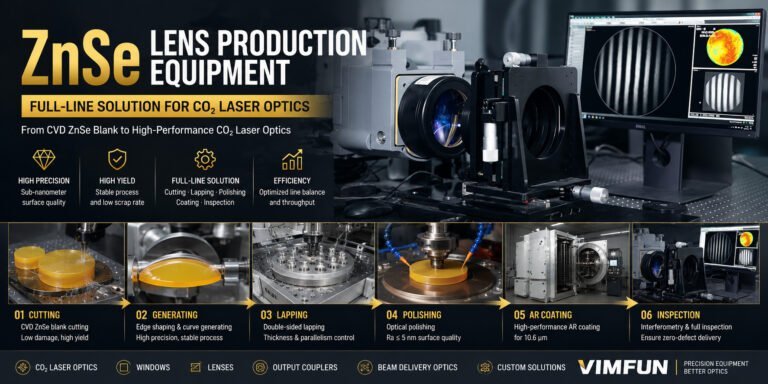
For the complete equipment range designed for germanium and other IR materials, see our infrared optics manufacturing equipment overview.