How can you achieve a flawless surface on an IR lens? I have over 15 years of experience in the infrared optics manufacturing industry. I’ve seen a lot of machines. But one is special – the ZnSe ZnS optics grinding machine.
What this machine is, I shall explain in this article. Let me show you how it regulates surface quality. I’ll compare it with other possibilities. I’ll provide genuine instances. And I will address the questions that come up the most.
What Is a ZnSe ZnS Optics Grinding Machine and Why Does It Matter?
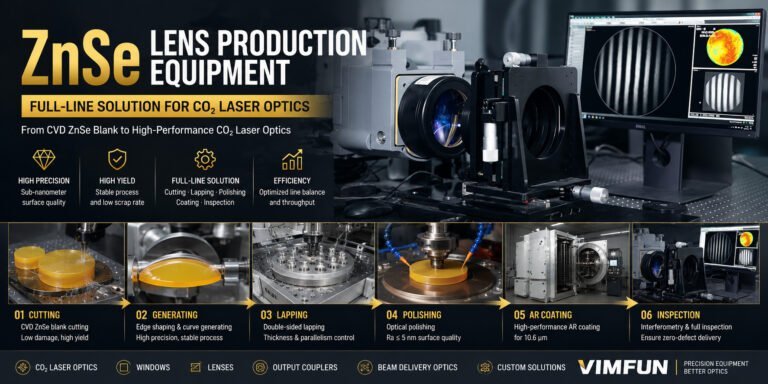
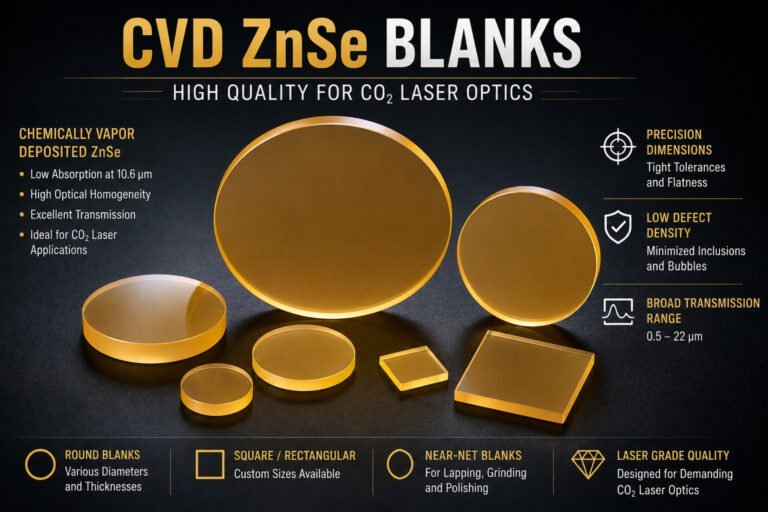
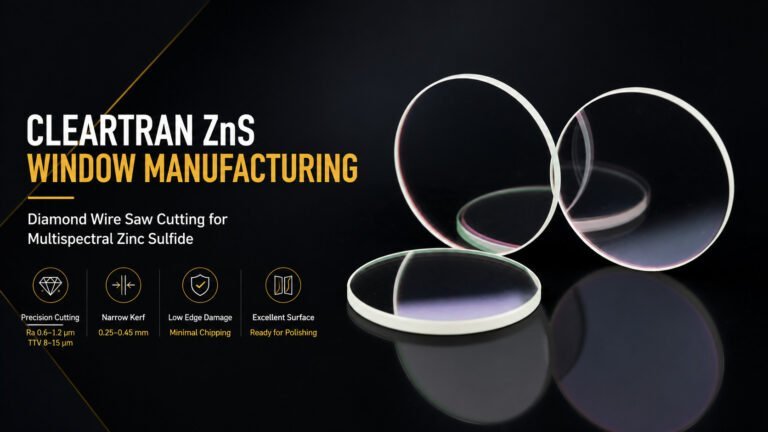
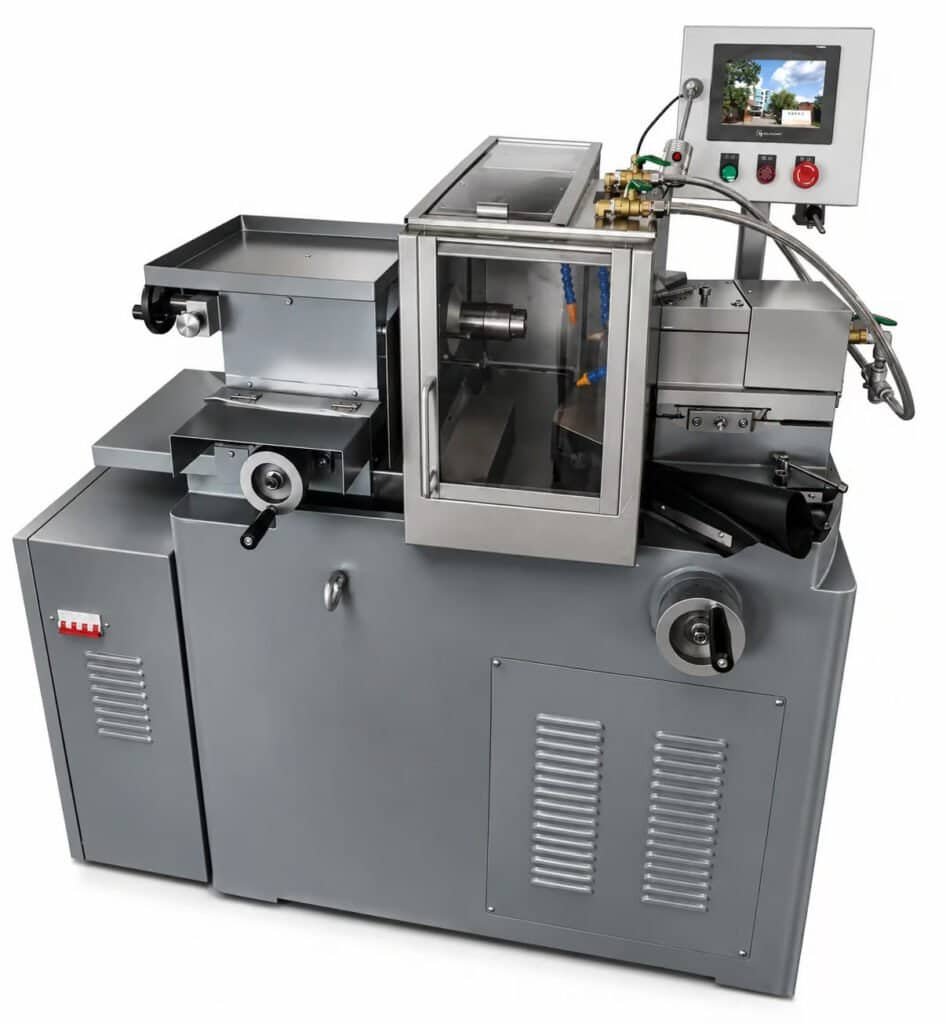
A ZnSe ZnS optics grinding machine is created for one purpose. It forms and polishes lenses of zinc selenide and zinc sulfide. They are delicate and fragile crystals. Used in thermal cameras, laser cutters and defence systems. Regular grinders will mar or break them. This task can only be done well by a machine designed to grind chalcogenide optics.
This is low vibration spindle machine design. It features strong servo control. It operates on fixed programs. The result is a lens that passes the most rigorous IR testing. A defective lens may make a whole camera or laser system go bad. That’s why it’s so important to have the correct precision optics machining setup.
ZnSe and ZnS Material Properties vs. Grinding Requirements
| Property | ZnSe | ZnS | Grinding Need |
| Hardness (Knoop) | 120 KHN | 160 KHN | Fine abrasive wheel |
| Fracture Toughness | Very Low | Low | Low-force feed control |
| IR Transmission | 0.5–22 µm | 0.4–14 µm | Sub-nm surface finish |
| Heat Sensitivity | High | Medium | Coolant temp control |
How Does a High Precision Grinding Machine Control the Optical Surface?
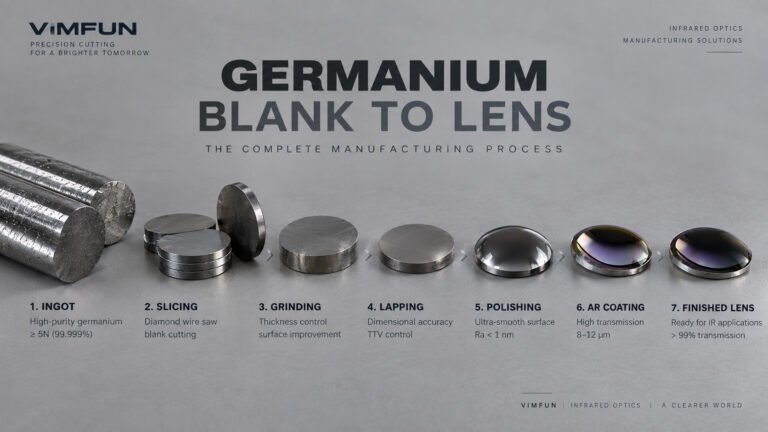
Surface control is the toughest element of manufacturing an IR lens. The high precision grinding machine is a servo grinding system. It concurrently regulates feed rate, wheel pressure and spindle speed. PLC controlled grinding machines allow the operator to save programs.
Each lens type has its own software. The machine does this the same manner every time. Coolant flow cools the lens . It also removes grinding waste. Surface final has a Ra value lower than 1nm. At this level, lenses for laser and thermal imaging are specified.
A. Servo Motor Grinding System
Servo motor grinding system regulates each axis motion. It says real time force. It adjusts pressure instantly. This prevents tiny fractures from developing. It also maintains the level surface over the whole lens region.
B. PLC Controlled Grinding Machine
A PLC controlled grinding machine will have recipes stored for each lens type. The operator selects a recipe from the screen. The machine does the rest. No hand cranks. No hypothesis. The outcome is always the same.
Surface Control Comparison
| Parameter | Manual Grinding | CNC Grinding | ZnSe ZnS Grinder |
| Surface Roughness (Ra) | >10 nm | 2–5 nm | <1 nm |
| Repeatability | Low | Medium | High (±0.5 µm) |
| Crack Risk on ZnSe | Very High | Medium | Very Low |
| Cycle Time | Slow | Moderate | Fast & Consistent |
Key Features That Control Surface Quality
- Low vibration spindle – stops chatter marks on soft crystals
- Real-time force feedback – adjusts pressure on its own
- Multi-stage polishing – built into the same machine
- Coolant temp control – prevents heat cracks in the lens
- Programmable oscillation – gives even grinding across large lenses
How Does ZnSe ZnS Lens Grinding Differ Across Industry Sectors?
Quality of the surface is not the same for each section. Defense lenses need the closest specs. Medical lenses should have smooth corners. Laser lenses need flat, smooth faces that can take tremendous power.
The ZnSe ZnS lens grinding procedure is different for each purpose. The optical surface grinding machine addresses this by altering the wheel, feed rate and coolant. Knowing your industry can help you choose the proper equipment configuration.
Sector Comparison: ZnSe ZnS Grinding Specs
| Sector | Surface Ra Target | Main Challenge | Machine Priority |
| Defense / Military IR | <0.5 nm | Scatter & wavefront | Fine wheel + PLC |
| Medical Thermal Imaging | <1 nm | Edge chipping | Low vibration spindle |
| Industrial CO2 Laser | <2 nm | High-power damage | Flat surface control |
| R&D / Lab Optics | 1–5 nm | Flexible spec range | Programmable recipes |
Advantages of ZnSe ZnS Optics Grinding Machines
- Sub-nanometer finish on brittle IR crystals
- Scrap rate reduction over manual or conventional CNC grinding
- PLC automation ensures similar outcome for each batch
- Works with both flat and curved IR lenses
Disadvantages of ZnSe ZnS Optics Grinding Machines
- Initial investment is more than conventional CNC grinding machines
- Needs qualified persons to mount and dress the wheel
- Will not work for hard crystals like silicon without modifications
What Are Real Examples of Precision Optics Machining With ZnSe and ZnS Grinders?
actual factories. Real outcomes. The actual narrative. Companies in China, Germany and the USA have moved over to IR optics grinding equipment. They all have considerable quality increases. Scrap rates were reduced. Cycle times became shorter.
More lenses passed wavefront testing. These devices can grind lenses up to 200 mm wide for big aperture optics. Surface form error is below 0.5 µm. The correct optical grinding equipment pays off quick.
ZnSe ZnS Grinders in Real Production
| Case | Sector | Machine Type | Result | Key Gain |
| 1 | Defense IR Camera | PLC ZnSe Grinder | Ra below 0.6 nm | Scrap rate down 40% |
| 2 | CO2 Laser OEM | Spherical Optics Grinder | Flat lenses at 0.8 nm Ra | Yield up 30% |
| 3 | Medical Thermal Imaging | Low-Vibration IR Grinder | Zero edge chips on 150 mm lens | Full batch passed tests |
| 4 | R&D Lab | Servo Motor Grinder | 12 lens recipes stored | 3x faster prototyping |
Sectors That Use These Machines
- Night vision and thermal imaging (defence and commercial)
- Industrial CO2 & Fiber Laser Machines
- Medical infrared instruments
- Space and aerospace sensors
- University research & photonics labs
What Features Should You Look for in an IR Optics Grinding Machine?
Buying the incorrect computer is an expensive error. For ZnSe and ZnS lenses, the spindle should be a low vibration spindle machine type. Any vibration will be recorded on the lens surface. Controls should be a PLC controlled grinding machine system.
It enables you to remember and save applications rapidly. See the biggest lens the machine can take. You need a larger work table for large aperture optics grinding and lenses. Before buying, always verify the coolant and wheel alternatives.
Feature Checklist for ZnSe ZnS Grinding Equipment
- Precision spindle or low-vibration air bearing
- Multi-axis servo motor with real time feedback
- PLC recipe storing for rapid lens replacement
- Diameter and radius measurement in-process
- Suitable for diamond,CBN and resin bond wheels
- Integrated coolant filter and temperature control
FAQs About ZnSe ZnS Optics Grinding Machines
What makes a ZnSe ZnS optics grinding machine different from a normal CNC grinder?
The standard CNC grinder is used for hard metals or ceramics. ZnS and ZnSe are brittle and soft. 2. They break with too much strain. A low-vibration spindle is used in a specialized ZnSe ZnS optics grinding machine. It eats slowly. It employs diamond wheels for soft IR crystals.
Force feedback servo prevents formation of micro-cracks
Diamond wheels designed for the hardness of ZnSe and ZnS
PLC programming makes every cycle the same
What surface finish can I get from a high precision grinding machine for IR lenses?
A high precision grinding machine for IR lenses may get a Ra value below 1 nm. Some versions may attain up to 0.3-0.5 nm Ra after polishing. In order to reach the point where it can do that, the machine goes through a multi-step cycle. Each step takes the surface closer to its goal.
Rough grind: eliminates bulk material quickly
Fine grind: surface within 5 nm Ra
Polish stage: final sub-nm finish
Is a PLC controlled grinding machine easy to use?
Sure. A PLC controlled grinding machine has recipes for each kind of lens. Operators just choose the appropriate recipe and hit start. The machine controls the speed, feed and dwell time automatically. Training is brief. Mistakes are uncommon.
Touch screen recipe selection – no manual knobs
Stores recipes for many lens types
Auto-stops if settings go out of range
Can a spherical optics grinder handle large lenses?
Yes. A sphere grinder for ZnSe and ZnS optics is capable of processing lenses up to 200 mm diameter.
For big aperture optics grinding, verify the specifications for maximum workpiece size before you purchase.
Some variants can use lenses with up to 200 mm diameter
Surface form error less than 0.5 µm for large lenses
Works with both flat and curved IR lens shapes
What grinding wheel should I use for chalcogenide optics grinding?
Use resin bonded diamond wheels. They cut softly. They reduce the possibility of surface fractures. Choose grit size, depending on stage. Coarser for tough work. More for the end. Dressing frequently to maintain the wheel sharp.
For soft IR crystals, resin bond diamond wheels are preferred
Grit size: 200-400 for rough, 800-1200 for fine
Regular dressing maintains the wheel shape true
Why should I choose Vimfun for optical grinding equipment?
Vimfun makes optical grinding equipment for IR and chalcogenide lenses. They have machines that grind using servo motors, are PLC controlled and have low vibration spindles. They offer complete support, parts and custom installations. Go to vimfun.com for specifications and price.
Machines designed for ZnSe, ZnS and other IR crystals
Complete after sales service and remote support
Custom choices for lens size, surface spec and volume
Conclusion
The ZnSe ZnS optics grinding machine is ideal for the IR lens works. It provides you a clean smooth surface every time. It is controlled via plc and servo motor system. Will not break or damage delicate IR crystals. It reduces waste and saves time. Vimfun: For when you need the appropriate tool for the right task.
They manufacture high grade optical grinding equipment for ZnSe and ZnS lenses. They provide comprehensive assistance and training. Factories all across the globe trust Vimfun. Visit them now to acquire the best equipment for your task.