A diamond cutting wire loop operates under tension, so the loop specification, machine tensioning system, connection, and operating procedure must be compatible. A breaking-load value, where supplied, is not the same as an approved working tension. This guide explains the factors buyers and operators should verify—core construction, loop dimensions, splice quality, machine limits, wear, and inspection—without assigning a universal safe load.
Use the wire manufacturer’s rated limits and the machine manual for the specific setup. Do not infer allowable tension from wire diameter alone or transfer values from a different machine, loop construction, or material. Stop and inspect a loop that shows damage, a suspect splice, or abnormal running behavior.
What Is a Diamond Cutting Wire Loop?
A diamond cutting wire loop is a loop of diamond coated wire. It is used in wire saw machines; It has a core of steel inside that carries the load. On the outside there are diamond beads/segments. We put the two ends together to make one loop. As it cuts, this loop is run under tension around guide pulleys.
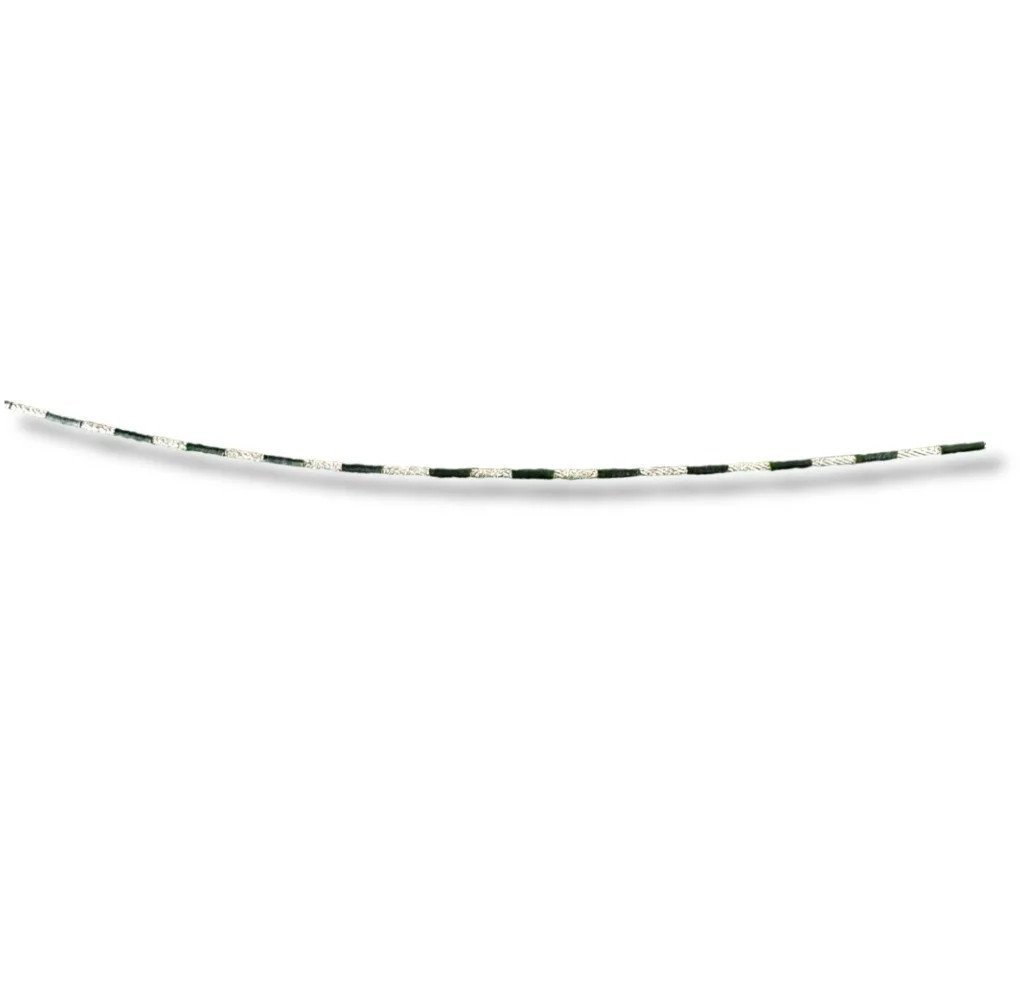
The diamond coating does the cutting. The core inside takes the strain. Many buyers believe the coating adds strength. It does not. There are many basic loop types and sizes. Whichever one is dependent on the material being cut.
- Diamond Loop vs. Diamond Coated Wire
The result is a diamond-shaped loop. It is joined, ready for use on a machine. Diamond coated wire is often just the bare wire. It hasn’t been cut and joined into a loop yet. This is important when you look at prices. A spool of raw wire and a finished loop are not the same product .
How Do Diamond Cutting Wire Loops Handle High Tension Loads?
The tension is mostly taken by the core of the diamond-cutting wire loop, not the coating. The core is often a multistrand steel wire rope. It operates against the tension system of the
machine. The coating helps with cutting , but does not take the load .
The makers set a maximum safe tension for each loop. Depending on the core build and wire gage. Now the rating is how much tension the loop can take before the risk goes up.
- Core Construction: Where the Strength Comes From
The core is meant to sustain a load. It is not meant for cutting. It is often a multi-strand wire rope. The number of strands and the steel grade determine the amount of tension it can hold. High carbon steel is a preferred core material. It is strong and takes well to being bent around guide pulleys.
- Tensile Rating: What the Number Really Means
The tensile rating is the load at which the core would probably fail during testing. It’s not a healthy working number. Real tension should be much below this top number. The loop is weakened by heat, wear and time. One costly mistake is to treat the top rating as a goal rather than a limit.
- Wire Diameter and Core Type: How Load Capacity Scales
The bigger the wire, the bigger the tension capacity, the better the core, the better the tension capacity. A thick wire in a strong core has more tension than a thin wire in a weak core. The real job helps to match the loop spec . Don’t just go for a loop based on price.
Machine speed and tension are system-specific settings. Use the machine manual and the loop manufacturer’s specification; do not transfer a speed or tension value from a different saw or process.
Steel Core Construction Types & Strength Characteristics
The core build is the largest factor in how much tension a loop can hold.
Comparing Core Types
| Core Type | Strand Pattern | Relative Tension Capacity | Best Suited For |
| Single-strand core | Solid or simple twist | Lower | Light jobs, low bend needs |
| Multi-strand wire rope | 6-strand build | Fair to high | General stone and concrete cutting |
| Multi-strand wire rope | 7-strand or more, fine wire | High | Heavy jobs, thick cuts |
| High-carbon steel core | Varies by maker | High, strong under fatigue | Fast, repeat-cycle CNC use |
The core can be built very easily. But it is less tense, and not as good a bend. Multiple strands in the core distribute the load among a number of wires. When subjected to bending, this will give greater strength and better fatigue life. Strand count and lay pattern (how the strands twist) affect both raw strength and bend behavior.
What Happens When a Wire Loop Is Overloaded
The first signs of overload are usually warnings. Look for areas where it is frayed or unevenly worn, or roughly cut. These are early signs that you are holding too much tension in your core.
Sudden failure is another matter. When a wire under high tension breaks, it snaps quickly. This is a real danger to anyone being near the cut. That is the basic reason for the existence of tension ratings.
There is also a slow road to failure. Running at near top rating repeatedly wears down the core. If you push a loop to its limit it will often wear out faster than one run with a safe margin.
Splice Points: Often the Real Weak Point
In the splice the two ends are joined to make a loop. This is generally the weakest link in the loop no matter what the rating of the core wire. Tests on diamond wire ropes and their joints repeatedly prove this. The splice joints are prone to failure at lower loads than the wire around them.
Splice quality counts. Real safe tension is a matter of the method of joining and the care used. This is the case even if the core has a high rating on paper. The most common joints are crimped joints and welded joints. These two types don’t always stand the test of time the same.
Matching Diamond Cutting Wire Loop Sizes to Application Tension Demands
Loop sizing should correspond to the tension a job requires. Don’t just pick the biggest wire on the shelf.
- Bigger loops tend to have more tension. But they are slower and less flexible on tight curves.
- Let the size be determined by the material, the cutting speed and the machine set up. Avoid routine picking.
- Maker guides often specify the right wire size and core type for each job.
- Wire dimensions vary by product family and application. Confirm the specified diameter, core, splice, and allowable operating limits for the actual loop instead of applying a range from unrelated stone-sawing equipment.
You pay too big to be safe. It can slow down the cut and waste money. A smaller loop with good safety rating is safe by design within its limit.
Diamond Wire Saw Machines and Tension Compatibility
The tension system of a diamond wire saw cutting machine should be controlled within the rated range of the loop. It should not just use all the force the machine can bring to bear. The match goes both ways.
- A CNC diamond wire saw with auto tension will still require setting within the rated limit of the loop. It shouldn’t just be running at the top end of the machine.
- Without tension, the cuts are rough and wandering, and the finish is poor.
- Even with a strong core, too much tension wears out your body and increases your risk of failure.
- Check your tension setting against the loop’s spec sheet every time you change diamond loops. Don’t just copy the previous setting.
What Affects Diamond Cutting Wire Loop Price
Loop pricing is based on several factors, not just one specification. That’s why you see large variations in quotes from different vendors.
- Number of strands, quality of cores. A strong, multi-strand core is more expensive than a plain single-strand core.
- Diamond bead density and quality of coating More diamonds and tighter spacing costs more.
- Loop size and total length required for your machine and job.
- Splicing method. A better joint is more expensive to make, but lowers the risk of an early break.
Frequently Asked Questions
- What makes a diamond cutting wire loop tensile strength?
The heart is the strength. It is typically a multi-strand steel-wire rope. The diamond coating does the cutting, but it doesn’t bear the load.
- How do I know the safe tension for a wire loop?
The top tension rating is determined by the maker from the core and wire size. Real tension should be well under this number to allow for wear and normal use.
- Is the splice weaker than the wire?
Yes, often. The point of attachment of the loop can be the weakest link. Even if the core has a high rating this is true. Splice quality is very important.
- What are the symptoms of overloading a wire loop?
Typical warning signs include fraying, irregular wear and jagged cuts. These signs often herald a sudden break.
- Does a larger wire loop always result in greater tension capacity?
Sometimes yes, but a bigger loop can also cut slower and bend less well. Pick a size appropriate for the actual job, not the largest one available.
- How big are these loops?
The diamond wire loops are typically 5 to 12 millimeters wide. Stone jobs generally use loops in the mid- to upper-end of this range for added tensile strength.
Conclusion
Safe tension handling boils down to three things. First, a solid core.” Secondly, a tensile rating that has a real safety gap at the tension you are using. Third, a good splice, which can be as important as the core. One number doesn’t tell the whole story. Not a one spec sheet, but check out all three together.
If you are comparing diamond cutting wire loop specs to machine needs, VimFun is worth a look. Their closed-loop diamond wire systems feature auto constant-tension control. That solves the above core-to-machine match problem, instead of relying on guesswork for tension control.