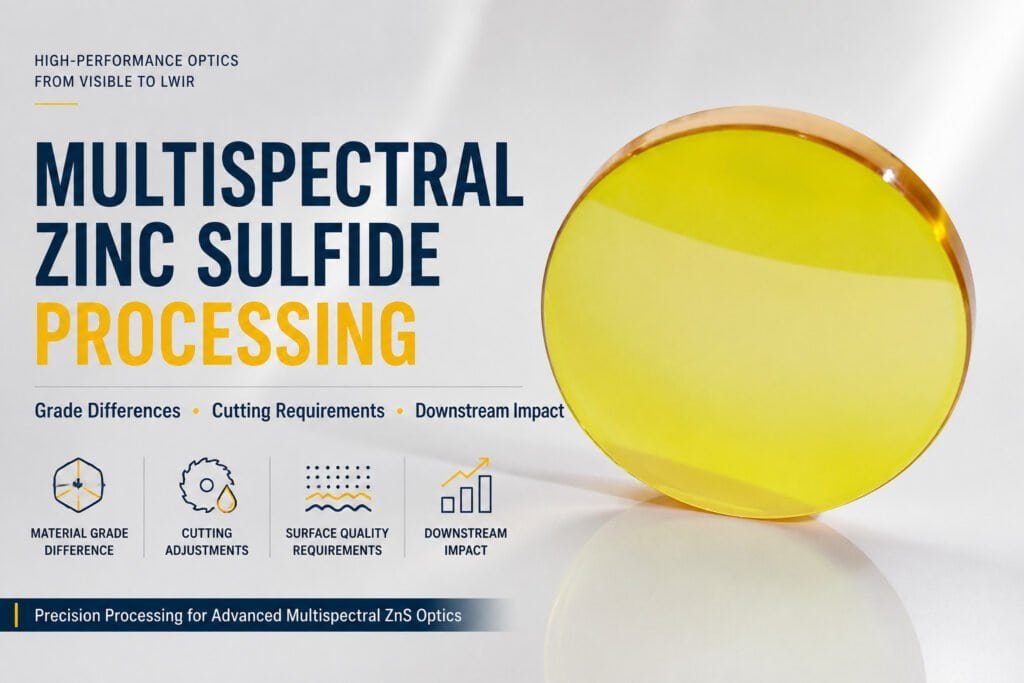
Multispectral zinc sulfide processing behaves differently from standard ZnS processing in three specific ways: the grain structure that emerges after hot isostatic pressing tolerates less cutting force, the surface quality requirements are tighter because subsurface damage becomes visible during the longer polishing cycle, and the material cost per usable substrate is substantially higher, which changes the economics of every scrap and rework decision made upstream. If you apply standard CVD ZnS process parameters to multispectral-grade material, you will produce blanks that pass first inspection but fail during the final polishing stage — after most of the value-add labor has already been spent.
This page covers what changes when the material grade changes, and why the cutting stage in particular carries more downstream risk than most operations recognize. For the equipment-side decision of which cutting machine to use on ZnS material generally, see the ZnS optics cutting machine overview — this page assumes that decision is made and focuses on the material-specific processing envelope for multispectral grade.
What Makes Multispectral Zinc Sulfide Processing Different from Standard ZnS
Standard CVD zinc sulfide is grown by chemical vapor deposition and used as-deposited. Its transmission window spans roughly 8–12 μm — the LWIR band useful for thermal imaging — and its polycrystalline grain structure is coarser, with grain sizes in the tens of microns and moderate optical scatter within the visible band.
Multispectral CVD ZnS starts from the same deposition process, then undergoes hot isostatic pressing (HIP) at temperatures typically in the 900–1000 °C range under 100–200 MPa argon pressure. This post-treatment recrystallizes the grain structure to sub-micron uniformity, reduces internal void density, and extends the transmission window down to roughly 0.4 μm. The material now passes visible light with acceptable haze and remains transparent through LWIR — hence “multispectral,” covering visible through long-wave infrared in a single substrate.
Multispectral zinc sulfide processing costs more than standard ZnS processing at every step because of three linked changes:
- Grain refinement reduces local fracture toughness at the surface layer. The fine grain structure that gives multispectral ZnS its optical uniformity also removes the grain-boundary crack arrest mechanisms present in coarser-grained material. Surface damage propagates more easily during cutting.
- Subsurface damage becomes visible during polishing. Standard ZnS polishing removes enough material to reach LWIR-band optical quality and stops. Multispectral polishing continues to lower Ra targets and thinner substrates, exposing subsurface damage layers that would have been polished off the standard-grade blank.
- Raw material cost is significantly higher. Multispectral CVD ZnS commands a substantial cost premium over standard CVD ZnS on a per-mass basis, which changes the acceptable scrap rate at every processing stage.
The result: the same cutting process that produces acceptable standard ZnS blanks will produce multispectral blanks with hidden subsurface defects that only surface at the polishing stage, when the substrate has already absorbed most of its production cost.
Material Properties That Drive Cutting Parameter Changes
The properties that shift when moving from standard to multispectral ZnS are not the ones most process sheets track. Bulk hardness (Knoop ~160–230 KHN) is essentially unchanged. Bulk fracture toughness (~0.8–1.0 MPa·m⁰·⁵) shifts only slightly. What changes materially is the surface-layer behavior under localized force:
| Property | Standard CVD ZnS | Multispectral CVD ZnS |
|---|---|---|
| Grain size (typical) | 5–50 μm | Sub-micron to ~2 μm |
| Transmission range | 8–12 μm | 0.4–12 μm |
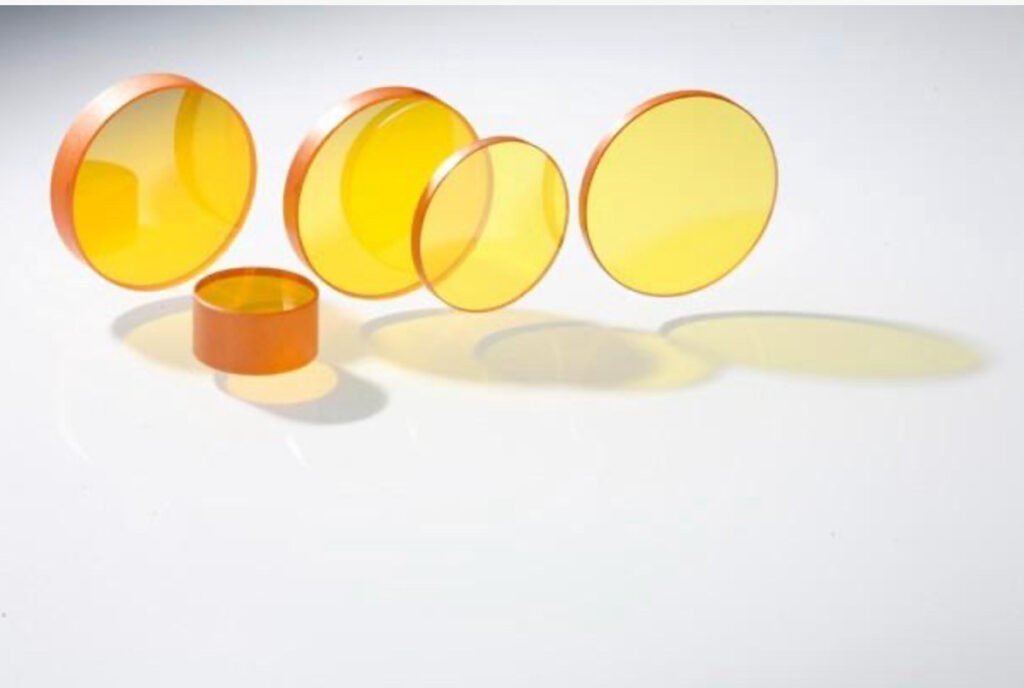
| Visible scatter | High (translucent yellow-orange) | Low (near water-white) |
| Surface fracture behavior | Grain-boundary chipping | Sub-grain microfracture, less visible |
| Typical raw material premium | Baseline | Substantial premium over baseline |
| Polishing removal target | Standard (LWIR-only) | Meaningfully higher (finer Ra, thinner final) |
The last two rows are the ones that matter for cost accounting. Multispectral zinc sulfide processing requires more removal at the polishing stage, meaning any subsurface damage from cutting has more time and more abrasion to become visible — either as a haze layer that fails visible-band inspection, or as micro-pits that fail the coating adhesion test after AR coating is applied.
For a reference on how similar polishing removal considerations apply to zinc selenide — a related but softer IR material — see the zinc selenide optics polishing process guide.
Cutting Force and Feed Rate Adjustments for Multispectral Grade
The parameter change from standard ZnS to multispectral zinc sulfide processing is not a proportional scale-down. Some parameters shift significantly, others barely at all.
Wire tension should be reduced modestly for multispectral cutting relative to the tension used for the same blank geometry in standard ZnS. The rationale is not to reduce cutting force at the material bulk level, but to reduce the peak force spike at cut entry and exit, where multispectral’s fine grain structure is most vulnerable to subsurface microfracture. In practice, this means running the wire saw closer to its low-tension operating range for the blank thickness.
Feed rate requires a larger adjustment — meaningfully slower than standard ZnS feed rates for the same blank thickness. Slower feed keeps the cut zone temperature down and reduces the density of contact events per unit substrate area. Both factors reduce the subsurface damage layer depth that the polishing stage must remove.
Coolant flow matters more, not less. Multispectral ZnS is more susceptible to swarf redeposition contamination because its fine surface texture retains particulates that a coarser-grained standard ZnS surface would shed. Water-based coolant flow rates typically need to be materially higher than standard ZnS practice, and coolant filtration intervals need to be shorter — measured in shift-hours rather than days of continuous cutting.
What does not change: the choice between diamond wire saw and ID saw remains the same as for standard ZnS — the ZnS optics cutting machine equipment analysis applies to both grades. Multispectral zinc sulfide processing rarely justifies switching machine types; it justifies re-tuning within the machine you have.
There is one situation where this guidance breaks down. If your cutting process was previously run at aggressive parameters to maximize throughput on standard ZnS, the parameter reductions above may not be sufficient — you may need to slow the process substantially overall, which changes production planning significantly. Operations that already run standard ZnS at conservative parameters have less adjustment to make.
Surface Quality Requirements for Multispectral Zinc Sulfide Processing
Surface targets after cutting are tighter for multispectral zinc sulfide processing than for standard grade, but the tightening is not uniform across metrics.
Ra (surface roughness) targets after cutting are tighter for multispectral than the Ra 0.6–1.2 μm window typical for standard ZnS as-cut surfaces. The narrower window matters because the polishing stage must remove any surface roughness above the final Ra target — and multispectral final Ra requirements for visible-band applications are meaningfully finer than the requirements for LWIR-only standard ZnS.
TTV (total thickness variation) for a Φ50 mm blank is more tightly constrained for multispectral than the 8–15 μm acceptable range for standard grade. TTV that is out of spec is not a cutting-only cost — it drives an entire additional lapping cycle to correct, and that lapping cycle carries subsurface damage risk of its own on multispectral material.
Subsurface damage layer depth is the metric most operations do not measure but should. The polishing stage must remove at least the depth of subsurface damage introduced during cutting before the “true” material surface is exposed. If cutting introduces more subsurface damage than the polishing removal budget was designed for, cycle time expands significantly and yield drops accordingly.
Edge chip zone requirements are stricter for multispectral because the visible-band transmission requirement means edge defects create measurable stray light. The acceptable chip zone from the substrate edge is meaningfully smaller for multispectral than for LWIR-only standard ZnS.
Not every application needs multispectral-grade surface quality. If your end use is LWIR imaging only and the substrate will be edge-mounted where the outer 2 mm is hidden behind a bezel, the visible-band edge requirements simply do not apply. Multispectral zinc sulfide processing at these tighter targets is worth the cost only when the application actually uses the visible band.
Coolant, Fixturing, and Handling Specifics
Beyond force and feed parameters, three handling factors matter more for multispectral zinc sulfide processing than for standard-grade work.
Coolant chemistry should be neutral pH water-based. Multispectral ZnS is more sensitive to acidic or alkaline coolant residues that etch preferentially at the fine grain boundaries and produce surface haze that is difficult to remove through mechanical polishing alone. Standard ZnS tolerates a wider coolant chemistry window; multispectral does not.
Fixture materials matter for the same reason equipment choice matters. Any fixture contact surface that can leave metallic transfer marks — carbon steel clamps, uncoated aluminum jigs — creates contamination that appears as visible-band inspection failures at the polishing stage. Multispectral fixturing should use PTFE-lined or stainless steel contact surfaces exclusively.
Between-operation handling requires more discipline than standard ZnS. Blanks should not sit on bench surfaces uncovered — airborne particulates settle onto the freshly cut surface and embed at the polishing stage. Standard practice is to move multispectral blanks directly into covered transfer trays after cutting, and to keep transfer time to lapping under 4 hours whenever possible. The failure mode from long uncovered storage is difficult to detect until polishing exposes the contamination layer.
The ZnSe window double-sided lapping process guide covers similar handling discipline for zinc selenide substrates, where the material sensitivity considerations overlap with multispectral ZnS.
Downstream Impact: Why Cutting Quality Determines Polishing Cost
The economic case for tight multispectral zinc sulfide processing at the cutting stage is not primarily about scrap rate at the cutting stage itself. Scrap at cutting is expensive but recoverable — the material lost is one blank. Scrap at final polishing, after all shaping and pre-polish work is complete, costs the material plus roughly 60–80% of the finished-part labor.
The subsurface damage introduced during cutting is not visible immediately. It becomes visible during the extended polishing cycle that multispectral requires — a substantially longer pitch-lap polishing sequence per surface compared to LWIR-only standard ZnS. If cutting introduces more subsurface damage than the polishing removal budget was sized to handle, the damage layer surfaces mid-way through polishing, after the operator has already invested significant finishing labor.
The cost multiplier for a defect discovered at final polish versus at cutting is substantially larger for multispectral than for standard ZnS. This asymmetry is what justifies the parameter conservatism and handling discipline described above.
When to Choose Multispectral ZnS vs Standard ZnS
Not every infrared optics application benefits from multispectral zinc sulfide processing. Standard CVD ZnS remains the correct choice for many applications, and specifying multispectral where it is not required adds cost without functional benefit.
Multispectral is required when:
- The optic must transmit visible light for alignment, boresighting, or dual-band imaging
- The application involves visible-band inspection or targeting through the same substrate
- The optic sits in a system where mixed visible/IR performance justifies the material premium
Standard ZnS is appropriate when:
- The application is LWIR imaging only (8–12 μm band)
- The optic is used in thermal weapon sights, uncooled thermal cameras, or infrared spectroscopy in the LWIR band
- Cost sensitivity outweighs the marginal visible-band capability
The overlap case — applications that could function on standard ZnS but sometimes benefit from multispectral — usually resolves toward standard ZnS on cost grounds unless the system engineer specifically requires visible transmission. Overspecifying multispectral in these applications is a common cost error that the material supplier will not push back on.
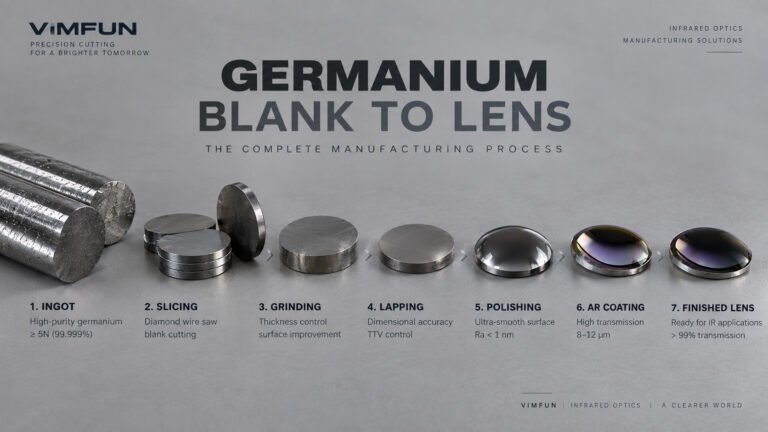
For a broader view of how ZnS fits within infrared optics manufacturing alongside germanium and ZnSe, the germanium IR optics manufacturing reference covers material selection across the IR optical materials family.
Related Reading
- ZnS Optics Cutting Machine: Wire Saw vs ID Saw — equipment choice for ZnS material generally
- ZnSe Lens Cutting Machine — related process for zinc selenide
- ZnSe Window Double-Sided Lapping — downstream lapping process reference
- Germanium IR Optics Manufacturing — comparative IR material selection
- Automotive Thermal Imaging Lens Equipment — LWIR application where standard ZnS applies