
Cylindrical Lens Grinding Machine CG-140
A cylindrical lens grinding machine that generates convex, concave and flat cylinder surfaces on glass optical parts. The wheel swings 0–45° to set the cylinder, while servo X and Y axes feed the part under CNC control.
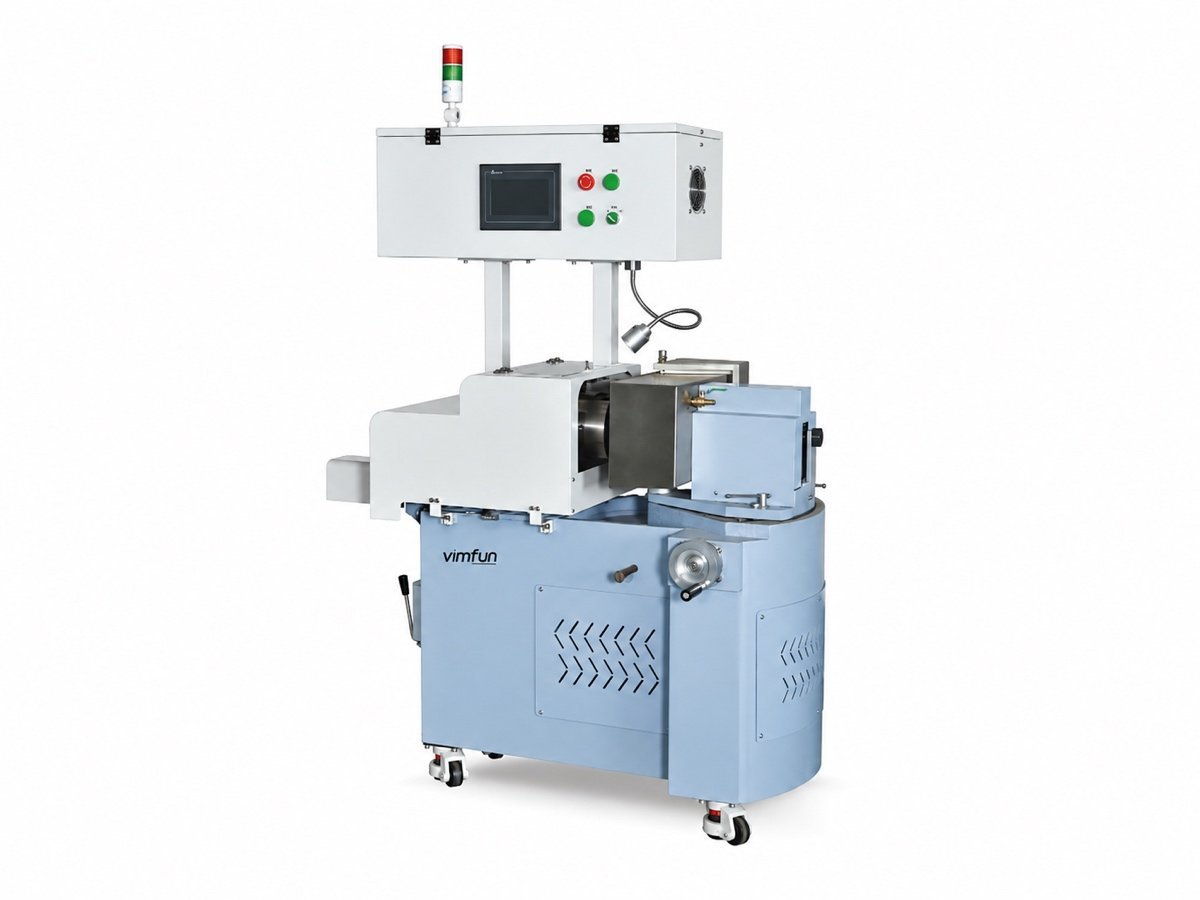
What this machine makes, and what happens before and after it
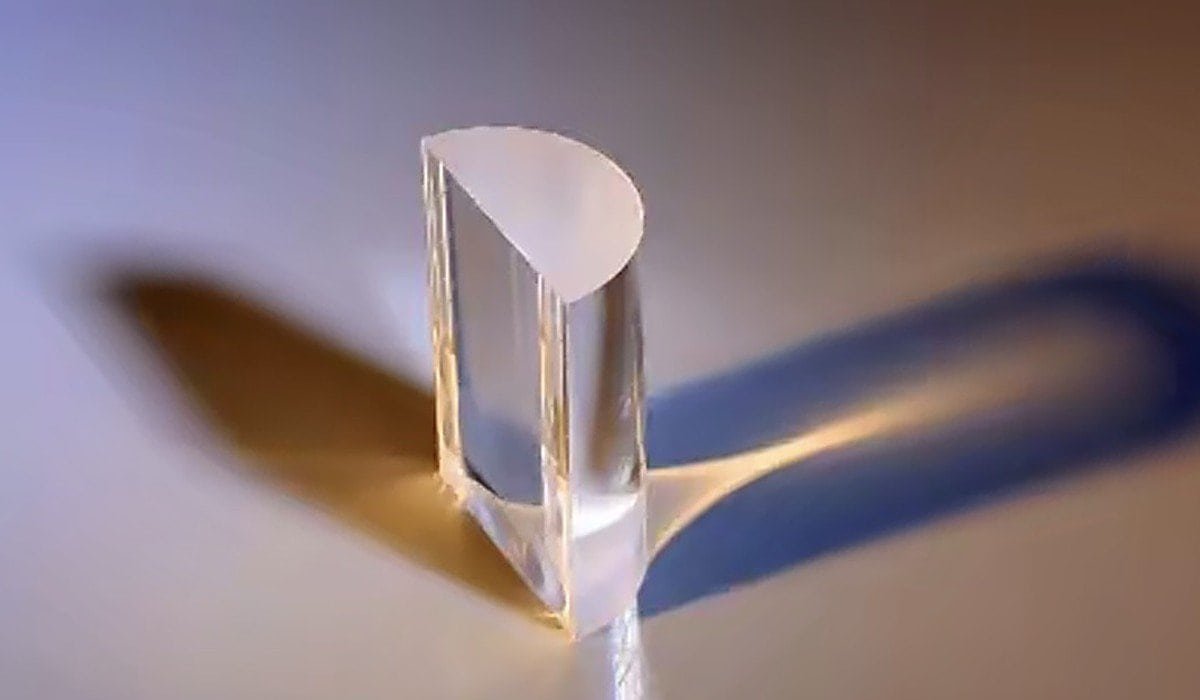
Not every optical surface is a sphere. A cylinder is curved in one direction and flat in the other — the shape of a cylindrical lens that stretches a beam into a line, or corrects astigmatism in one axis. A cylindrical lens grinding machine owns the generating step for those parts: it cuts the cylinder into a glass blank and brings the size close to the drawing, ready for fine grinding and polishing.
The part is fixed on the table, the servo axes feed it through the swung wheel, and the cylinder is cut. What leaves is not finished — its surface is close enough that the lapping and polishing stage removes microns rather than re-cutting the form.
For spherical surfaces the spherical generators are the right machines. The CG-140 is the member of the family built for the single-axis curvature of cylindrical optics — both convex and concave, plus flats at zero swing.
How does a cylindrical lens grinding machine cut a cylinder?
No template, no copy former, no profile cam. The cylinder comes out of a swung wheel and two servo axes.
The grinding wheel runs on a horizontal spindle at 8,000 or 10,000 rpm and is swung to an angle on its base. As the servo X and Y axes carry the fixed part past the wheel, the swung edge sweeps a curve in one direction and leaves the perpendicular direction flat — that is a cylinder.
The swing angle is what sets the cylinder:
- Swing 0–45° — the angle between wheel and part sets the radius of the cylinder; steeper swing, shorter radius
- θ = 0° — the wheel runs parallel to the part and the machine generates a flat
- Convex or concave — both cylindrical forms are cut, decided by how the part meets the wheel
- Servo X / Y, 140 mm each — precision linear rails feed the part smoothly and repeatably
A cylindrical lens grinding machine carries micro-adjustments on the workpiece in two directions, so the cut stays free of eccentricity and taper across the length of the part.
You are buying a range of cylinder radii set by swing and wheel, not a fixed set. Send us the cylinder radius, the length and the material, and we specify the wheel with the quotation.
Four things the CNC does that a manual machine cannot
Loading and unloading are by hand on this cylindrical lens grinding machine; the grinding cycle itself is automatic once the part is fixed. This is where the CNC earns its place.
Servo X and Y feed the cut
Both axes run on precision linear rails under servo control, so the feed into and along the part is smooth and repeats part to part — the surface quality follows from steady motion.
Micro-adjusts out eccentricity and taper
The workpiece carries fine adjustments up-and-down and fore-and-aft, so a cylinder comes out true along its length rather than running eccentric or tapered.
Holds the recipe per material
Grinding parameters are chosen for the part material and the stock left on it, then run from the panel — the same recipe repeats instead of being dialled in by feel each time.
Runs from a 7-inch touchscreen
Every parameter and button is set and checked on the screen, and faults are read there too, so setup and troubleshooting stay on one panel rather than scattered across the machine.
Which materials and geometries can it handle?
| Item | Capability |
|---|---|
| Surfaces generated | Convex and concave cylinders; plane (flat) surfaces at zero swing |
| Radius range | Set by wheel swing 0°–45° and wheel diameter |
| X / Y travel | 140 mm / 140 mm, precision linear rails |
| Loading | Manual load and unload; grinding cycle automatic |
| Materials | Glass optical parts — cylindrical lenses; send your material for a free trial run |
| Trueness control | Two-direction micro-adjust against eccentricity and taper |
| Control | CNC, 7″ touchscreen |
If your drawings are dimensioned to the ISO 10110 framework, send one with the enquiry. On a cylindrical lens grinding machine the cylinder radius tolerance and the length are what decide whether the job fits — see the optical materials data if you are choosing glass.
Technical specifications
The CG-140 is the cylindrical lens grinding machine in the generating family; the spherical generators cut spheres and flats, not cylinders.
| Surfaces | Convex & concave cylinders, flats |
| Wheel spindle speed | 8,000 / 10,000 rpm |
| Wheel swing angle | 0° – 45° |
| X-axis travel | 140 mm |
| Y-axis travel | 140 mm |
| Axis guides | Precision linear rails, servo driven |
| Trueness adjust | Workpiece micro-adjust, two directions |
| Control | CNC, 7″ touchscreen |
| Total installed power | 1.5 kW |
| Overall dimensions (L × W × H) | 1400 × 900 × 1600 mm |
| Total weight | approx. 700 kg |
| Base construction | Cast iron, hand-scraped mating surfaces |
The grinding wheels and dressing stones are process consumables chosen for the material and the cylinder radius. They are quoted separately — tell us your radii and materials and we will specify them.
Main assemblies and what each one is for
This is the vocabulary your operator and our service engineer will share on the shop floor.
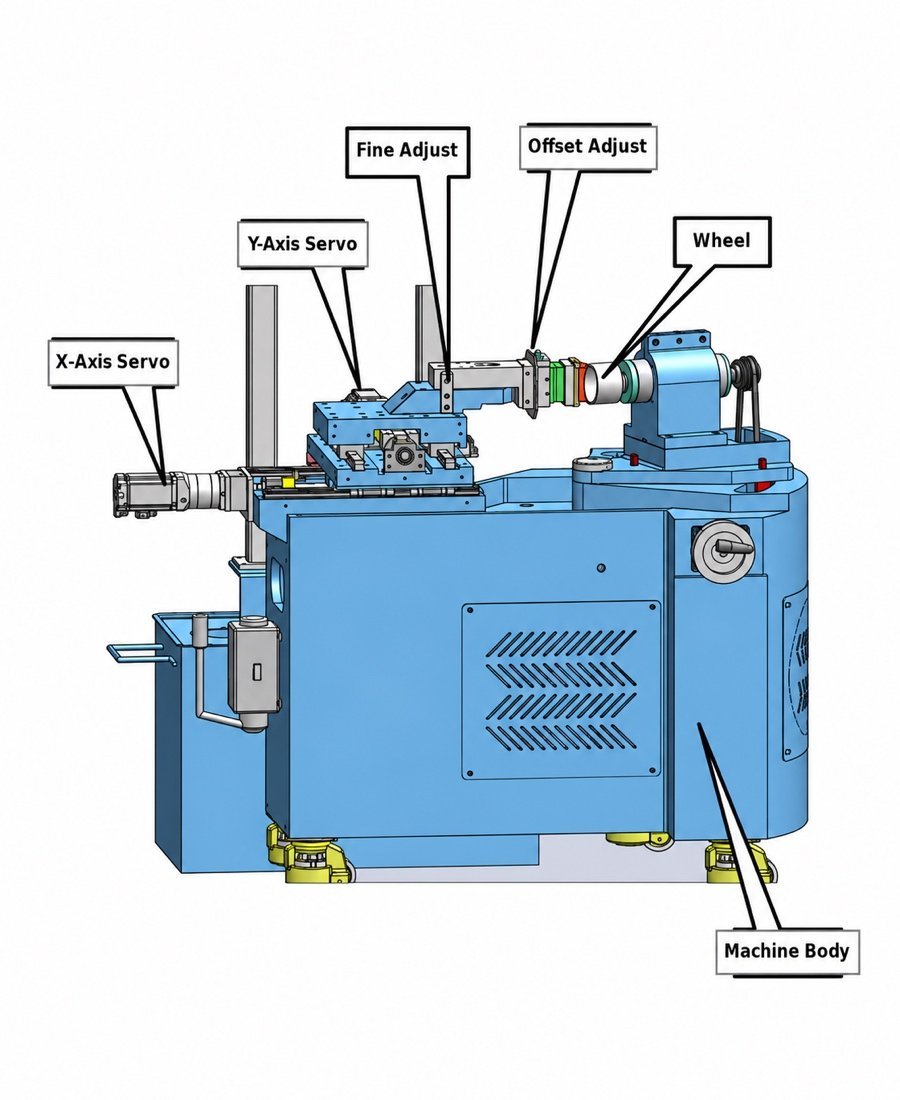
| Assembly | Function |
|---|---|
| X-axis servo | Precision linear rail, servo driven; feeds the part in one direction |
| Y-axis servo | Precision linear rail, servo driven; feeds the part in the other direction |
| Grinding wheel & base | Horizontal wheel spindle on a swing base; swing angle sets the cylinder |
| Trueness micro-adjust | Up-and-down and fore-and-aft adjustment of the workpiece against eccentricity |
| Edge micro-adjust | Fine adjustment to keep the cut square to the part edge |
| Coolant system | Circulating supply, stainless coolant tray in the base |
| Operation panel | 7″ touchscreen for parameters, buttons, inspection and troubleshooting |
Utilities, environment and safety
Electrical supply, compressed air, coolant, floor loading and the ambient conditions the machine is to run in are confirmed with us for each order, together with the safety and protective arrangement supplied with it. These figures depend on the voltage and frequency of your site, the material you are running and the destination market, so we do not publish a single set of them here.
Send us the site conditions with your enquiry and we will return the utility and environmental requirements in writing, before the order is placed.
The CG-140 grinds cylinders, not spheres, and loading is by hand — it suits a shop making cylindrical optics rather than one wanting fully automatic feed. A new material needs its parameters settled on trial parts, which is why we ask for your blanks before quoting.
What happens after the machine is installed?
The same terms apply to every machine we ship, wherever in the world it goes.
| Warranty period | 12 months from final acceptance |
| Response during warranty | Response within 8 hours · solution proposed within 24 hours · issue resolved within 48 hours, including procurement, installation and commissioning of parts |
| After the warranty period | Service and spare parts available for the life of the machine |
| Certification | CE |
Specifications are subject to change as a result of design upgrades. Minor differences may occur at certain parts. For a binding specification, refer to the order confirmation.
See the machine running
The CG-140 generating a cylinder, and the servo axes feeding the part through the swung wheel.
01 — Cylinder generating cycle
02 — Servo X and Y feed and wheel swing
Send one drawing and a few blanks
A cylindrical lens grinding machine is easy to specify badly from a datasheet. Send us one element drawing — the cylinder radius, the length, the material and the tolerance grade you have to hold — with a few of your own blanks. We run them, return them, and send the process sheet with the quotation.
If your surfaces are spherical rather than cylindrical, we will point you to the right member of the family instead of quoting this one.
12-month warranty · free trial run on customer-supplied material
Optics customers include Edmund Optics and Coherent
Related equipment and reading:
- CNC optical curve generator Auto-SG-50 — the spherical CNC generator
- Spherical lens curve generator SG-80 — spheres up to Ø80 mm
- Convex lens polishing machine FP-4L — the fine-grind and polish stage
- Optical lens fabrication line — how the stations connect