
Tray Fed Lens Generator Auto-SG-80T
A tray fed lens generator that grinds a convex, concave or flat radius on parts Ø10–80 mm, loaded by an X/Y module from a blank tray and returned to a finished tray. Parts arrive already laid out — no bowl, no hand feeding. R5 mm to plane.
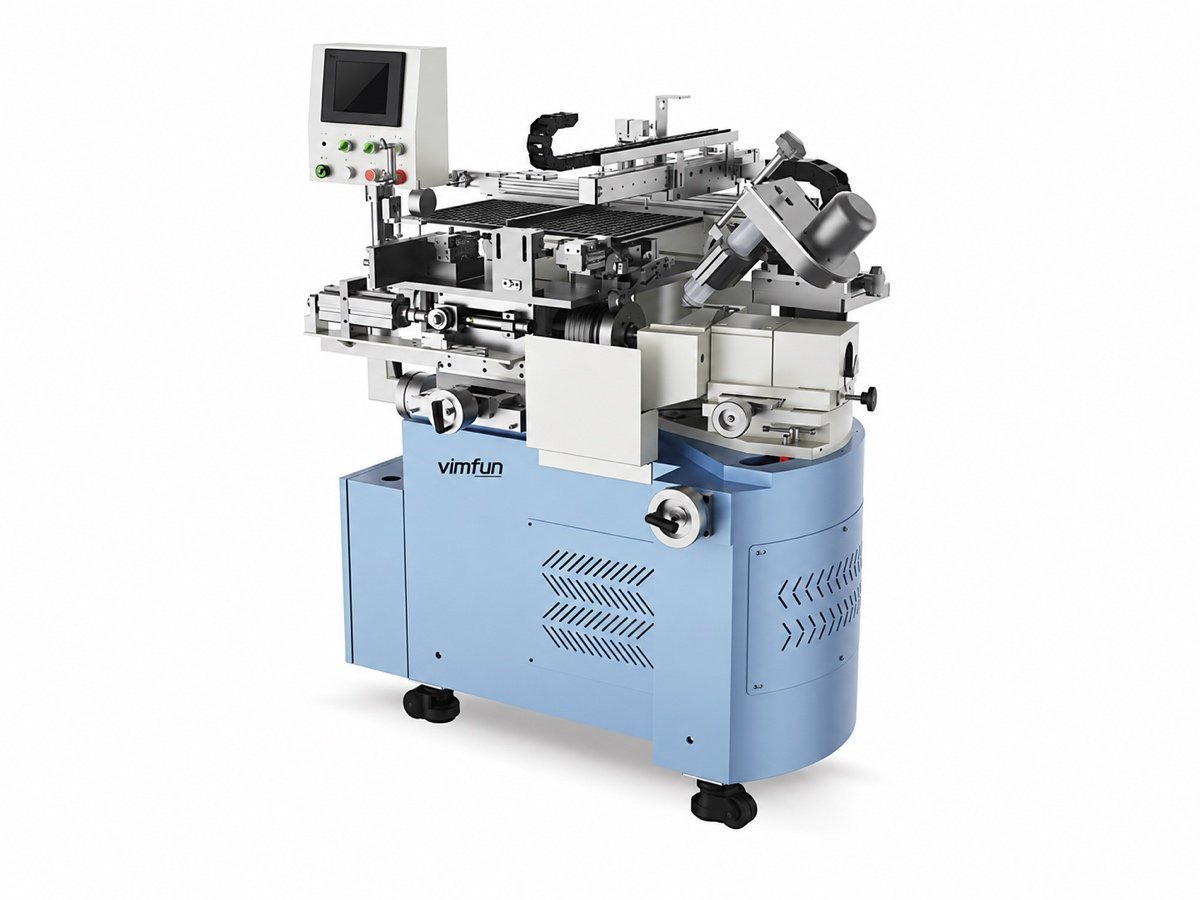
What this machine makes, and what happens before and after it
An optical element starts as a sawn or pressed blank and ends as a coated, centred lens. A tray fed lens generator owns the step in the middle: it cuts the radius of curvature into the face of a blank Ø10–80 mm and brings the centre thickness close to the drawing. What is distinctive here is how the parts get to the wheel — laid out on a tray, not tipped in loose.
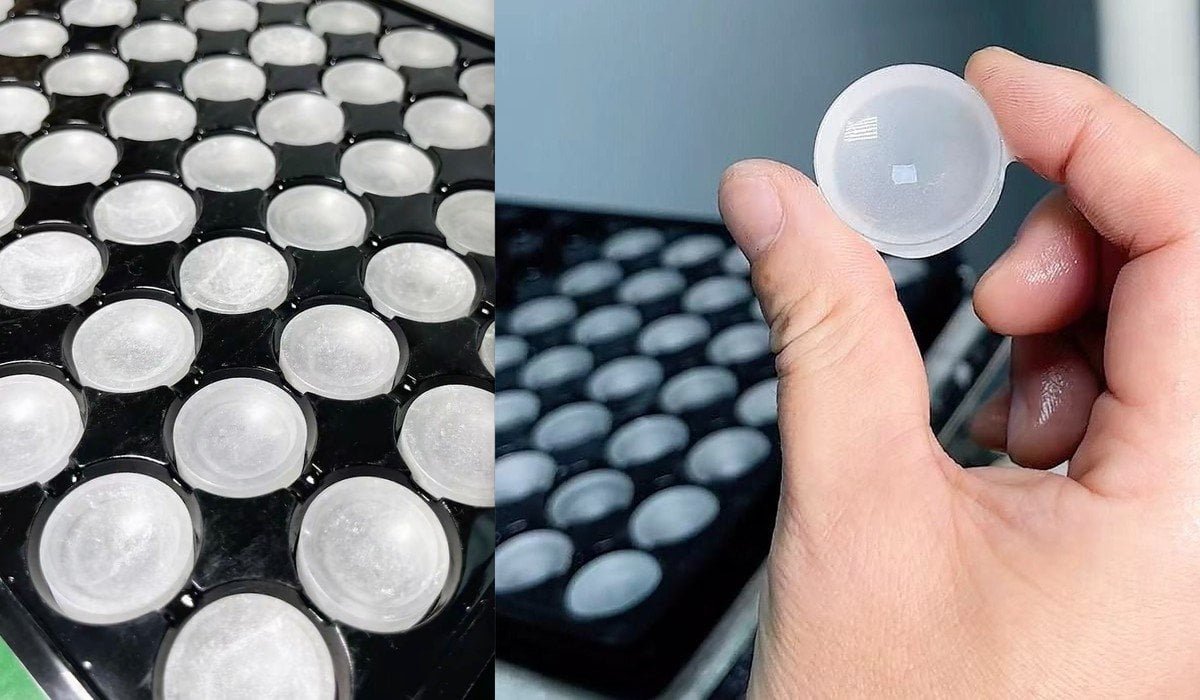
A blank tray and a finished-part tray sit side by side; an X/Y module lifts each blank, presents it to the wheel and lays the finished part in the second tray. The part that leaves is not finished — its radius is close enough that the lapping and polishing stage removes microns rather than re-cutting the curve.
Trays suit parts that already arrive organised, and cover the larger Ø10–80 mm range. For small loose parts Ø4–20 mm, a vibratory-bowl generator feeds bulk faster; for both feeds in one machine, see the integrated version.
How does a tray fed lens generator produce a radius?
No template, no copy former, no profile cam. On this class of machine the radius comes out of an angle.
Two spindles do the work. The tool spindle carries a diamond cup wheel and turns it at 8,000 or 10,000 rpm. The workpiece spindle holds the blank on a vacuum chuck, rotates it at 0–35 cycles per minute and feeds it into the wheel under control.
Because the cup wheel is tilted, its circular cutting edge sweeps out a sphere as the blank turns underneath it. The radius of that sphere is fixed by geometry alone:
- sin θ = d / (2R) — where θ is the spindle tilt, d the effective cutting-edge diameter of the cup wheel, and R the radius produced
- θ = 0° — the two axes are parallel and the machine generates a plane
- tilt 0–45° — the steeper the setting, the shorter the radius produced
- Convex or concave — decided by which side of the workpiece axis the wheel is tilted to
Set the angle once and every part on the tray comes out with the same radius. This is why a tray fed lens generator has no tooling to change between one radius and the next — only the angle and the wheel.
You are buying a range, R5 mm to plane, and the wheels for your material — not a fixed set of radii. Send us the radii and the tray your parts come on, and we specify the wheels with the quotation.
Four things the machine does while nobody is watching
This is where a tray fed lens generator separates itself from a hand-loaded one. Each of these replaces a decision an operator would otherwise make part by part.
Loads and unloads from parallel trays
An X/Y module lifts each blank from the blank tray, presents it to the wheel and lays the finished part in a second tray beside it. Parts that arrive organised stay organised.
Tells the two faces apart and flips
A data-transmitting micrometer identifies which face of the blank is up and turns the part over when it needs to, so a tray does not have to be hand-sorted before it goes on.
Refuses to run on an empty chuck
Vacuum on the hold-down is monitored continuously; if a part is missing or has released, the cycle does not start. Empty cycles are what crash a cup wheel into a chuck.
Guards brittle parts from chipping
Pressure and damping are adjustable, so the touch a thin or brittle blank needs is set on the machine — the edges come off clean rather than chipped.
Which materials and geometries can it handle?
| Item | Capability |
|---|---|
| Surfaces generated | Convex and concave spherical surfaces; plane (flat) surfaces |
| Radius range | R5 mm to plane, set by tool-spindle tilt 0°–45° |
| Workpiece diameter | Ø10 – Ø80 mm |
| Workpieces per cycle | 1 — single-part handling, tray fed |
| Feed | X/Y module, parallel blank and finished trays |
| Materials | Optical lenses — send your material for a free trial run; suitability confirmed on your own parts |
| Face recognition | Automatic, with automatic flip when required |
| X / Y travel | 600 mm / 400 mm |
If your drawings are dimensioned to the ISO 10110 framework, send one with the enquiry. On a tray fed lens generator the radius tolerance and centre-thickness tolerance are what decide whether the job fits, and the tray format is what decides the handling — see the optical materials data if you are choosing glass.
Technical specifications
The Auto-SG-80T is tray-fed; the vibratory-bowl and integrated members of the family cover loose small parts and both feeds in one machine.
| Curvature machining range | R5 mm – flat (plane) |
| Diameter machining range | Ø10 – Ø80 mm |
| Spindle adjustment angle | 0° – 45° |
| Tool spindle speed | 8,000 / 10,000 rpm |
| Workpiece speed | 0 – 35 cpm, stepless |
| X / Y travel | 600 mm / 400 mm |
| Spindle mounting | Ø24 / M20 × 1.5 |
| Feed system | X/Y module, parallel blank / finished trays |
| Total installed power | 1.5 kW |
| Overall dimensions (L × W × H) | 1500 × 850 × 1500 mm |
| Total weight | approx. 700 kg |
| Base construction | Cast iron, hand-scraped mating surfaces |
On a tray fed lens generator the diamond cup wheels and dressing stones are process consumables chosen for the material and the radius. They are quoted separately — tell us your materials and radii and we will specify them.
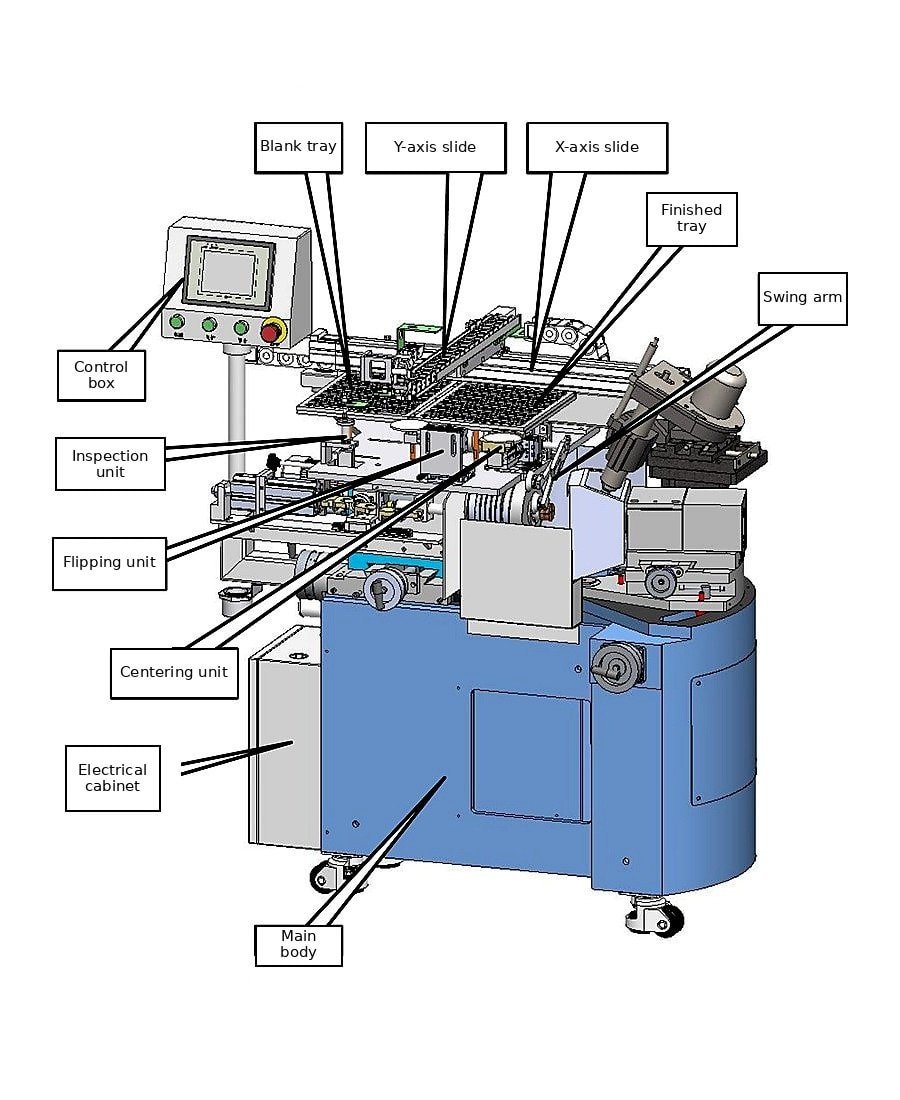
Main assemblies and what each one is for
This is the vocabulary your operator and our service engineer will share on the shop floor.
| Assembly | Function |
|---|---|
| X / Y module | Servo-driven linear gantry carrying the part between the blank tray and the finished tray; 600 / 400 mm travel |
| Workpiece trays | Parallel blank tray and finished-part tray for automatic loading and unloading |
| Tool spindle head | Carries the diamond cup wheel; tilt adjustable 0°–45° to set the generated radius |
| Workpiece spindle | Vacuum chuck turning the blank at 0–35 cpm and feeding it into the wheel |
| Data-transmitting micrometer | Identifies the presented face and triggers the automatic flip |
| Coolant system | Circulating supply with the tank in the machine base |
| Operation panel | 7″ touchscreen for parameters, pressure and damping, inspection and troubleshooting |
Utilities, environment and safety
Electrical supply, compressed air, coolant, floor loading and the ambient conditions the machine is to run in are confirmed with us for each order, together with the safety and protective arrangement supplied with it. These figures depend on the voltage and frequency of your site, the material you are running and the destination market, so we do not publish a single set of them here.
Send us the site conditions with your enquiry and we will return the utility and environmental requirements in writing, before the order is placed.
Tray feed pays off when parts arrive organised on compatible trays; if they come loose in bulk, a vibratory-bowl machine sets up faster. And a new material needs its pressure, damping and feed settled on trial parts — the reason we ask for your blanks before quoting.
What happens after the machine is installed?
The same terms apply to every machine we ship, wherever in the world it goes.
| Warranty period | 12 months from final acceptance |
| Response during warranty | Response within 8 hours · solution proposed within 24 hours · issue resolved within 48 hours, including procurement, installation and commissioning of parts |
| After the warranty period | Service and spare parts available for the life of the machine |
| Certification | CE |
Specifications are subject to change as a result of design upgrades. Minor differences may occur at certain parts. For a binding specification, refer to the order confirmation.
See the machine running
The Auto-SG-80T generating parts, and the X/Y module moving blanks from the blank tray to the finished tray.
01 — Spherical generating cycle, tray-fed blank
02 — X/Y tray loading and unloading
Send one drawing and a few blanks
A tray fed lens generator is easy to specify badly from a datasheet. Send us one element drawing — diameter, radius, centre thickness, material and the tolerance grade you have to hold — with a few of your own blanks and the tray they come on. We run them, return them, and send the process sheet with the quotation.
If your parts are small and loose, or you want both feeds in one machine, we will point you to the right member of the family instead of quoting this one.
12-month warranty · free trial run on customer-supplied material
Optics customers include Edmund Optics and Coherent
Related equipment and reading:
- Small lens generating machine Auto-SG-20V — the vibratory-bowl version for loose small parts
- Integrated lens generating machine Auto-SG-50VT — bowl in, tray out, in one machine
- CNC optical curve generator Auto-SG-50 — the CNC generator
- Optical lens fabrication line — how the stations connect