ZnSe 렌즈 절단기는 CVD로 성장된 황화아연 셀레나이드 블랭크를 CO₂ 레이저 광학, 열화상 시스템 및 FLIR 애플리케이션용 렌즈 기판으로 절단하도록 설계된 정밀 절단 장비입니다. ZnSe는 넓은 적외선 투과 범위(0.5–22 μm)와 레이저 파장에서 낮은 흡수율 덕분에 10.6 μm CO₂ 레이저 초점 렌즈 및 창에 주로 사용되는 재료이지만, 부적절하게 가공될 경우 부드럽고 깨지기 쉬우며 독성이 있습니다. 올바른 ZnSe 렌즈 절단기를 선택하는 것은 깨끗하고 균열 없는 기판을 얻을지, 아니면 유해한 셀레늄 먼지가 포함된 값비싼 스크랩을 얻을지를 결정합니다.
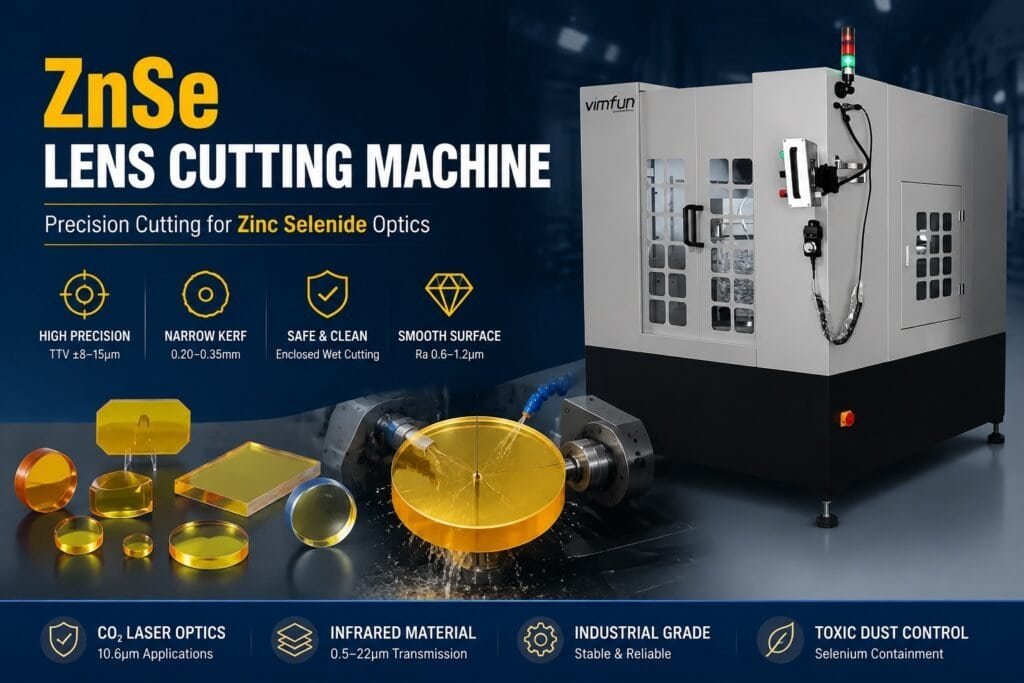
ZnSe 렌즈 절단기란 무엇인가요?
ZnSe 렌즈 절단기는 일반적으로 CVD로 성장된 잉곳 또는 사전 성형된 실린더인 황화아연 셀레나이드 블랭크를 후속 연삭 그리고 연마. 를 위한 평평한 기판으로 절단하도록 특별히 구성된 다이아몬드 연마 절단 시스템입니다. 일반적인 광학 절단 장비와 달리 ZnSe 렌즈 절단기는 재료의 고유한 특성 조합을 고려해야 합니다.
- 부드러움: ZnSe의 Knoop 경도는 약 120으로, 게르마늄(~780) 또는 실리콘(~1,150)보다 훨씬 부드럽습니다. 이는 절단 요소가 쉽게 침투하지만 과도한 힘이나 이송 속도로 인해 깊은 표면 손상을 유발할 수 있음을 의미합니다.
- 취성: 부드럽지만 ZnSe는 깨지기 쉽습니다. 충격이나 불균일한 응력 하에서 절단면을 따라 파손되어 칩과 균열이 기판으로 전파됩니다.
- 독성: 황화아연 셀레나이드에는 규제 대상 독성 원소인 셀레늄이 포함되어 있습니다. ZnSe를 절단, 연삭 및 연마하면 흡입 및 피부 접촉 시 유해한 미세 입자 먼지가 발생합니다. 절단기는 셀레늄 함유 입자를 포함하기 위해 밀폐된 절단 챔버와 습식 절단 공정을 통합해야 합니다.
- 넓은 IR 투과: ZnSe는 가시광선(0.5 μm)부터 원적외선(22 μm)까지 투과하므로 CO₂ 레이저 광학(10.6 μm) 및 다중 대역 열화상에 대체 불가능합니다. 절단으로 인한 표면 손상은 투과율을 저하시키고 산란을 증가시킵니다. 눈에 보이지 않는 결함도 렌즈를 광학적으로 사용할 수 없게 만들 수 있습니다.
ZnSe 렌즈 절단기 — 주요 매개변수
| 매개변수 | 다이아몬드 와이어 톱 | ID(내경) 톱 | 환형 톱 |
|---|---|---|---|
| 절단 폭 | 0.20–0.35 mm | 0.3–0.8 mm | 0.8–1.5 mm |
| 절단 정확도 (TTV) | 8–15 μm (Φ50 mm) | 5–10 μm | 10–20 μm |
| 표면 거칠기 (Ra) | 0.6–1.2 μm | 0.4–0.8 μm | 1.5–3.0 μm |
| 최대 블랭크 직경 | 모델에 따라 다름 | 블레이드 ID에 의해 제한됨 | 최대 200 mm |
| 표면 아래 손상 깊이 | 15–40 μm | 10–30 μm | 40–80 μm |
| 냉각수 종류 | 수성 (밀폐형) | 수성 (밀폐형) | 수성 (밀폐형) |
| 셀레늄 분진 제어 | 습식 절단 + 밀폐 챔버 | 습식 절단 + 밀폐 챔버 | 습식 절단 + 밀폐 챔버 |
| 최적의 적용 분야 | 생산 슬라이싱, 커프(kerf) 민감 작업 | 고정밀 단일 절단 | 대형 블랭크, 거친 형상 가공 |
참고: 모든 ZnSe 절단 방법은 셀레늄 함유 분진과 슬러리를 관리하기 위해 밀폐된 습식 절단 환경이 필요합니다. ZnSe의 건식 절단은 품질과 안전 측면 모두에서 허용되지 않습니다.
모든 IR 재료에 대한 와이어 쏘 대 ID 쏘 기술의 자세한 비교는 당사의 와이어 쏘 대 ID 쏘 비교 가이드를 참조하십시오.

최적의 결과를 위한 ZnSe 렌즈 절단기 설정 방법
1단계: ZnSe에 적합한 다이아몬드 연마재 선택
ZnSe의 낮은 경도(Knoop ~120)는 다이아몬드 입자 크기를 신중하게 맞춰야 함을 의미합니다. 너무 거친 입자는 빠르게 절단하지만 깊은 표면 손상을 유발하여 광범위한 연마 작업이 필요하며, 이는 절약된 시간을 상쇄합니다. 너무 미세한 입자는 절단 속도를 비실용적인 수준으로 낮춥니다.
ZnSe의 다이아몬드 와이어 절단 시, 생산 슬라이싱을 위해 20–40 μm 범위의 다이아몬드 입자가 있는 와이어를 사용하십시오. ID 쏘 날의 경우, 부드러운 결정질 재료(CdTe 또는 GaAs 권장 사항과 유사하며, 훨씬 더 단단한 게르마늄 권장 사항과는 다름)에 대해 날 제조업체에서 권장하는 다이아몬드 농도와 입자 크기를 선택하십시오.
Step 2: Set Feed Rate Below the Fracture Threshold
ZnSe’s combination of softness and brittleness creates a narrow optimal feed rate window. Too fast → cleavage fractures and edge chipping. Too slow → excessive heat buildup from friction (even with coolant), which can cause thermal stress cracking.
Start at 30–50% of the feed rate you would use for germanium on the same machine. Run test cuts and inspect edge quality under magnification before increasing speed. The target is a clean cut edge with no visible chipping at 10× magnification.
Step 3: Configure Coolant for Selenium Containment
Coolant serves dual purposes on a ZnSe lens cutting machine: thermal management and hazardous dust suppression. Use water-based coolant delivered at sufficient flow to keep the entire cutting zone submerged. The coolant system must include:
- Filtration to capture selenium-bearing particles before recirculation
- Enclosed collection for spent coolant and cutting slurry — this is hazardous waste requiring proper disposal per local environmental regulations
- Splash containment around the cutting chamber to prevent selenium-contaminated mist from escaping
The U.S. Occupational Safety and Health Administration (OSHA) sets a permissible exposure limit (PEL) of 0.2 mg/m³ for selenium compounds. Proper wet cutting with enclosed chambers keeps airborne levels well below this threshold.
Step 4: Secure the Blank with Uniform, Low-Stress Fixturing
ZnSe blanks must be mounted with uniform support to prevent bending stress during cutting. Use wax or adhesive mounting on a flat reference surface rather than mechanical clamping, which creates point loads on the soft material. For cylindrical blanks, V-block fixtures with soft contact surfaces (PTFE or rubber-lined) distribute clamping force evenly.
Uneven fixturing is the leading cause of cracked ZnSe blanks during cutting — the material fractures before the operator realizes the mounting was misaligned.
Step 5: Inspect Cut Surfaces Before Proceeding to Grinding
After cutting, inspect every substrate for:
- Edge chipping — chips larger than 0.3 mm typically cannot be removed by subsequent grinding without reducing the clear aperture below specification
- Surface cracks — use cross-polarized light to detect subsurface cracks invisible in normal lighting
- TTV — measure total thickness variation to confirm it falls within the lapping allowance for your downstream process
Catching defects at the cutting stage prevents wasting grinding and polishing time on substrates that are already scrap.
ZnSe Lens Cutting Machine Troubleshooting
Edge Chipping on Every Cut — What to Do?
Reduce feed rate by 20–30% and check diamond grit condition. On diamond wire, edge chipping usually means the wire is either worn (exposed metal core contacting the workpiece) or the grit is too coarse for ZnSe. Also verify coolant is reaching both the entry and exit sides of the cut — chipping is often worse on the exit side where the wire or blade breaks through unsupported material. Adding a sacrificial backing plate (soft graphite or wax block) behind the ZnSe blank supports the exit edge and dramatically reduces breakout chipping.
Surface Roughness Worse Than Expected After Cutting?
If Ra exceeds 1.5 μm on diamond wire cuts, check wire tension and speed. Low tension causes wire deflection, producing a wavy cut surface. Also verify that coolant is not carrying re-deposited cutting debris back into the cut zone — contaminated coolant acts like loose abrasive and scratches the freshly cut surface. Filter or replace coolant and re-run a test cut.
For operations where as-cut surface quality is critical, consider whether an ID saw would better suit your tolerance requirements — ID saws typically achieve finer Ra on ZnSe than wire saws, though at higher kerf cost. See our germanium kerf loss reduction ZnSe에도 적용되는 커프 최적화 원리에 대한 가이드입니다.
절단 중 블랭크 균열 — 절단선이 아닌 곳에서 발생?
절단 영역에서 떨어진 곳에서 균열이 나타나는 것은 고정 문제 또는 기존 재료 결함을 나타냅니다. 접착제 결합 균일성을 확인하십시오. 블랭크 아래의 공기 방울은 절단력이 가해질 때 유연해지고 균열이 발생하는 지지되지 않은 부분을 만듭니다. CVD ZnSe의 경우, 응력 집중기로 작용하는 성장 결함(공극, 포함물)에 대해서도 블랭크를 검사하십시오. 각 부울에 대한 공극 밀도 및 포함물 수를 보여주는 공급업체의 품질 인증서를 요청하십시오.
셀레늄 노출 문제 — 격리를 어떻게 확인할 수 있습니까?
작동 중 절단기 근처의 공기질을 모니터링하십시오. 개인 공기 샘플링 배지(셀레늄에 대한 NIOSH 방법 7300)를 사용하여 작업자 노출을 측정하십시오. 판독값이 OSHA PEL(0.1 mg/m³)의 50%에 접근하면 조치 임계값에 도달하기 전에 환기 또는 냉각수 흐름을 개선하십시오. 모든 모니터링 결과를 문서화하십시오. 이는 작업자 건강과 시설의 규정 준수 모두를 보호합니다.
ZnSe 대 게르마늄 렌즈 절단: 비교 방법
| Factor | ZnSe 절단 | 게르마늄 절단 |
|---|---|---|
| 크누프 경도 | ~120 (부드러움) | ~780 (단단함) |
| 파괴 인성 | 낮은 | 낮음 (~0.6 MPa·m^0.5) |
| 최적 공급 속도 | 낮음 (Ge 속도의 30–50%) | 기준 |
| 커프 손실 민감도 | 보통 ($800–1,200/kg) | 매우 높음 ($7,000–9,000/kg) |
| 지하 손상 위험 | 높음 (부드러움 → 낮은 힘으로 깊은 손상) | 보통 (단단함 → 더 얕은 손상) |
| 열 감도 | 보통 (약 300°C까지 안정적) | 높음 (100°C 이상에서 밴드갭 이동) |
| 독성 | ⚠️ 셀레늄 — 유해 분진 | 무독성 (표준 PPE) |
| 주요 응용 분야 | CO₂ 레이저 렌즈/창 (10.6 μm) | 열화상 렌즈 (8–14 μm) |
| 절단 후 처리 | 연삭 → 연마 → AR 코팅 | 연삭 → 연마 → AR 코팅 |
| 냉각수 격납 | 밀폐 + 유해 폐기물 처리 | 표준 여과 |
핵심 요점: ZnSe는 절단하기 쉽지만(더 부드러운 재료, 더 적은 힘 필요) 절단하기는 더 어렵습니다. 잘 — 부드러움은 손상이 더 깊이 침투한다는 것을 의미하며, 셀레늄 독성은 게르마늄에는 없는 환경 및 안전 요구 사항을 추가합니다. 게르마늄 렌즈 절단기 매개변수 조정을 통해 종종 ZnSe를 처리할 수 있지만 냉각수 및 먼지 봉쇄 시스템을 업그레이드해야 합니다.
모든 적외선 광학 재료에 걸친 절단 장비에 대한 포괄적인 개요는 당사의 적외선 광학 제조 장비 허브 페이지를 참조하십시오.
다이아몬드 와이어 절단 기술이 ZnSe 렌즈 생산에 미치는 이점
다이아몬드 와이어 절단은 재료 활용도와 처리량이 중요한 작업에서 ZnSe 렌즈 기판 생산에 선호되는 방법이 되었습니다. 그 이유는 다음과 같습니다.
좁은 커프는 재료 낭비를 줄입니다. 직경 0.20–0.35mm의 다이아몬드 와이어는 환형 톱(0.8–1.5mm 커프)에 비해 절단당 50–75% 적은 재료를 제거합니다. ZnSe 블랭크의 경우 이는 모든 볼에서 추가 기판을 얻는 것을 의미하며, 처리 시 상당한 절감 효과를 가져옵니다. CVD ZnSe 1kg당 800–1,200달러.
낮은 절단력은 표면 아래 손상을 최소화합니다. The thin wire contact area generates lower peak force than blade-based methods, producing shallower subsurface damage on soft ZnSe. Shallower damage means less material must be removed during grinding and double-sided lapping, further improving material utilization and reducing processing time.
Enclosed wet-cutting environment controls selenium dust. Diamond wire saws operate in enclosed cutting chambers with continuous coolant flow — the same configuration required for selenium containment. This makes diamond wire cutting naturally compatible with ZnSe safety requirements without significant additional engineering.
Consistent cut quality across production runs. Controlled wire tension and speed produce repeatable TTV and surface roughness from the first cut to the last. This consistency reduces the inspection burden and ensures downstream 연삭 그리고 연마 processes receive substrates within specification.
Our diamond wire cutting systems are configured for the full range of infrared optical materials — germanium, ZnSe, ZnS, and chalcogenide glasses. Contact our engineering team with your ZnSe blank dimensions, target substrate thickness, and production volume for a specific equipment recommendation with test cut data.
절단에서 최종 마감으로 이동하는 부품의 경우, 당사의 셀렌화아연 광학 연마 공정 노트를 검토하여 ZnSe 표면 손상, 슬러리 거동 및 절단 후 재고 여유를 제어하십시오.