How can you cut hard materials and lose less product every time? I have been in the industrial cutting and abrasive wire business for over 7 years. This problem I’ve seen over and over again: production line problems. The solution I keep going back to is segment coated diamond wire.
In this article, I will show you how segment-coated diamond wire reduces material loss. I’ll also cover how it regulates kerf width. And I will show you how it helps you obtain higher yield from each block you cut.
What Is Segment Coated Diamond Wire and Why Does It Matter?
Segment Coated Diamond Wire: Diamond cutting wire with diamonds set in spaced groups. Small gaps separate each group. These slots let coolant in and debris out. The core is made up of high tensile steel. The diamonds are bonded to a resin or electroplated onto a substrate.
Industries such as quartz slicing wire saw, silicon, sapphire and ceramics. Work each portion before moving on to the next. This reduces heat and wear and increases the output per reel.
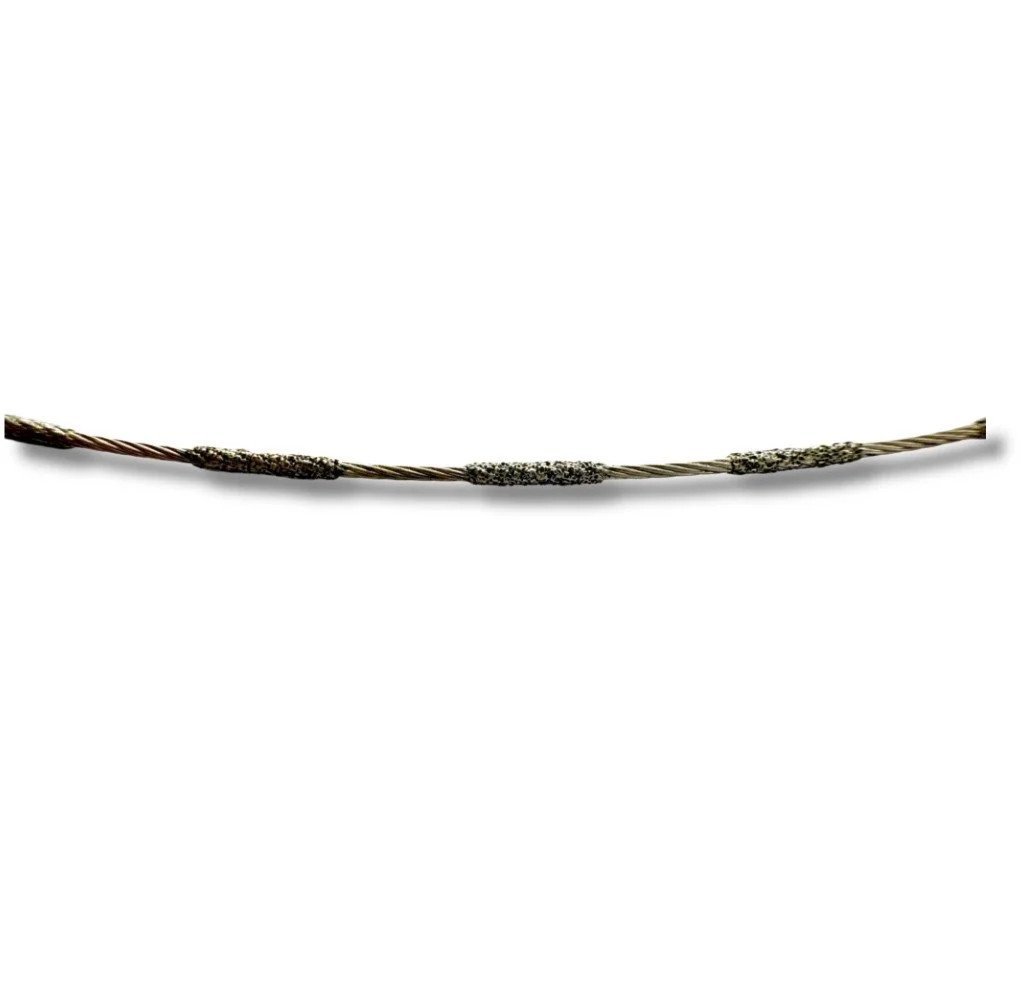
Segment Coated Diamond Wire – Key Technical Specifications
| Parameter | Typical Range | Unit | Notes |
| Wire Core Diameter | 0.12 – 0.50 | mm | High-tensile steel |
| Diamond Grit Size | 20 – 60 | µm | Varies by material |
| Segment Spacing | 1 – 5 | mm | Controls coolant flow |
| Tensile Strength | 2000 – 3500 | MPa | Prevents wire breakage |
| Cutting Speed | 10 – 40 | m/s | Depends on application |
| Wire Life (avg.) | 300 – 600 | m² | Per reel on quartz |
What Is the Real Cost of Kerf Loss in Precision Quartz Cutting?
Kerf is the amount of material removed with each cut. It is lost product, not waste, in quartz slicing. Increasing the kerf by 0.02 mm might cost several wafers every lot. Segment coated diamond wire for tight kerf Small even diamond clusters and thin wires.
Less material becomes powdery with each pass. For precision quartz cutting this implies more useable slices per ingot and a yield of 92%.
Factors That Control Kerf Width
A few important factors determine the kerf width in the diamond wire saw for quartz work:
- Wire diameter – smaller wire results in narrower kerf
- Diamond grit size – smaller grit cuts cleanly and less material
- wire tension, adequate tension prevents wire from bending sideways
- Feed rate – a slower feed rate will provide a tighter, cleaner cut
- Coolant pressure – good flow keeps cut zone cool and clear
Kerf Width Comparison by Wire Type
| Wire Type | Avg. Kerf (mm) | Material Loss (%) | Suitable For | Surface Finish |
| Standard Abrasive Wire | 0.35 – 0.50 | 18 – 25% | General cutting | Rough |
| Resin Bond Diamond Wire | 0.25 – 0.35 | 12 – 18% | Silicon, ceramics | Medium |
| Segment Coated Diamond Wire | 0.14 – 0.22 | 6 – 10% | Quartz, sapphire | Fine |
| Electroplated Diamond Wire | 0.16 – 0.24 | 7 – 12% | Hard materials | Fine–Ultra fine |
How Segment Spacing Reduces Heat and Kerf Spread
Coolant flows between each segment when the segments are adequately spaced on an industrial diamond wire loop. This cools down the cut zone rapidly. It prevents the wire from heating up and expanding. It also prevents the wire from bending sideways.
A hidden source of broad or irregular kerfs is wire bowing. The wire remains straight with appropriate spacing. Path cut still narrow. And the yield increases—without slowing the machine down.
How Does Wire Gap and Pitch Directly Change Your Slice Count Per Block?
The wire gap is defined as the distance between two parallel wires in a multi-wire saw machine. The pitch equals wire diameter plus the spacing between wires. In quartz cutting wire usage it determines how many slices you obtain per block. Smaller pitch equals more cuts. Cut more, get more product from the same block.
The segment coated diamond wire allows you to decrease pitch safely. The wire is extremely fine and uniform. This is why many semiconductor and optical quartz manufacturers are converting to it. More slices = less gap. greater slices means greater income each block.
Pitch Reduction With Segment Coated Wire
- The wire is steady in size thus a tighter pitch is safe
- Even coating depth inhibits wire to wire contact
- The tighter pitch permits 15–20% more slices/block
- Thinner wire produces a finer finish also – no additional polishing required
Comparison – Wire Pitch vs Output Yield
| Wire Type | Wire Dia. (mm) | Typical Pitch (mm) | Slices per 100mm Block | Yield Rating |
| Old abrasive slurry | 0.18 | 0.55 | ~180 | Low |
| Standard diamond wire | 0.16 | 0.42 | ~238 | Medium |
| Segment coated wire | 0.13 | 0.30 | ~333 | High |
| Electroplated thin wire | 0.12 | 0.28 | ~357 | Very High |
The switch from slurry to segment coated diamond wire can increase the slice count out of the same block by as much as 85%. This is one of the nicest things any quartz plant can do.
Advantages and Disadvantages
Advantages:
- Additional cuts from each block
- fewer kerf, fewer material waste
- Better surface polish from the first pass
- Longer life of cable than slurry
Disadvantages:
- Higher initial cost to purchase the wiring
- It may be necessary to make some adjustments to the machine set-up.
- Wire tension should be regulated carefully
Where Is Segment Coated Diamond Wire Delivering the Best Real-World Results?
Segment coated diamond wire is a proven product from solar plants to optical factories. It aids companies that require both speed and clean cutting. The results aren’t merely on paper. Real production statistics demonstrate improved output, cheaper cost and higher quality.
This is a perfect match for endless diamond wire loop systems. Segment cutting ensures even wear that increases the life of the loop. Industries that cut quartz, silicon carbide and sapphire are the major consumers of this wire today.
Real Results by Industry
| Industry | Material Cut | Key Gain | Yield Improvement | Wire Type Used |
| Solar PV | Monocrystalline Silicon | Thinner wafers | +18% slices | Segment coated loop |
| Optical Components | Synthetic Quartz | Better surface quality | +22% usable pieces | Quartz cutting wire |
| Semiconductor | Silicon Carbide (SiC) | Less breakage | +15% output | Electroplated segment |
| LED Substrates | Sapphire | Fewer polishing steps | +25% throughput | Industrial diamond loop |
Why the Solar Industry Leads in Adoption
- Solar manufacturers need the most slices per ingot to be profitable
- Cost of wire per wafer Reduce segment wire
- A tighter pitch means thinner wafers which improves cell output
- The segment coated diamond wire loop runs swiftly without interruption
Optical Quartz – A High-Value Use Case
Optical quartz demands extremely flat very clean cutting. The surface damage has to be nearly nil. These goals were successfully hit by a diamond wire saw for quartz setups using segment coated wire. The smooth cut action decreases the tiny fractures. This is essential for optical-quality quartz parts.
Electroplated Diamond Wire vs. Segment Coated Wire – Which One Should You Choose?
Both electroplated diamond wires and segment coated wires employ bonded diamonds. But the pattern is different. The electroplated wire is fully and densely coated with diamond throughout its length. Segment coated wire has dispersed diamond clusters and spaces between clusters. Different types are best in different situations.
- Electro-plated wire works best for very hard or brittle materials that need constant abrasion.
- Segment coated wire is excellent for lengthy cuts and large volume jobs when heat is an issue.
- The spaces between segments allow for penetration of coolant . This reduces the heat stress on the material .
- Segment-coated wire is frequently the preferred choice for precision quartz cutting, since it runs colder
- Both types are faster, finish and consistent than old slurry wire
It depends on what you’re cutting, depends what you’re finishing, depends how much you’re cutting. For most quartz slicing wire-saw configurations, segment-coated wire is often the best compromise between performance and cost.
FAQs
How does segment coating reduce material loss?
The spaced segments keep the wire thin. This cuts the kerf to a minimum. Less material goes to powder each cut. So after cutting, a more useable product remains.
- Debris escapes rapidly from spaces between segments
- Coolant easily circulates between each section
- The wire remains straight and cool during lengthy runs
What is the best wire for quartz cutting?
For precision quartz cutting, segment coated or electroplated diamond wire is the best option. Both make small kerfs and crisp cuts. But on extended stretches, segment coated wire is better with heat.
- Quartz cutting wire requires fine grit for a clean surface
- For optical quality quartz wire, diameter should be less than 0.20 mm
- Tension and speed parameters are equally as important as wire type.
How long does a diamond wire loop last?
An industrial diamond wire loop normally has a lifespan of 300 to 600 square meters. It depends on the hardness of the material, the speed and whether coolant is used. Segmented coated loops wear evenly and tend to last longer.
- Change the wire when surface finish deteriorates
- Track the use of wire per reel to plan ahead
- Good tension helps the loop stay longer
Is segment coated wire better than slurry wire?
Yeah, pretty much all the way. Less kerf with Segment coated wire. It’ll cut quicker. It gives a neater finish. And there’s no slurry to work with or dispose of.
- No slurry to mix, store or dispose of
- Quick setup and changeover
- Long-run cutbacks that are more persistent
Conclusion
Coated diamond wire is the best option for any precise cutting operation. “Less material is lost, the kerf remains narrow and more slices are produced per block.” It has made good progress with solar, semiconductor, and optical manufacturers.
Don’t lose yield to slurry or old abrasive wire. Trust Vimfun – the provider of segment coated diamond wire and industrial diamond wire loop. Visit Vimfun now, and start cutting smarter.