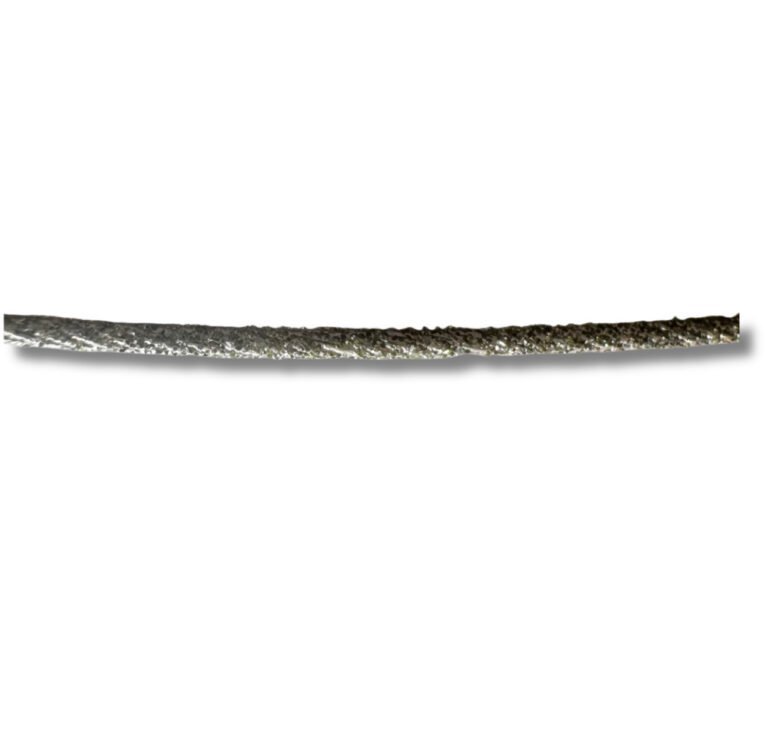
Choosing a fully coated quartz cutting wire starts with confirming what the product name means for the actual wire construction and the intended cutting setup. “Fully coated” describes abrasive distribution along the wire; it does not guarantee a particular kerf, cut rate, edge condition or service life.
Use the name as a starting point for a technical discussion. Confirm the construction and operating recommendations with the supplier, then judge suitability through a controlled trial on the intended material, machine and cut geometry.
What “fully coated” describes
In this context, “fully coated” refers to abrasive coverage distributed along the active wire length. The label alone does not identify the abrasive grade, particle distribution, bond, core material, wire diameter, loop length or allowable operating range. Those details need to come from a drawing, specification or written supplier confirmation.
Do not infer that every point on the wire has identical cutting behavior, or that a full coating will produce a specific result on every quartz blank. Workpiece composition, dimensions, mounting, wire path, machine motion, feed and coolant conditions all affect the trial outcome.
What the product name does not confirm
A coating description is not a performance guarantee. It does not by itself establish cutting speed, kerf width, surface quality, chipping level, crack-free results or tool life.
Before comparing products, ask for the information that applies to the supplied item: wire construction, nominal dimensions and tolerances, recommended machine and wire path, operating limits, coolant requirements, storage guidance and batch identification. If a value is not documented, treat it as unknown rather than filling it in from another wire type.
Selection factors for quartz slicing
Start with the part and the cut, then match the wire and machine around them. A useful selection review covers:
- Workpiece: quartz type or grade, blank dimensions, starting condition and any existing surface damage.
- Required geometry: slice thickness, cut location, parallelism or dimensional limits, and the allowance available for downstream grinding or polishing.
- Wire: confirmed construction, dimensions, abrasive details and the supplier’s written operating recommendations.
- Machine: wire path, motion, tensioning method, workholding, available travel and control of feed.
- Process media: coolant or flushing arrangement, cleanliness requirements and how the workpiece will be handled after cutting.
- Acceptance: how kerf, edge chips, visible cracks, surface condition and dimensional variation will be inspected.
Do not select on a single headline number. A configuration should meet the required part geometry and inspection criteria while remaining workable on the actual machine.
Compare coating layouts using confirmed information
Fully coated, segmented and thread-coated are product descriptions that should be checked against the actual wire drawing or sample. They are not enough on their own to rank cutting performance.
| Comparison point | What to confirm | What to evaluate in a trial |
|---|---|---|
| Construction | Coating pattern, abrasive details and core as documented for the supplied wire | Whether the wire runs consistently through the intended path |
| Compatibility | Machine, loop or wire-path requirements and operating limits | Stability, handling and repeatability on the intended setup |
| Workpiece response | Material and blank condition used for the evaluation | Kerf, edge condition, surface appearance and dimensional results |
| Production fit | Batch identification, storage and replacement guidance | Changeover, inspection and downstream finishing requirements |
For different coating descriptions, review the separate segmented-coated quartz wire guide and thread-coated quartz cutting guide. Compare only product attributes that have been confirmed for the specific items.
Plan a controlled sample-cut trial
A representative trial gives the buyer and supplier a shared basis for judging fit. Use a workpiece that reflects the intended material, dimensions and condition. Agree in advance on the cut geometry, process variables to record and inspection method.
- Record the workpiece identification, dimensions and starting condition.
- Record the wire specification, machine, wire path, workholding and relevant settings.
- Document coolant or flushing conditions and any process changes made during the run.
- Inspect the result against agreed criteria, including edge chips, visible cracks, surface condition and dimensional variation.
- Consider whether the result leaves the required allowance for downstream grinding or polishing.
Change one process variable at a time where practical. Keep samples and records traceable so the comparison is about the wire and setup that were actually tested, rather than a general product label.
How to interpret trial observations
Chipping, visible cracking, taper, wire breakage or inconsistent dimensions are observations to investigate, not proof of a single cause. Review the workpiece, mounting, wire condition, machine motion, feed, coolant and inspection method together. If the result changes between runs, compare the recorded conditions before drawing a conclusion about the wire.
Keep the acceptance criteria tied to the part drawing and the next operation. A cut that appears acceptable visually may still need dimensional inspection; a surface issue may also be affected by how the part was mounted or handled. The trial report should state what was inspected and under which conditions.
Information to include in an inquiry
For a useful review, share the workpiece material and dimensions, required cut geometry, machine model and wire path, current process conditions, expected output and inspection criteria. Ask the supplier to confirm the proposed wire construction and specification in writing. If the application is new or the tolerance is tight, agree on a sample-cut plan and acceptance method before selecting a production quantity.
See the full-coated quartz cutting wire product page for the product inquiry route. The final selection should be based on confirmed specifications and results from the intended application.
Frequently asked questions
Does fully coated mean a guaranteed cut rate?
No. The description refers to coating distribution. A cut-rate claim needs supporting test conditions, including the workpiece, machine, wire specification and measurement method.
Can I infer kerf or wire diameter from the name?
No. Request the specification for the exact item and confirm tolerances before planning a cut.
Should I compare it with segmented or thread-coated wire?
You can compare confirmed construction and trial results. Do not assume one layout is faster, cleaner or longer-lasting without evidence from the products and conditions being compared.
What should a sample-cut report include?
Record the workpiece, wire and machine details, process conditions, cut geometry, inspection method and measured or observed results. This makes the conclusion specific to the setup that was tested.