Diamond Wheel Dressing on Lens Generators: When and How
On a lens generator, diamond wheel dressing restores the working face when wheel condition begins to affect the cut. A reflective or loaded-looking face can be a clue, but appearance alone does not tell an operator whether the wheel is glazed, contaminated, worn to a different profile, or simply wet. Confirm the condition against the generated surface, the measured sagitta trend and the machine’s documented dressing procedure before changing a production setting.
The wheel generates the curve; dressing restores its working face. It does not correct a wrong drawing, loose fixture or inconsistent blank. Keeping those causes separate avoids using maintenance to solve a setup or measurement problem.
What diamond wheel dressing changes
A diamond wheel contains abrasive grains held by a bond. During use, grains can blunt or become covered by material and debris, while the bond and wheel profile also change over time. Dressing is intended to restore useful cutting points and the working face geometry for the operation. The exact effect depends on the wheel construction and dressing method; do not assume every wheel responds to the same stick, feed or cycle.
On a lens generator, check whether the wheel still produces the intended surface under the established setup. A wheel may rotate normally while removal behavior changes; that does not identify the cause. Dressing cannot compensate for a worn spindle, damaged fixture, incorrect angle or shifted measuring reference.
Diagnose before diamond wheel dressing
Glazing is often discussed as a visible change in the wheel face, yet a shiny appearance is not a complete diagnosis. Inspect the wheel with the machine stopped and isolated according to its safety procedure. Check whether the face is uniformly covered, whether the profile has changed, and whether chips or residue are present. Do not touch or inspect a rotating wheel by hand.
Then compare parts made with the same material, geometry, fixture, coolant condition and measurement method. A change in surface appearance or in the finishing allowance can indicate that the process deserves review, but these symptoms can also come from material variation, contamination, coolant delivery or setup. Record what changed before deciding to dress.
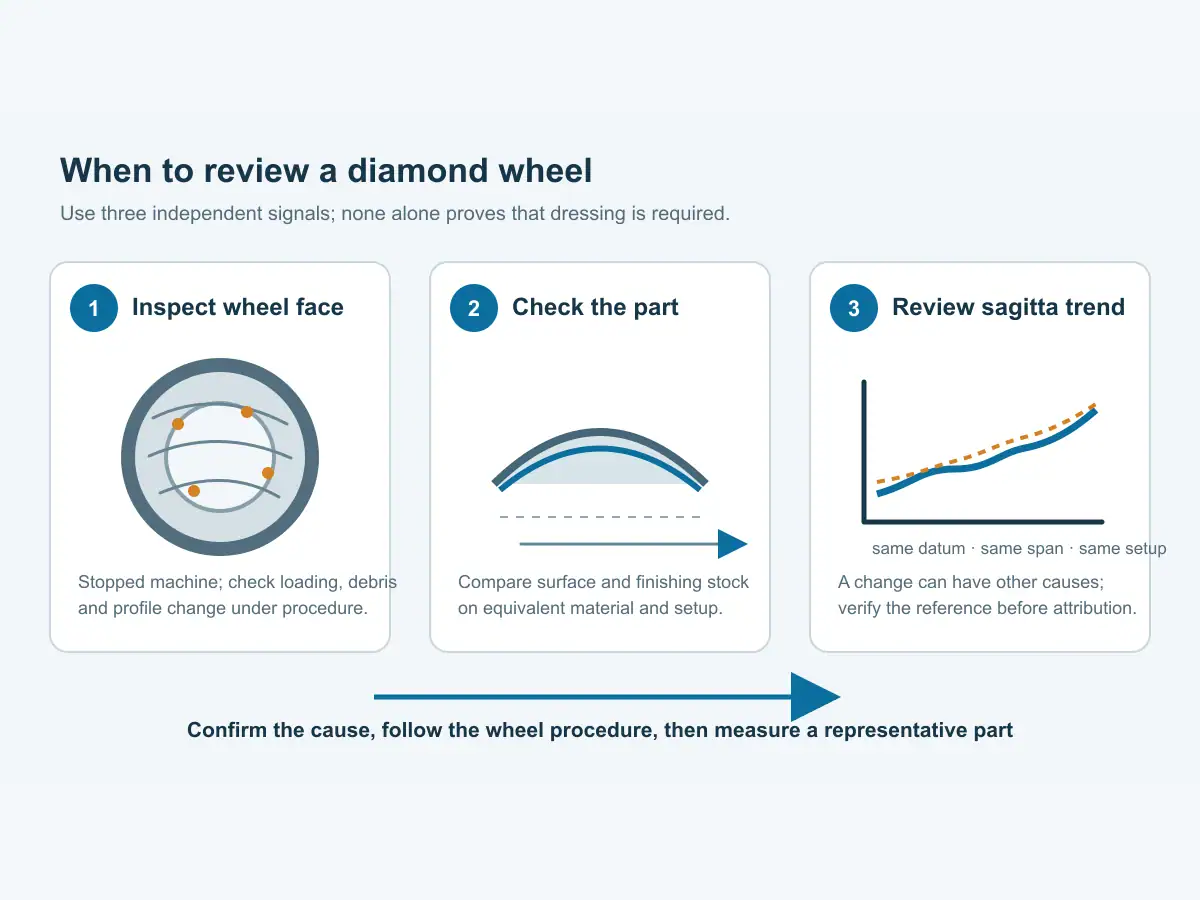
Sagitta provides a useful process signal when it is measured consistently. It describes the height of a spherical surface over a defined chord. A trend may reflect tool condition, but it can also reflect a change in blank thickness, part location, datum, fixture seating or measurement setup. Compare like with like and confirm the reference before attributing a sagitta shift to the wheel.
A practical review records dressing history, material, blank condition, fixture, coolant and output measurements. This helps distinguish gradual wheel wear from a setup change and gives a controlled basis for action. Plan diamond wheel dressing against the same verification points used to qualify the lens-generation process.
When to use diamond wheel dressing
Use the machine supplier’s maintenance instructions and the wheel maker’s requirements as the starting point. If the process is stable, do not add dressing simply because a fixed interval has elapsed unless the approved procedure calls for it. If output begins to drift, first verify the blank, fixture, coolant, spindle condition and measuring setup. Dress when the inspection and process evidence point to the wheel, then check a representative part before returning to production.
For a controlled check, hold the part material and setup constant, record the pre-dressing condition, carry out the documented dressing cycle, and measure the next parts with the same method. Keep the dressed wheel and measurement record associated with the batch. If the surface or sagitta does not recover, stop changing parameters at random; investigate wheel profile, spindle runout, fixture seating and the measurement reference.
There is no universal dressing interval or removal amount that can be transferred across wheel bonds, grit sizes, materials and generator designs. Those values must come from the wheel and machine documentation or from an approved trial. Do not copy a dressing condition from another model just because the wheel diameter looks similar.
Automatic diamond wheel dressing on a lens generator
Automatic dressing can make a defined maintenance step repeatable and reduce the need for an operator to initiate it by judgment alone. It does not remove the need to select or validate the interval. The cycle must match the wheel and application, and its result should still be confirmed on a representative part.
The Vimfun Auto-SG-50 documents automatic diamond wheel dressing with in-process sagitta measurement and automatic compensation; its main spindle is specified at 8000 rpm. These are machine features, not a finished-part guarantee. Ask what starts the cycle, how it is set for the wheel, and what measurements verify the part afterward.
The manual SG-80 lists wheel speeds of 8000/11000 rpm. That is a machine specification, not a dressing recommendation. Compare the manual and CNC configurations by how the part is loaded, how the curve is checked, and how maintenance is controlled for the actual production mix. The CNC optical curve generator describes the Auto-SG-50 process, while the SG-80 spherical lens curve generator serves the manual route. The broader optical lens grinding machine range helps place generating among the available machine families.
What the automatic cycle video can confirm
The Auto-SG-50 video shows a machine cycle, including its handling and generating sequence. It can help a buyer understand the equipment arrangement, but a video cannot establish the correct dressing interval or prove the finished part against a drawing. Those require the wheel specification, the agreed setup and measured sample results.
Keep diamond wheel dressing separate from grit selection
Grit selection and dressing address related but different decisions. Grit selection determines the abrasive scale and is chosen for the material removal and surface condition required by the process. Dressing restores the active wheel face and profile according to the wheel construction and machine procedure. A suitable grit does not eliminate dressing, and dressing does not make an unsuitable grit appropriate.
Diamond wheel grit selection is a related but separate decision: one guide answers which abrasive to choose; this one explains how to maintain the selected wheel. Keep the two questions distinct and cross-link the guides when the grit-selection page is live.
Record diamond wheel dressing for the next shift
For each dressing event, record the wheel identifier, machine, part material and geometry, reason for dressing, procedure used, and the first post-dressing inspection. Include the measurement reference and any finishing allowance. If the wheel is changed, keep that event distinct from dressing; a new wheel may need its own setup and qualification.
This record helps a later shift distinguish planned maintenance from an unexpected change and compare parts against the same measurement references.
The best trigger is the one supported by the machine procedure and a repeatable relationship between wheel condition and accepted parts. A visual check can start the investigation; the decision should use process history and measurement.
Send a drawing and representative blanks
For an application review, share the material, drawing, incoming blank size, target radius, production quantity and current measurement method. Include wheel type and dressing records if available. The team can review the generating route and define checks for free sample cutting without treating a machine feature as a finished-part guarantee.
Frequently asked questions
When is diamond wheel dressing needed on a lens generator?
Dress when inspection or process results show the wheel working face is affecting the cut and the machine procedure calls for dressing. Appearance alone is not sufficient diagnosis.
Does dressing change the wheel grit?
No. Dressing restores or exposes the wheel working face; grit selection is a separate process choice.
Can an automatic dressing cycle prove the finished radius?
No. It demonstrates a machine maintenance cycle. The finished surface still requires measurement against the drawing.
Sources checked
- Vimfun, CNC Optical Curve Generator Auto-SG-50.
- Vimfun, Spherical Lens Curve Generator SG-80.
- Bremen University Library, Engineered Wheels for Grinding of Optical Glass.
- Auto-SG-50 cycle, Vimfun YouTube video.
