
Tilt Axis Lens Polishing Machine FP-6X
A tilt axis lens polishing machine whose main axis tilts −10° to +30°, so the same six-head platform fine-grinds and polishes both flat and spherical faces. R10 to flat, Ø10–80 mm, on glass, ceramic and sapphire.
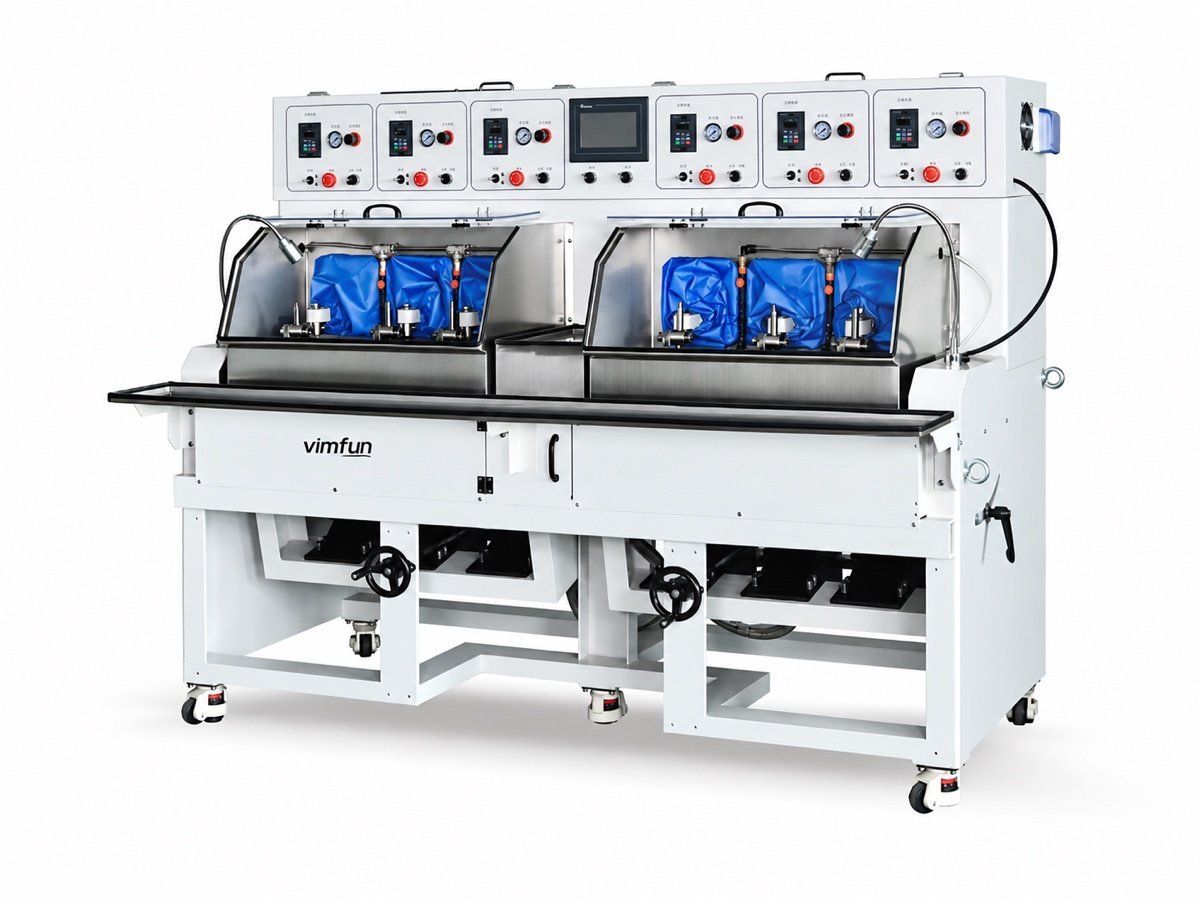
What this machine does, and what happens before and after it
After a face is generated, it still has to be fine-ground true and polished clear. Most fine-grinding machines are built for one family of shapes. A tilt axis lens polishing machine is built to cross that line: because its main axis tilts, the same six heads finish a flat window, a shallow sphere or a steeper curve without swapping platforms. It works glass, and with the drip-feed option, technical ceramic and sapphire.
Parts come in from the generating stage and leave ready for centring and edging. In the J configuration it fine-grinds; in the P configuration it polishes — flats and spheres on the same tilt-axis platform, single parts or several to a head.
How does a tilt axis lens polishing machine reach both flats and spheres?
By tilting the main axis. The angle of the axis, not a change of tooling, is what moves the work from a plane to a curve.
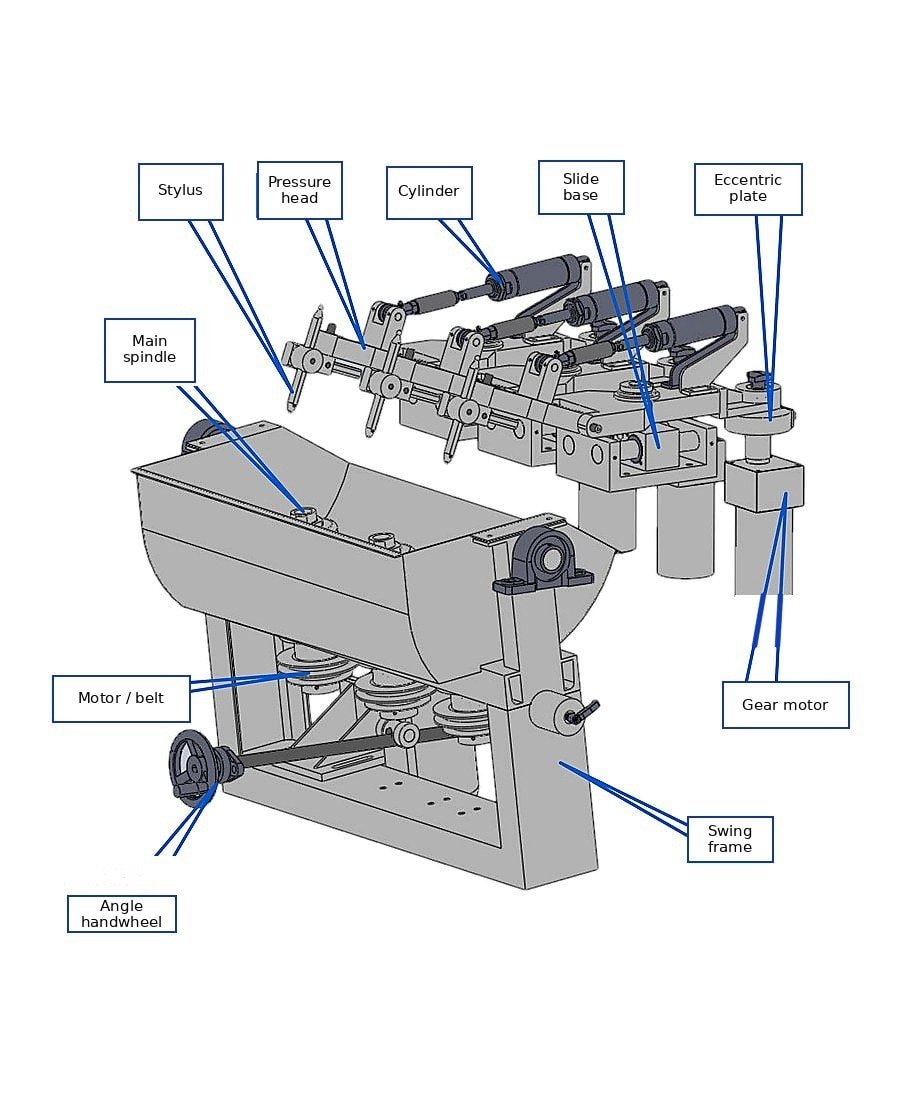
Each of the six heads holds a work bucket that tilts on the swing frame, set by a hand-wheel with a graduated scale. The tool is pressed onto the face by a pneumatic pressure head through a lapping pin, and an eccentric disc sweeps the seat in a centripetal, figure-of-eight arc while the spindle turns from 0 to 2000 rpm.
What the tilt buys you:
- Axis tilt −10° to +30° — sets the machine between a flat and a spherical face without changing the platform
- R10 to plane — covers shallow curves down to flat, on parts Ø10–80 mm
- Swing 0–45 CPM — the figure-of-eight arc evens the finish across the face
- Multi-segment speed — the spindle runs a program of speed steps, each with its own time
Because a tilt axis lens polishing machine holds each of its six axes under independent control, one head can be reloaded or paused while the rest keep running, and each carries its own pressure sensor and vacuum check.
You are buying reach — flat through R10, up to Ø80 mm — and the tools, pads and drip-feed set for your material. Send us the faces, the diameters and the material, and we specify the tooling and whether the peristaltic drip feed is needed with the quotation.
Four things that set the FP-6X apart
Loading is by hand at each head; the fine-grinding and polishing run automatically once a part is under the tool. These are what a tilt axis lens polishing machine adds over a fixed-swing one.
Flat and spherical on one platform
The tilting axis moves the work from a plane to a curve without a platform swap, so windows, prisms’ faces and shallow lenses run on the same six heads.
Pressure sensor and vacuum check
Each head is fitted with a pressure sensor and a vacuum check, so the down-force and the hold on every part are monitored rather than assumed.
Multi-segment speed program
The spindle runs a sequence of speed steps, each stepless and each with its own set time, so a cut can start gentle and finish fast without an operator at the dial.
Drip feed for ceramic and sapphire
An optional peristaltic pump and a graduated 3–5 L reservoir with a stirrer meter diamond slurry drop by drop — the supply hard-brittle ceramic and sapphire need, alongside the standard circulating pump for glass.
Which materials and geometries can it handle?
| Item | Capability |
|---|---|
| Process | Fine grinding (J) or polishing (P), single or several parts per head |
| Surfaces | Flat (plane) and spherical faces |
| Radius range | R10 mm to plane |
| Diameter | Ø10 – Ø80 mm |
| Axis tilt | −10° (front) to +30° (back) |
| Materials | Glass, technical ceramic, sapphire and other hard-brittle materials; send yours for a free trial run |
| Coolant | Circulating pump for glass; peristaltic drip feed for ceramic / sapphire (option) |
| Spindles | 6, each independently controlled |
If your drawings are dimensioned to the ISO 10110 framework, send one with the enquiry. On a tilt axis lens polishing machine the face type, the radius, the diameter and the material are what decide the tooling and the coolant — see the optical materials data if you are choosing glass.

Technical specifications
The FP-6X is the tilt axis lens polishing machine in the range; the fixed-swing FP-4/FP-6 machines each specialise in one face type.
| Process | Fine grinding (J) / polishing (P) |
| Surfaces | Flat and spherical |
| Curvature range | R10 mm – flat (plane) |
| Diameter | Ø10 – Ø80 mm |
| Number of spindles | 6 |
| Axis tilt | −10° to +30°, hand-wheel with scale |
| Spindle speed | 0 – 2,000 rpm, stepless, multi-segment |
| Swing rate | 0 – 45 CPM, stepless |
| Process timer | 0 – 99 hours |
| Monitoring | Pressure sensor and vacuum check per head |
| Coolant | Circulating pump; peristaltic drip feed (option) |
| Spindle mounting | Ø28 / M24 |
| Total installed power | 4.0 kW (linked) / 5.0 kW (single-control) |
| Overall dimensions (L × W × H) | 2000 × 1200 × 1600 mm |
| Total weight | approx. 1100 kg |
| Base construction | Welded steel base, stainless work deck, central lubrication |
The grinding tools, polishing pads, compounds and — for ceramic or sapphire — the diamond slurry are process consumables chosen for the material and the face. They are quoted separately.
Main assemblies and what each one is for
This is the vocabulary your operator and our service engineer will share on the shop floor.
| Assembly | Function |
|---|---|
| Spindle & work bucket | Spindle sits in a stainless bucket that tilts with the swing frame, 0–2000 rpm |
| Tilt hand-wheel | Sets the axis angle −10° to +30° on a graduated scale |
| Pressure head & lapping pin | Pneumatic head presses the tool onto the face through the lapping pin |
| Eccentric disc & slide | Reduction motor drives the eccentric disc, sweeping the slide in a figure-of-eight arc |
| Sensors | Pressure sensor and vacuum check on each head |
| Coolant & drip feed | Circulating pump for glass; optional peristaltic pump and reservoir for ceramic / sapphire |
| Central lubrication | Oil supplied to the moving parts from one point |
Utilities, environment and safety
Electrical supply, compressed air, coolant, floor loading and the ambient conditions the machine is to run in are confirmed with us for each order, together with the safety and protective arrangement supplied with it. These figures depend on the voltage and frequency of your site, the material you are running and the destination market, so we do not publish a single set of them here.
Send us the site conditions with your enquiry and we will return the utility and environmental requirements in writing, before the order is placed.
The FP-6X trades the simplicity of a fixed-swing machine for reach across flat and spherical faces and larger parts, and it is loaded by hand at each head. If you only ever run one small concave or convex radius, a fixed-swing polisher is simpler; and ceramic or sapphire needs the drip-feed option and its settings proven on trial parts, the reason we ask for your parts before quoting.
What happens after the machine is installed?
The same terms apply to every machine we ship, wherever in the world it goes.
| Warranty period | 12 months from final acceptance |
| Response during warranty | Response within 8 hours · solution proposed within 24 hours · issue resolved within 48 hours, including procurement, installation and commissioning of parts |
| After the warranty period | Service and spare parts available for the life of the machine |
| Certification | CE |
Specifications are subject to change as a result of design upgrades. Minor differences may occur at certain parts. For a binding specification, refer to the order confirmation.
See the machine running
The FP-6X finishing a flat and a spherical face, and the tilt hand-wheel moving the axis between them.
01 — Flat and spherical faces on one platform
02 — Tilt axis and the drip feed for sapphire
Send one drawing and a few parts
A tilt axis lens polishing machine is easy to specify badly from a datasheet. Send us one element drawing — the face type, the radius, the diameter, the material and the surface-quality grade you have to hold — with a few of your own parts. We run them, return them, and send the process sheet with the quotation.
If you only run one small concave or convex radius, we will point you to a fixed-swing member of the family instead of quoting this one.
12-month warranty · free trial run on customer-supplied material
Optics customers include Edmund Optics and Coherent
Related equipment and reading:
- Six spindle optical polishing machine FP-6U — the fixed upper-swing version for concave
- Convex lens polishing machine FP-4L — the lower-swing machine for convex lenses
- Concave lens polishing machine FP-4U — the four-spindle upper-swing version
- Optical lens fabrication line — how the stations connect