
What does one-stop infrared optics machinery actually buy you?
Mostly, it buys you a calendar. One-stop infrared optics machinery means one quote, one delivery window and one acceptance standard — in place of the six-to-twelve-month, multi-vendor qualification that a new IR lens line usually demands before it makes a single good part.
The line covers five operations: cutting (SGI 40), centering and bevelling (C-120L / C-185L), spherical grinding (G-100 / G-250), polishing (aspheric polisher) and AR coating (DLC / BBAR chamber). One supplier configures, commissions and signs off the whole chain.
The real advantage is not the box count — it is that the stations share one tolerance budget. The TTV off the saw is the centering machine's input budget; the centered roundness is the grinder's input budget, and so on. You receive a single tolerance-flow document, not five datasheets you have to reconcile yourself.
Five operations that share one tolerance budget
One-stop infrared optics machinery only earns the name if each stage hands the next a known input, not a surprise. Here is the chain for a typical germanium lens, with the machine and the per-piece time at each step.
- 1 · CutSGI 40 — closed-loop wire saw; contour and slice; 0.35–0.5 mm kerf. Φ50 contour ≈ 26 min.
- 2 · CenterC-120L / C-185L — OD rounding and bevel in one chucking; 1–3 min/piece.
- 3 · GrindG-100 / G-250 — convex, concave or plano spherical generation; ≈ 5 min/side.
- 4 · PolishAspheric polisher — sphere, asphere and plano on one spindle; ≈ 3 min/side.
- 5 · CoatDLC / BBAR chamber — 8–12 μm LWIR standard; batch of 50+.
The order matters: centering runs before grinding so the ground sphere is concentric with a known cylindrical reference, which keeps eccentricity inside the 30 arc-second budget athermal thermal-imaging assemblies demand and that ISO 10110 drawings call out. Get the sequence wrong and every station downstream fights it, because the centering fixtures on the C-120L are cut to the known thickness and edge state coming off the saw — change the input and the whole chain needs re-tuning.
Does buying the whole line really beat buying the parts?
One-stop infrared optics machinery is a procurement decision before it is a technical one. A Turkish thermal-imaging integrator bought the complete germanium line — saw, C-185L centering, G-250 grinder, aspheric polisher and AR chamber — in a single purchase, commissioned under one delivery window for defense optics. Their deciding factor was explicitly not unit price; it was compressing a multi-vendor qualification into one technical hand-off.
Coating is where the line ends and the choice gets real. A multilayer BBAR film gives the best transmittance but scratches easily on bare germanium, while a DLC hard coat trades 2–3% per surface for abrasion resistance — exposed elements (automotive, handheld, weapon sights) usually take DLC, protected internal elements keep BBAR. Either way, finished AR transmittance runs above 95% per surface across the 8–12 μm band, on a polish held to Ra < 5 nm.
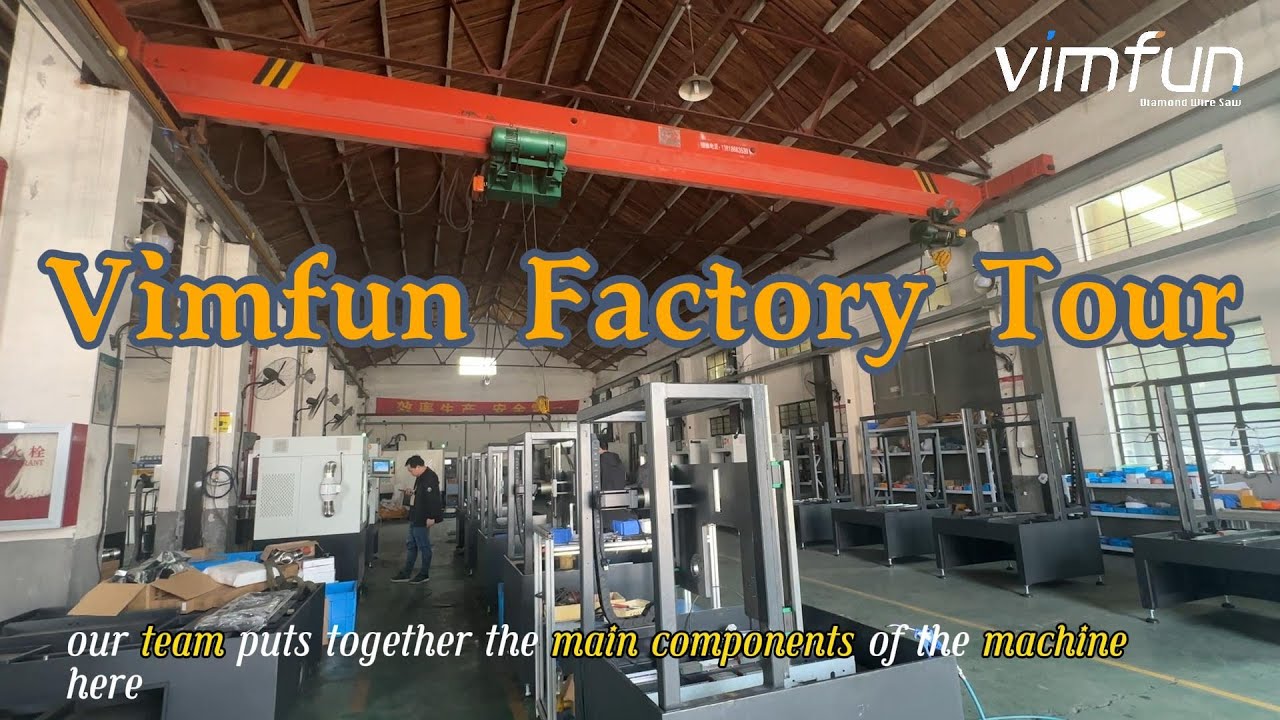
The clip below is the Shanghai floor where the line is built and tested before it ships — the same machines, configured and signed off together rather than sourced from five places.
What if you don't need the whole line?
One-stop infrared optics machinery is not always the right purchase, and we would rather say so than oversell a line you won't use. The model flexes both ways.
- Full lineNew production from scratch — one quote, one window, one acceptance standard (the Turkish route).
- Front-end onlyAlready have grinding and polishing? Buy just the cut and retrofit it (a Dutch shop recovered it in one fiscal year).
- Sample firstWe cut your material and return measured results before you commit to any configuration.
- One acceptanceWhatever the scope, you sign off against one tolerance-flow document and one ISO 9001 quality system, not five vendor specs.
Where the line starts and ends
The integrated line is one answer to a bigger question — how to manufacture IR optics without a tolerance gap between stations. The cut feeds the centering, which feeds the grind, and the whole chain is held to a single budget rather than negotiated across suppliers.
Buying one-stop infrared optics machinery is, in the end, buying that single budget. Everything else on this page — the stage times, the Turkish case — is just what that budget looks like in practice.
To place it in context, start at the infrared optics manufacturing equipment hub, walk the five stages on the germanium lens manufacturing solution page, and see the front-end machine on the germanium lens blank cutting machine page. For the company behind the line, see why we're a trusted infrared optics equipment supplier.