OPTICAL ENGINEERING / PROCESS NOTE

Cerium Oxide Polishing for Optics: Slurry, Pads and Pitch

The process described here applies to optical-glass elements; it does not cover scratch removal from consumer glass or coated screens. Cerium oxide polishing uses an abrasive suspension at the interface between a glass surface and a tool; the result depends on the glass, slurry condition, pad or lap, motion, pressure and inspection method. A compound name alone does not define a polishing recipe.

For cerium oxide polishing, the buyer’s practical questions are how to keep the slurry consistent, how to detect drift, whether to recirculate or meter the supply, and when a pad or pitch lap suits the part. Qualify these decisions on the actual glass and surface requirement. The literature shows that concentration and chemistry can change removal behavior, but one test setup cannot provide universal settings.

How cerium oxide polishing works on glass

Cerium oxide, often called ceria, is widely used as a polishing abrasive for glass. Its action is commonly described as a combination of chemical interaction at the glass surface and mechanical removal by abrasive particles. A classic study of multiple optical glasses examined how glass properties related to polishing behavior and described the cerium oxide and water slurry process as both chemical and physical. That mechanism helps explain why a polishing compound for glass cannot be selected from particle hardness alone: glass composition and slurry chemistry also matter for cerium oxide polishing.

The abrasive must reach the contact zone in a condition that supports repeatable removal. Agglomeration, settling, contamination or a change in dispersion can alter how particles behave. The apparent concentration in a tank may remain unchanged while the slurry’s useful behavior changes through time, water loss, replenishment, pH movement, mixing and carryover from previous work. Treat these as process variables to monitor, not as a single concentration number that predicts the finished surface.
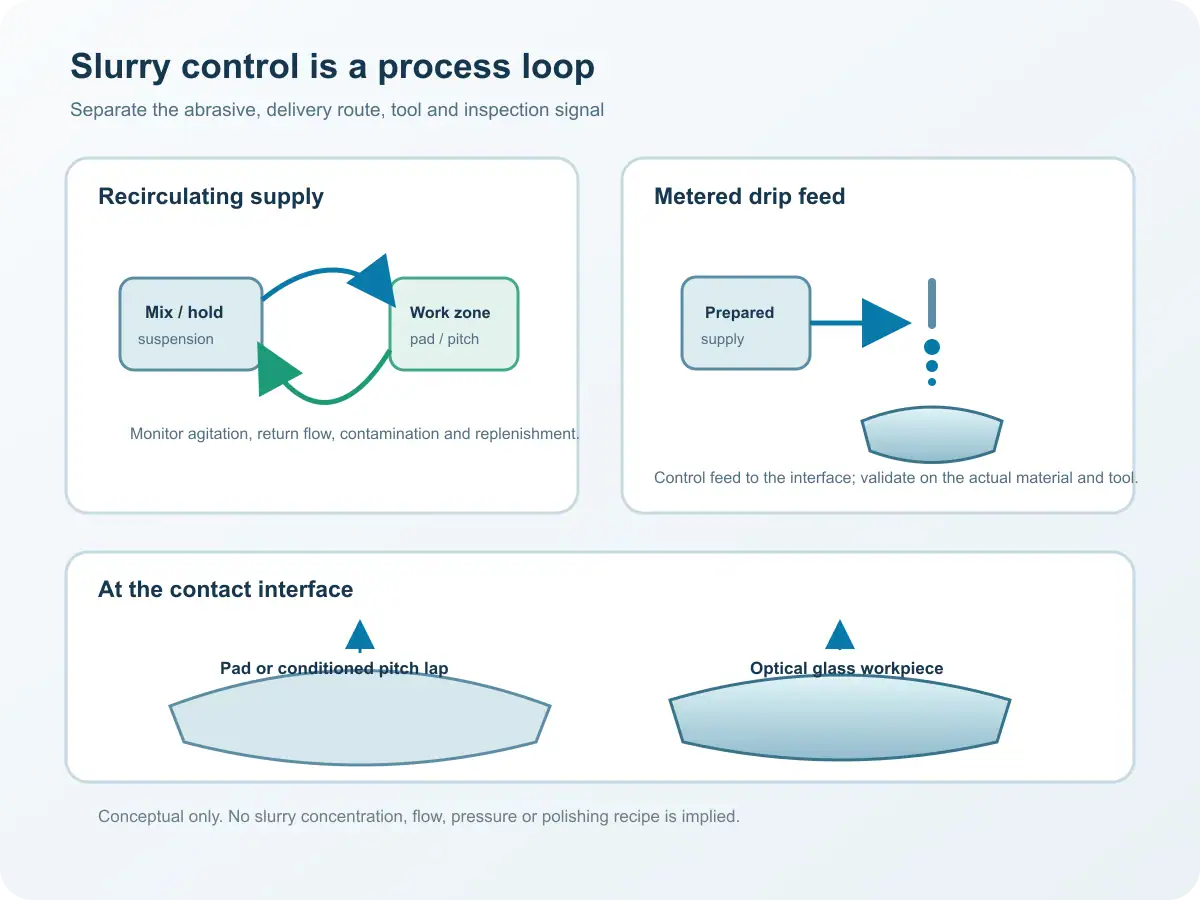
Conceptual recirculating and metered slurry routes feeding a pad or pitch lap during optical glass polishing.
Diagram of supply paths and the tool/workpiece interface. It does not prescribe slurry concentration, flow, pressure or polishing settings.

Studies of cerium oxide polishing on optical glass have reported that removal rate can respond nonlinearly to concentration within a specific test setup. A separate study found that glass composition influenced slurry pH and particle behavior during polishing. Validate the batch and material together; these results do not establish a universal concentration or shelf life.

Video — Concave Lens Polishing Machine FP-4U – Four-Spindle Polishing with Auto Loading

Concave Lens Polishing Machine FP-4U operation. The clip demonstrates lens polishing; it does not identify cerium-oxide slurry or specify a slurry recipe.
### Keep polishing slurry stable through the batch

In cerium oxide polishing, treat the slurry as a controlled process material. Record preparation date, source lot, water quality, mixing method, replenishment and reuse history. If the process depends on a target property such as solids content or pH, measure it using the same method and instrument throughout the run. The plan provides no approved concentration, specific gravity or pH setpoint, so this article does not prescribe one.

Watch for process signals that change together: removal behavior, part-to-part finish, visible streaks, the way slurry wets the tool, residue after cleaning and the amount of settled material. A change in only one signal may have another cause, such as tool wear, altered pressure, face geometry, fixture seating or contamination. Compare samples made with the same material, incoming condition, tool condition and inspection method before deciding that the slurry is responsible.

When adding make-up liquid or abrasive, follow the qualified shop procedure and mix adequately before returning the batch to the process. Avoid topping up by eye. If a batch has been idle, confirm that it can be re-dispersed consistently and inspect for contamination before use. A batch that cannot be returned to its known condition should be quarantined and evaluated rather than blended into production without a record.

Recirculation or metered feed?

In cerium oxide polishing, a recirculating pump returns slurry from the work area to a supply tank and sends it back to the tool. This arrangement can support continuous supply and batch processing when the tank is mixed, the return path is clean and the supply remains consistent. Particles and residues can travel through the loop, so screens, tank maintenance and cleaning should match the abrasive and work.

A metered drip route supplies slurry near the contact zone in a controlled stream or drops. It can reduce the amount of liquid delivered compared with a flooded approach, but it does not automatically make concentration or delivery stable. The feed line must remain clear, the supply must be agitated as required, and the point of delivery must reach the tool/workpiece interface. Validate the route on sample parts and observe whether flow remains consistent over the full cycle.

These are delivery strategies, not competing universal rules. For glass polishing, the public FP-6X tilt-axis lens polishing machine page specifies a circulating pump for glass and an optional peristaltic drip feed for ceramic or sapphire work. That is a machine configuration example, not a claim that cerium oxide should be used on those hard materials. Abrasive chemistry and feed method must both match the workpiece and qualified process.

Choose a pad or pitch lap from the surface and process

A polishing pad is a manufactured tool surface with defined compliance and texture. It may suit a repeatable production route when the pad, slurry and motion are compatible with the material and geometry. A pitch lap is conditioned to establish contact with the intended surface. It can be useful for conformal finishing, but its condition and preparation need control. Neither tool is inherently better for every optic.

For cerium oxide polishing, hold material, incoming surface, geometry and inspection method constant when comparing pad and pitch. Record tool identity and condition, preparation, slurry batch, workholding and motion. Measure the characteristic the drawing requires. Surface figure, roughness and scratch-dig acceptance are different; visual clarity does not prove all three.

The optical lens polishing machine range covers several geometries. The FP-4U concave-lens machine is an upper-swing configuration with a documented spindle-speed range of 450–3,000 rpm. The FP-6X has a tilt axis and material-dependent slurry feed options. These are platform characteristics; they do not define slurry concentration, removal rate or finished-part acceptance.

Know when to refresh or replace a batch

Do not discard or reuse a batch based on calendar age alone unless a qualified procedure defines that limit. Look for the conditions that affect its usability: separation that does not redisperse, evidence of foreign particles, a change in the measured property used for control, or a repeatable change in polishing behavior. Compare against a fresh reference batch where practical, keeping other process variables fixed.

If a batch begins to drift, stop adding variables. Take a sample for the shop’s approved checks, verify the mixing and delivery route, inspect the tool and review recent material or process changes. If the slurry remains outside its control limits or contamination is suspected, isolate it. Document the decision, clean the system as required and requalify with representative parts before returning to production.

Separate slurry maintenance from tool conditioning. A worn pad or pitch lap can change contact even when the slurry is stable; a fresh tool can also behave differently while it beds in. Track both records so the next operator can distinguish a batch change from a tool change. This makes cerium oxide polishing easier to troubleshoot and prevents repeated parameter changes from hiding the original cause.

Build a repeatable process record

For a useful cerium oxide polishing trial, identify the glass type, surface geometry, incoming condition, required finish, tool, machine configuration and inspection method. Record how the slurry is prepared and supplied, the sample sequence, observations and measurement results. Use the same cleaning and handling steps so residue or fingerprints are not mistaken for polishing defects.

If material changes, verify suitability rather than carrying over settings from another glass. A 2024 study on ceria slurry stability reported that some glass compositions shifted slurry pH during polishing and affected particle behavior; the result is material- and formulation-specific. It supports monitoring the slurry during a controlled trial, not applying one correction to every optical glass.

Provide the material, part drawing, incoming condition, batch size and acceptance method when requesting process review. The team can compare a recirculating or metered route and evaluate pad or pitch tooling on a free sample cutting or finishing trial where appropriate. The final process record should define the chosen slurry control method and the measurements that release each batch.

Frequently asked questions

Does cerium oxide polish every optical glass at the same rate?

No. Glass composition, surface condition, abrasive concentration, tool interface and slurry condition affect removal. Qualify the process on the specified glass and surface.

When should polishing slurry be replaced?

Use a defined refresh or replacement criterion based on the process record and observed slurry condition. Do not rely on appearance alone as a universal endpoint.

Should slurry be recirculated or metered?

Choose from the machine layout, batch duration and required delivery stability. Verify flow and cleanliness during a representative run.

Sources checked

Scroll to Top