
Automatic Glass Stacking Machine AL-7S
An automatic glass stacking machine that stacks 5–7 inch cover glass with interleaving paper into racks, ready for edge polishing. It picks two panels at a time, centres them to ±0.20 mm, and builds a stack up to 210 mm tall — the height the edge polisher takes.
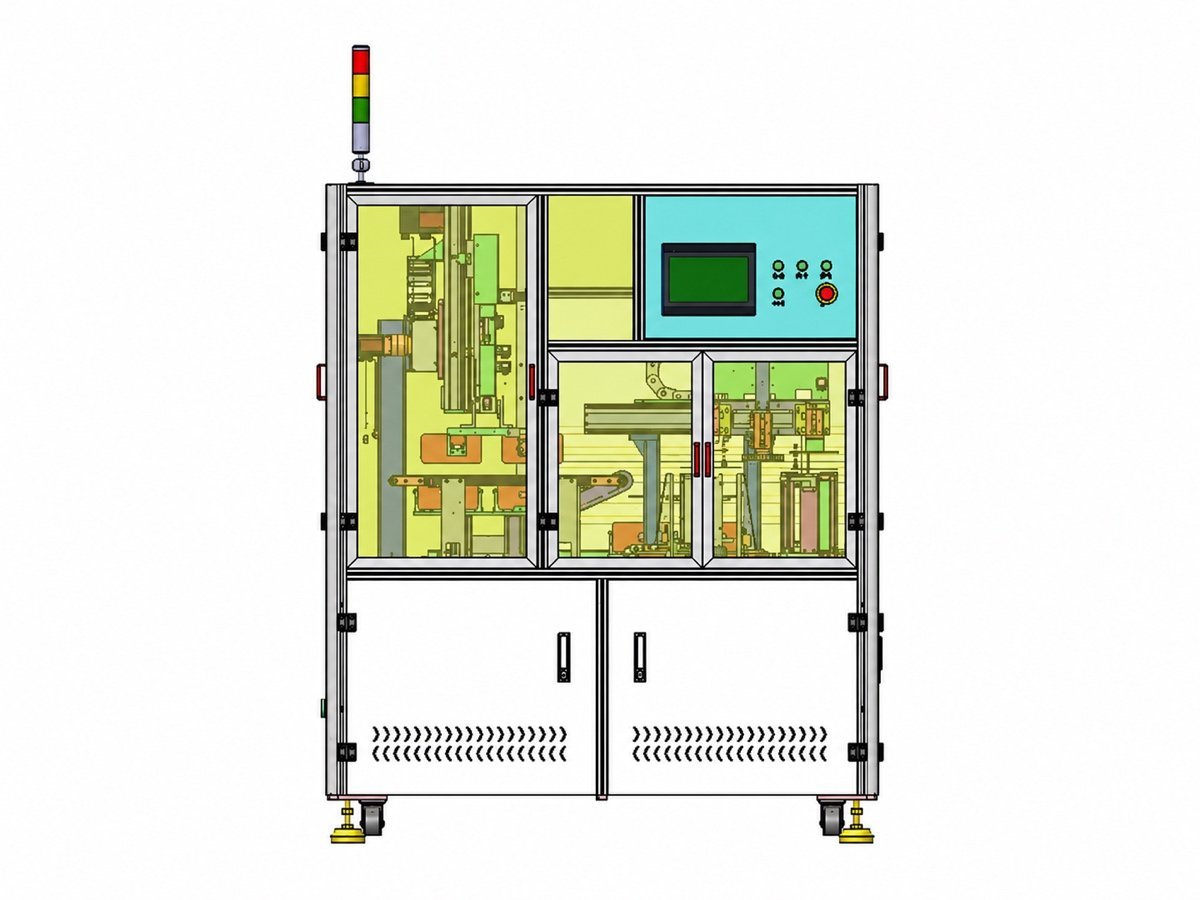
What this machine does, and which machine it feeds
Before a batch of cover glass can be edge-polished, the panels have to be stacked into racks with a sheet of paper between each one, faces matched and edges aligned. Done by hand that is slow and it scratches faces. An automatic glass stacking machine does it: it takes the panels and the interleaving paper, centres each panel, and builds the rack the edge polisher runs from — replacing the hand-stacking that used to feed that machine.
The AL-7S docks to the CNC edge polishing machine: it builds the stacked racks that machine polishes. The numbers line up exactly — the AL-7S stacks to 210 mm, which is the maximum clamp height the edge polisher takes, so a full stack loads straight in with no re-handling.
An automatic glass stacking machine moves and stacks parts; it does not grind or polish them. What matters here is cycle time, the glass size and paper it fits, the stack height, and which host machine it feeds — the questions a line builder asks.
How does an automatic glass stacking machine build a stack?
Two panels at a time, a sheet of paper between each, centred mechanically — a rack built without a hand touching the faces.
Pick, interleave, centre, stack — repeated to 210 mm, with the racks changed over without stopping.
- Pick two — a servo motor and synchronous-belt module lift two panels at a time, which is what holds the 2.5–3.5 s cycle
- Interleave — a sheet of paper is laid between panels; two paper types can be alternated, and the magazine sits at the same height as the stack so glass and paper are taken without a wasted move
- Centre — each panel is mechanically centred to ±0.20 mm, and 2D faces stack to 2D, 2.5D to 2.5D, with the notch or earpiece cut-out kept on one side
- Stack to height — the rack is built up to 210 mm, the height the edge polisher clamps
Because an automatic glass stacking machine uses upper and lower rack positions, one rack is unloaded while the next is built, so an operator can tend several machines without stopping any of them.
Panels should arrive facing the same way with a small gap left between them for the gripper, and the racks facing the same way too. Send us your glass size, the paper and the rack, and we confirm the AL-7S suits your line with the quotation.
Four things that keep the edge polisher fed
The AL-7S runs between rack changeovers; these are what an automatic glass stacking machine has to get right to keep a polishing cell supplied.
Two panels a pick
Lifting two panels at a time on a servo belt module holds the cycle at 2.5–3.5 s a part, fast enough to keep the edge polisher fed.
Paper interleaved, two types
A sheet of paper goes between every panel to protect the faces, and two paper types can be alternated for jobs that need it.
Non-stop rack changeover
Upper and lower rack positions let one rack be removed while the next is built, so one operator keeps several machines running.
Adjusts across 5–7 inch
The stacking head adjusts for the different 5-, 6- and 7-inch formats, so a change of glass size is a setting, not a rebuild.
Which glass and racks does it fit?
| Item | Fit |
|---|---|
| Glass size | 60 × 150 – 80 × 175 mm (5–7 inch cover glass) |
| Faces | 2D to 2D, 2.5D to 2.5D; notch / earpiece cut-out on one side |
| Stack height | ≤ 210 mm, including paper |
| Alignment | Mechanical centring, ±0.20 mm |
| Paper | Two interleaf types, alternated |
| Glass load | 200 pcs across 4 racks (customer’s racks) |
| Docks to | The CNC edge polishing machine |
The cover glass an automatic glass stacking machine handles is cut to a fixed outline before it reaches this station; those drawings are usually dimensioned to the ISO 10110 framework and cut from the glasses in the optical materials data. What the machine itself needs is the glass size, the paper and the rack.
A sister unit, the AL-6R, does the neighbouring job — automatic racking of 4–6 inch phone glass and other rectangular parts: it carries the glass from a supply tray, positions it and inserts it into a rack, three functions in one. It is offered as part of a line rather than as a catalogue item; for its specification, please ask us and we will send the details for your parts.
Technical specifications
The AL-7S feeds the edge polisher with stacked flat cover glass; for standing round lenses into baskets ahead of the generating line, the basket loader is the automation piece instead.
| Function | Automatic stacking of cover glass with paper interleaving |
| Glass size | 60 × 150 – 80 × 175 mm (5–7 inch) |
| Stack height | ≤ 210 mm, including paper |
| Fastest cycle | 2.5 – 3.5 s a part (excluding load / unload) |
| Alignment | Mechanical centring, ±0.20 mm |
| Panels per pick | 2 |
| Paper types | 2, alternated |
| Glass load | 200 pcs, 4 racks |
| Drive | Servo motors with synchronous-belt modules |
| Power supply | 220 V |
| Power | 2.5 kW |
| Air pressure | 5 – 7 kg/cm² |
| Overall dimensions (L × W × H) | 1600 × 1230 × 2360 mm (with signal tower) |
| Total weight | approx. 1100 kg |
| Certification | CE |
The grippers, paper magazines and rack interfaces are chosen for your glass size and rack, and are confirmed with the quotation.
Main assemblies and what each one is for
This is the vocabulary your operator and our service engineer will share on the shop floor.

| Assembly | Function |
|---|---|
| Servo belt module | Servo motor and synchronous belt; picks two panels a time and holds the position repeatability |
| Paper magazine | Holds two interleaf paper types at stack height, so glass and paper are taken together |
| Centring station | Mechanically centres each panel to ±0.20 mm before it is placed |
| Rack positions | Upper and lower racks for non-stop changeover |
| Control & signal tower | Runs the cycle and shows status on a three-colour tower |
| Pneumatics | Air supply for the grippers, 5–7 kg/cm² |
Utilities, environment and safety
Electrical supply, compressed air, floor space and the ambient conditions the machine is to run in are confirmed with us for each order, together with the safety and protective arrangement supplied with it. These figures depend on the voltage and frequency of your site and the destination market, so we do not publish a single set of them here.
Send us the site conditions and the host machine with your enquiry and we will return the utility and environmental requirements in writing, before the order is placed.
The AL-7S stacks flat 5–7 inch cover glass with paper into racks for edge polishing — it is a handler, not a machine that grinds or polishes, and it is not for round lenses. Incoming glass has to arrive facing the same way with a gripper gap; we confirm your glass, paper and rack before quoting.
What happens after the machine is installed?
The same terms apply to every machine we ship, wherever in the world it goes.
| Warranty period | 12 months from final acceptance |
| Response during warranty | Response within 8 hours · solution proposed within 24 hours · issue resolved within 48 hours, including procurement, installation and commissioning of parts |
| After the warranty period | Service and spare parts available for the life of the machine |
| Certification | CE |
Specifications are subject to change as a result of design upgrades. Minor differences may occur at certain parts. For a binding specification, refer to the order confirmation.
See the machine running
The AL-7S picking two panels, laying paper between them, and building a stack up to the edge polisher’s height.
01 — Two-panel pick and paper interleave
02 — Non-stop rack changeover
Tell us your glass, paper and rack
An automatic glass stacking machine is specified from the line it joins, not from a datasheet. Tell us the cover-glass size, the interleaf paper, the rack the edge polisher runs and the rate you need. We confirm the fit and send the quotation, and can quote the AL-6R racking unit alongside if your line needs it.
If your parts are round lenses for the generating line rather than flat cover glass, the basket loader is the automation piece — we will point you to it.
8-hour response · service and spare parts for the life of the machine
Line automation for optics and cover-glass makers worldwide
Related equipment and reading:
- CNC edge polishing machine EP-220C — the machine the stacked racks feed
- Lens basket loading machine AL-20B — the basket loader for round lenses
- Wafer lapping and polishing machine DL-290/395 — face finishing for flat parts
- Optical lens fabrication line — how the stations connect