
§ 01 — Who it’s for
Who is a germanium lens manufacturer equipment supplier actually for?
For the people who make the lens — not the people who buy it finished. A germanium lens manufacturer equipment supplier sells the machines (the saw, the centering machine, the grinder, the polisher, the coater) to optics shops that want to own their process rather than outsource it to a contract house.
That covers a wide span of buyers. Some start with a single SGI 20 on an R&D bench to prove a part, then scale; others run fleets of 30+ machines across multiple sites. Some build a brand-new germanium line from scratch; others keep their existing grinding and polishing and retrofit only the front-end cut. The common thread is that they process the material in-house. What they are buying is capability they keep, not a service they rent.
Germanium is the centre of gravity, but the same platforms handle ZnSe, ZnS, silicon and sapphire — so the customers are thermal-imaging makers, defense optics integrators, IR sensor-module and automotive teams, and research optics groups, more than any single industry. The finished parts run from thermal-scope objectives and weapon-sight optics to automotive night-vision modules, gas-sensor windows and bench research components.
§ 02 — The shops we equip
Which shops buy this equipment, and what they buy
A germanium lens manufacturer equipment supplier sees roughly three kinds of buyer, and each tends to buy a different slice of the line. Knowing which one you are is the fastest way to scope a quote.
Thermal-imaging OEMs & defense integrators
These buyers run germanium and chalcogenide optics for thermal scopes, weapon sights and surveillance systems. They tend to buy complete turnkey lines under a single delivery window, because consolidating supplier responsibility simplifies a defense-grade quality audit more than shaving unit price would. Fleet uniformity matters too — one platform programmed once and reproduced across sites keeps a multi-line operation consistent.
Sensor-module & automotive thermal makers
High-volume producers of IR sensor modules and automotive night-vision optics need repeatable contour and slice cycles above all. They value programmable, hands-off slicing and the low kerf loss that protects margin on expensive germanium at scale. A fraction of a millimetre of kerf, multiplied across thousands of cuts a year, is a six-figure material line on its own.
Research optics & contract shops
Labs, university groups and small contract optics shops usually start with one compact machine — an SGI 20 bench unit for R&D or small-batch work — and add capacity once a part proves out. The same platform scales with them rather than being outgrown — because programming carries between jobs, a bench unit that proves a part can hand the exact recipe to a production frame later.
§ 03 — On the wall
Who already buys from us?
The clearest answer to “are we a credible supplier” is the list of names already running the machines, backed by a documented ISO 9001 quality system. Across optics and hard-material processing, our reference customers include:
Sunny Optical30+ machines · thermal & ADAS optics (CN)
Edmund OpticsOptical components
CoherentLaser optics
SGL CarbonGraphite machining
Mersen GraphiteIndustrial graphite
TecniscoSemiconductor substrates
The range of deployment matters as much as the names. A Turkish thermal-imaging integrator took a full turnkey germanium line in a single purchase; a Dutch precision-optics shop bought only the front-end cut and kept the rest of its floor. Same supplier, two very different scopes — which is the point of equipping shops rather than selling them a fixed package. Together they span more than twenty countries, from established European optics houses to Asian volume producers and North American labs. What ties them together is less the size of the order than the decision behind it: they would rather hold one supplier accountable for the equipment than coordinate three or four who each point at the others when a tolerance slips.
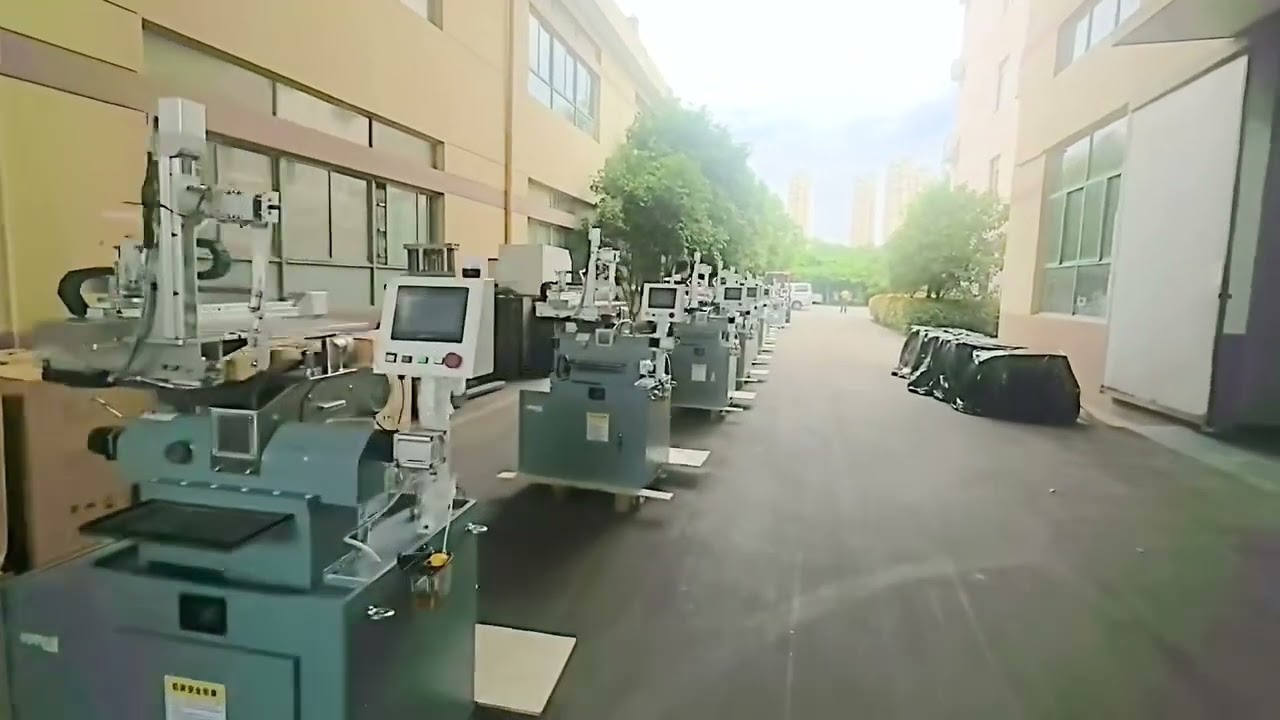
The clip below isn’t a render: it’s a batch of finished optics machines crated and staged on the floor, waiting to ship to customers — the install base, mid-delivery.
§ 04 — Are you a fit?
Are we the right supplier for you?
Not every optics buyer should buy from a germanium lens manufacturer equipment supplier, and saying so up front saves everyone a wasted quote. We would rather scope you out early than oversell. You’re a fit if most of these are true:
- You processYou cut and finish Ge (or ZnSe, ZnS, Si, sapphire) in-house, or you’re building that capability.
- You ownYou want to own the equipment and the process, not buy finished lenses by the batch.
- Any scaleFrom one R&D bench saw to a multi-site fleet — new line or front-end retrofit.
- You verifyYou’ll send a sample so we can prove the cut on your material before you commit.
§ 05 — Where to start
What you’d actually be looking at
Once you know you’re a fit, the question is which part of the line you need — and that depends on what you already run. New shops tend to look at the whole chain; established ones usually start at the cut. Either way, the right entry point is the one that matches the parts you already struggle to make cleanly.
Choosing a germanium lens manufacturer equipment supplier comes down to whether the range fits both ends of your future, from bench to production. A supplier that only sells production frames strands the small buyer; one that only sells bench units caps the large one — the range has to cover both, or it forces an expensive re-buy later. Ours is built to.
Start at the infrared optics manufacturing equipment hub for the overview, see the five-stage line on the germanium lens manufacturing solution page, and look at the entry-point machine on the germanium lens blank cutting machine page. For the company behind it, see why we’re a trusted infrared optics equipment supplier.