
Is china optical cutting machinery export a risk worth taking?
It's a fair question, and the honest answer is to show the mechanics rather than wave them away. China optical cutting machinery export carries a real perception of risk — distance, customs, after-sales — so this page walks each one: how the machine ships, how it powers up on your floor, and what happens the day something needs attention.
Every machine passes a factory acceptance test before it is crated, and after contract we cut your own material on the actual unit, so the first part you see is on the machine you are buying. The saws run on single-phase 220–240V at about 2 kW, so they plug into ordinary shop power almost anywhere without a transformer. Crated weight and dimensions are on the spec sheet for freight planning — a standard SG40 is roughly 650 kg at 1066 × 1066 × 1970 mm. Machines ship in export crates with the coolant system drained and the wire tensioner secured for transit, so nothing shifts during weeks of sea freight.
After-sales is where overseas purchases usually fall down, so the machine is built to be self-serviceable. The diamond wire and the guide wheels — the only real wear parts — are user-replaceable, so your own team swaps them instead of waiting on a technician's flight. Remote diagnostics handle most of the rest, spare parts are held in stock, and every machine ships with a one-year warranty plus install and operator training. A starter pack of spare wire, guide wheels and cutting oil travels with the machine, so you are productive on day one rather than waiting on a first consumables order.
What lands on your dock, and what happens next
China optical cutting machinery export is really three phases — before it ships, on arrival, and over the machine's life — and a serious supplier has an answer for each.
Before it ships
The machine clears a factory acceptance test, we run a sample cut on your material, and you receive the CE marking, RoHS declaration and ISO 9001 documentation your customs broker will ask for at the border. We can pre-fill the technical-file and declaration-of-conformity references too, since missing paperwork is usually what stalls a machine at customs rather than the machine itself.
On arrival
Single-phase power means no transformer to source; install and operator training are delivered remotely or on-site, and the machine is commissioned against the acceptance terms you agreed before paying the balance. Commissioning runs over a video call with your operators at the machine, or on-site by arrangement in regions where we have partners.
Over its life
Remote diagnostics resolve most issues without a visit, consumables are user-replaceable, spares ship from stock, and the one-year warranty covers parts and engineering support. Because the controller is our own PLC, a firmware or parameter problem is something we diagnose and patch remotely rather than shipping a black box back across the world. The aim is a machine your own people can keep running.
Where has it actually shipped?
To more than twenty countries — the US, Germany, France, Korea, Singapore, India and beyond — and the technology is shown each year at Photonics West in San Francisco and Laser World of Photonics in Munich. Power compatibility is the quiet reason the reach is so wide — a single-phase 2 kW machine needs no special supply, so a shop in one country installs it the same way a lab in another does. The essentials that make that reach practical are below.
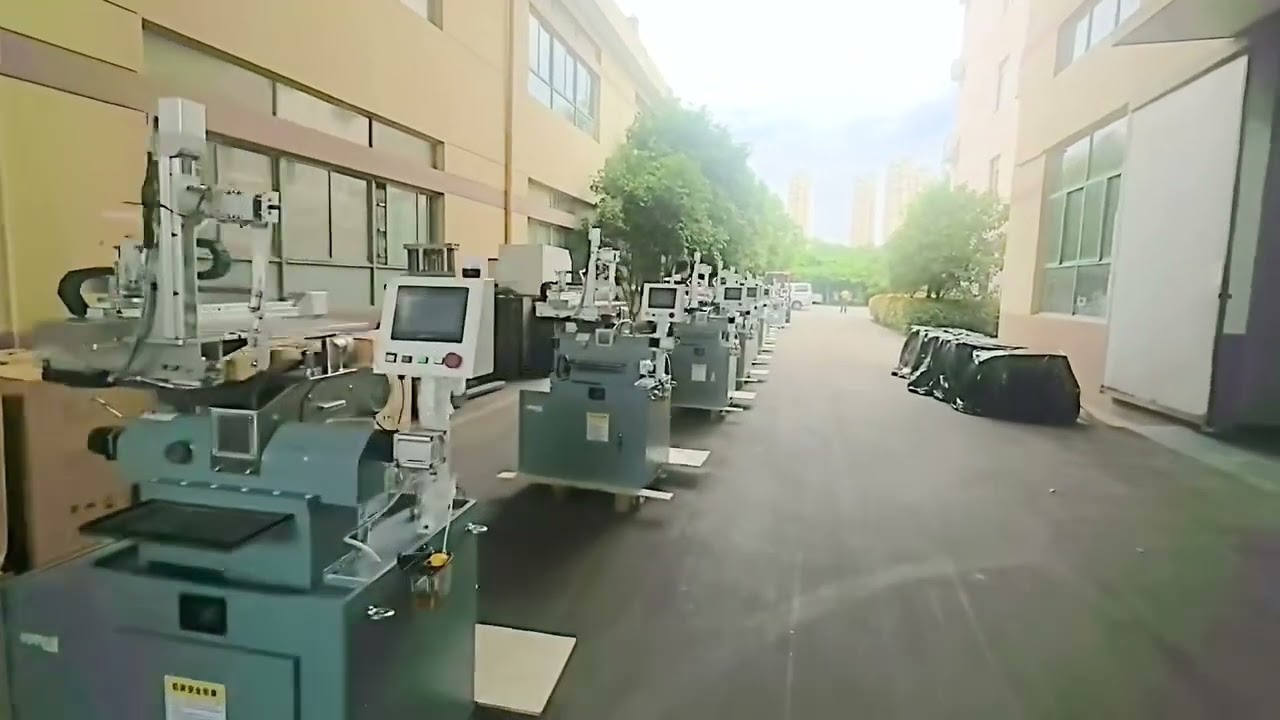
The clip below isn't a render: it's a batch of finished optics machines crated and staged on the floor, waiting to ship to customers — export volume, mid-delivery.
What could still go wrong buying from overseas?
No china optical cutting machinery export is risk-free, and a supplier who tells you otherwise is the actual warning sign. We would rather set the expectation now than manage a dispute later. Here is what we control and what we don't.
- Lead timeDepends on configuration and queue — we quote a real window, not a best case.
- CustomsDuties, import paperwork and clearance are buyer-side; we supply the compliance documents, not the clearance.
- PowerConfirm your voltage and phase up front; we configure to it before shipping.
- ProofA sample cut on your material comes before commitment, not after.
- CommsThe time-zone gap is real — we hold to a one-business-day reply, but live calls are scheduled rather than instant.
Where export sits in the decision
Shipping, certification and support are the last link in the chain — and none of it matters unless the machine at the other end earns its place on your floor. Export logistics are how a good machine reaches you; they are not a substitute for the machine being good. Freight, insurance and Incoterms are settled in the quote, so there are no surprises on landed cost.
So china optical cutting machinery export is only as strong as what it delivers: a closed-loop wire saw built to hold its tolerances, backed by a supplier you can still reach once the crate is open.
To judge the machine itself, start at the infrared optics manufacturing equipment hub, see the front-end saw on the germanium lens blank cutting machine page, and walk the full line on the germanium lens manufacturing solution page. For the company standing behind the shipment, see why we're a trusted infrared optics equipment supplier.