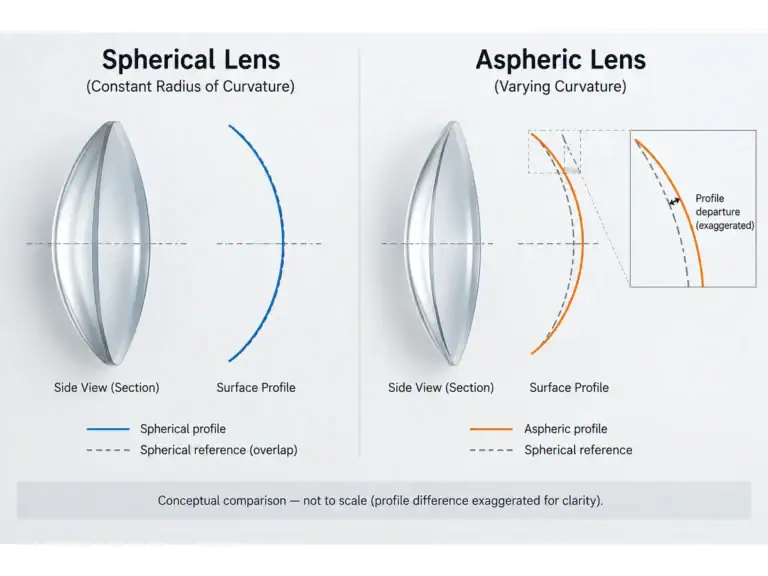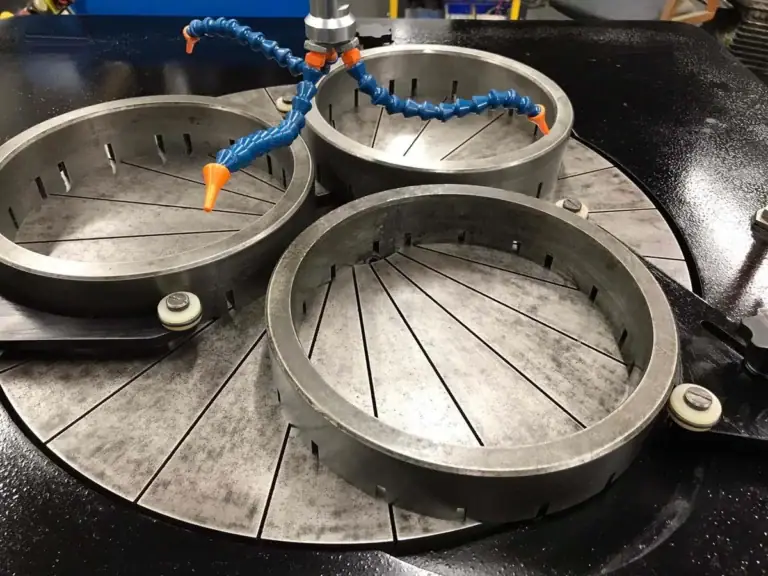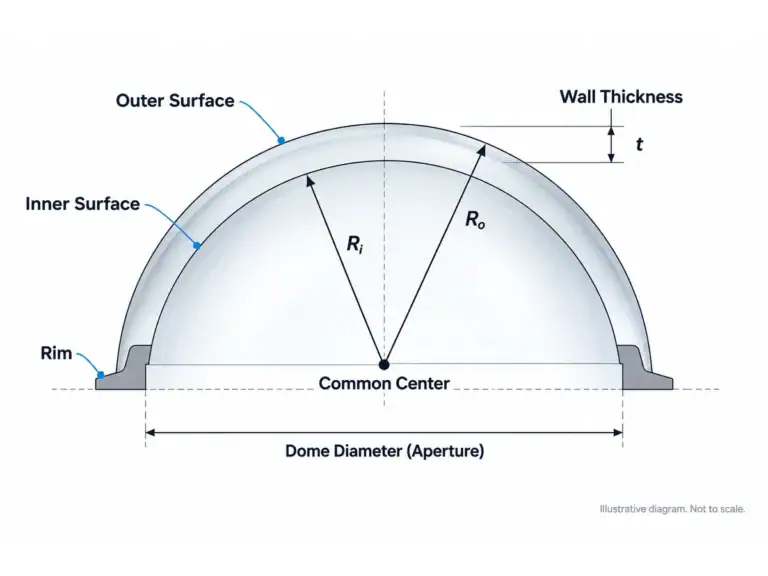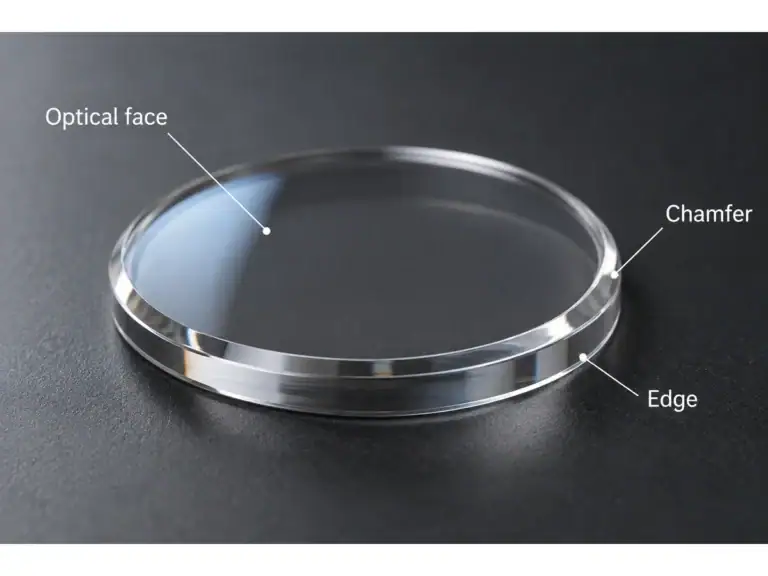
Die optical lens manufacturing process läuft von der Material- und Rohlingsvorbereitung über Formgebung, Polieren, Beschichten und Inspektion. Die Route hängt vom Material und dem erforderlichen Ergebnis ab: ein Rohling, ein halbfertiger Brillenglasrohling oder eine fertige optische Linse. Vergleichen Sie unten die Routen für Glas- und Gießharzrohlinge, bevor Sie den allgemeineren Präzisionsoptik-Workflow verfolgen.
Brillenglasrohling-Prozessablauf anzeigen
Herstellungsprozessablauf für Brillenglasrohlinge
Ein Brillenglasrohling ist nicht dasselbe wie eine fertige Korrektionsfassung. Ein Rohling liefert Material für die spätere Formgebung. Ein halbfertiger Rohling hat bereits eine fertige optische Oberfläche auf einer Seite; die andere Seite wird für die erforderliche Korrektur bearbeitet. Eine fertige Linse hat ihre optischen Oberflächen fertiggestellt, obwohl das Randen zur Anpassung an die Fassung noch folgen kann. Geben Sie an, welche dieser Ergebnisse Sie benötigen, bevor Sie die Herstellungsrouten vergleichen.
Gießharzrohlinge
Für geeignete gießbare Harze ist die vereinfachte Route: Monomermischung vorbereiten → Form füllen → aushärten → entformen und Restspannungen behandeln → Rohling prüfen. Die Form und das Materialsystem bestimmen die Anfangsgeometrie. Dies ist keine universelle Route für jedes Kunststoffmaterial: Gehen Sie nicht davon aus, dass Polycarbonat, Gießharze und maschinell bearbeitete Polymeroptiken die gleiche Produktionssequenz verwenden.
Mineralglasrohlinge
Eine vereinfachte Mineralglas-Brillenglasroute ist: Glas schmelzen → Rohling pressen → Vorderseite schleifen → polieren → halbfertigen Rohling prüfen. Das Schneiden von Material aus größeren Glasstücken ist eine andere Vorbereitungsoption, die für geeignete optische Glasmaterialien verwendet wird; es darf nicht als zwingender Schritt in jeder gepressten Brillenglasrohlinglinie dargestellt werden. Halten Sie die Rohlingsherstellungsroute getrennt von der späteren Korrekturflächenbearbeitung.
Vom halbfertigen Rohling zur Korrektionsfassung
Die anschließende Route kann die Auswahl des Rohlings, das Blockieren für die Werkstückaufnahme, das Erzeugen der erforderlichen Rückseite, das Polieren, das Entblockieren und Reinigen, das Aufbringen der spezifizierten Beschichtungen und die Überprüfung des optischen Ergebnisses umfassen. Das endgültige Randen passt die Linse an die Fassung an. Diese Vorgänge erklären, warum ein Rohlingsherstellungsflussdiagramm und ein Fertigglasflussdiagramm nicht als austauschbar behandelt werden sollten.
Für eine Produktionsübergabe notieren Sie das Material, den Rohlingtyp, den Durchmesser, die Dicke und die verfügbare Bearbeitungszugabe. Vereinbaren Sie, welche Oberfläche bereits fertig ist und wie sie geschützt werden muss. Inspektionskriterien sollten die Zeichnung und den nächsten Vorgang betreffen, einschließlich sichtbarer Defekte, Kantenschäden und der erforderlichen optischen Eigenschaften. Akzeptable Grenzwerte müssen aus der Teile spezifikation stammen, nicht aus einem generischen Prozessdiagramm.
ZEISS beschreibt die Unterscheidung zwischen Lagergläsern, halbfertigen Rohlingen und der Verarbeitung von Korrektionsfassungen. Seine Beispiele helfen, die Routen zu unterscheiden; sie sind keine Spezifikationen für Vimfun-Ausrüstung.
Ausrüstungsgrenze: Diese Seite erklärt die Herstellungsstufen. Sie behauptet nicht, dass eine Diamantdrahtsäge Harzguss, Formgebung oder Korrekturflächenbearbeitung ersetzt oder dass Vimfun jede Stufe einer Brillenglasproduktionslinie liefert. Für einen vorgeschlagenen optischen Glasschneideauftrag teilen Sie bitte das Material, das Ausgangsmaterial, die Zeichnung und die nachgelagerte Zugabe mit, damit die Eignung der Ausrüstung beurteilt werden kann.

Der folgende siebenteilige Überblick konzentriert sich auf Präzisionsoptiken, die durch Materialabtragungsverfahren hergestellt werden. Die tatsächlichen Produktionssequenzen hängen vom Material, dem gelieferten Rohling und der Endspezifikation ab; nicht jede Linse durchläuft einen separaten Schneidvorgang.
For a general overview of optical lens fabrication methods, see this Encyclopaedia Britannica resource on lens manufacturing:
https://www.britannica.com/technology/lens-optics/Manufacturing-optical-lenses
From Raw Material to Finished Lens: 7‑Step Process (Text Flow Diagram)
Unten ist ein Beispiel optical lens manufacturing process für Präzisionsoptiken. Passen Sie die Sequenz an den gelieferten Rohling und die Teilespezifikation an; es ist keine universelle Brillenglas-Gießroute:
- Material Selection & Inspection ← Raw optical glass or polymer blank
- Blank Generation & Pre‑Forming ← Rough shaping to near net profile
- Precision Cutting & Contour Establishment ← [Cutting]
- Grinding & Sizing ← Oberflächenfigur und Dickenkontrolle
- Polieren ← Erforderliche Oberflächengüte und optische Qualität erzielen
- Beschichtungs- & Funktionsschichtauftrag ← AR-Beschichtungen, Filter
- Endkontrolle & Qualitätssicherung ← Interferometrie, MTF-Tests
Jeder dieser Schritte baut auf dem vorherigen auf. Fehler addieren sich statt sich aufzuheben, daher ist eine solide Basis – insbesondere ab Schritt 3 – entscheidend.
Stufenweise technische Herausforderungen
1. Material Selection & Inspection
- Technische Herausforderungen: Kontrolle der Brechungsindexhomogenität, Doppelbrechung, innerer Spannungen, Einschlüsse.
- Unvollkommenheiten in diesem Stadium begrenzen die erreichbare Oberflächenqualität unabhängig von nachfolgenden Bemühungen.
2. Blank Generation & Pre‑Forming
- Die Grobformgebung etabliert die Anfangsform. Für geeignetes Glasprisma-Material, Prisma-Schneidausrüstung ist eine anwendungsspezifische Option, keine allgemeine Lösung zur Herstellung von Brillenglasrohlingen.
- Sorgfältiges thermisches Management und Spannungsmanagement sind erforderlich, um Rissbildung zu vermeiden.
3. Precision Cutting & Contour Establishment
- Das Schneiden definiert die äußere Kontur und die Materialbasis für alle nachfolgenden Operationen.
- Erfordert hohe geometrische Genauigkeit, stabile Spannvorrichtungen und geringe induzierte Spannungen.
- Die Korrektur von Exzentrizität, Neigung oder unebenem Material erfordert eine ausreichende Bearbeitungszugabe; andernfalls erfüllt der Rohling möglicherweise nicht die Endgeometrie.
4. Grinding & Sizing
- Dieser Schritt entfernt Material auf einer optische Linsen Schleifmaschine um die endgültige Krümmung und Dicke zu erreichen.
- Challenges include tool wear, wheel loading, heat management, and maintaining consistent stock removal.
5. Polieren
- Das Polieren auf einer optische Linsenpoliermaschine eliminiert Mikro-Rauheit und erzielt optische Oberflächenqualität.
- Sensitive to subsurface damage; polishing cannot “heal” cracks or deep fractures.
6. Coating
- Multilayer dielectric and AR coatings require surface cleanliness and stable substrate.
- Coating adhesion and uniformity depend on preceding surface quality.
7. Abschließende Inspektion
- Uses interferometry, modulation transfer function (MTF) testing, and other metrology tools.
- Confirms conformity to design, but cannot correct inherent flaws.
The Role of Cutting in Different Materials
Cutting in Glass Optics
Glass lenses (e.g., borosilicate, crown/flint types) are brittle and prone to micro‑fracture. Cutting must minimize:
- Surface cracks
- Subsurface damage
- Edge chipping
Typical strategies include diamond‑tool cutting and controlled feed rates to reduce fracture propagation.
Cutting in Plastic Optics
Plastic lenses (e.g., PMMA, PC) are more ductile than glass.
- Cutting can introduce heat softening, melting, or edge roll‑over if thermal build‑up is poorly managed.
- Coolants and low‑heat tool paths help preserve geometric accuracy.
Einige Glas- und Polymeroptiken werden aus Rohmaterial maschinell bearbeitet, während andere Rohlinge gegossen oder nahe der erforderlichen Form geformt werden. Das Schneiden ist daher routenabhängig, keine obligatorische Operation für jede Linse.
Wenn Schnittfehler die nachgelagerte Wiederherstellung einschränken
Die Wiederherstellbarkeit eines Schnittfehlers hängt von seiner Tiefe, der verbleibenden Bearbeitungszugabe und der Endspezifikation ab. Überprüfen Sie diese Grenzwerte, bevor Sie einen Rohling zur weiteren Verarbeitung freigeben:
1. Baseline Geometric Error
If the contour or stock distribution is uneven, grinding and polishing consume additional material to compensate, reducing yield and potentially exceeding tolerances.
2. Subsurface Cracks and Fractures
Unterflächliche Schäden können die mechanische Integrität verringern. Das Entfernen einer beschädigten Schicht erfordert genügend Materialabtrag, um unter die Defekte zu gelangen; es sollte nicht davon ausgegangen werden, dass das Polieren allein tiefe Risse innerhalb der verfügbaren Zugabe entfernt.
3. Residual Stress
Improper cutting strategies can leave residual stresses that later warp during polishing or coating, affecting curvature stability.
4. Material Removal Asymmetry
Uneven starting stock makes symmetrical shaping difficult; downstream processes amplify these asymmetries in final optical performance.
In short: Prüfen Sie die Defekttiefe und das verfügbare Material, bevor Sie einen Rohling nacharbeiten. Einige Defekte können entfernt werden; andere machen die Endgeometrie oder die Qualitätsanforderung unerreichbar.
Abschluss
A robust optical lens manufacturing process beginnt mit der richtigen Materialroute und einer klaren Definition des Rohlings, der jeder Operation zugeführt wird. Wo ein Schnitt erforderlich ist, kontrollieren Sie Geometrie und Beschädigung und reservieren Sie ausreichend Material für die nachgelagerte Endbearbeitung.
By understanding how each stage contributes—especially how cutting errors propagate downstream—engineers can design more resilient workflows and reduce defect rates in high‑precision optical products.