
Irregular germanium lens cutting at Sunny Optical: two test cuts, four purchase orders
A crescent-shaped thermal imaging lens with R1 corners had defeated core drills, ID saws, and grinding from square blanks. This is the record of how we qualified it: a first test cut that already beat every method the customer had tried, and a second that dialed in the last two dimensions.
Why does irregular germanium lens cutting defeat conventional saws?
Irregular germanium lens cutting fails for a simple reason: every conventional cutting tool is built around one geometry, and germanium punishes any attempt to work outside it. Core drills cut circles — nothing else. ID saws cut straight lines — nothing else. When Sunny Optical (HKEX 2382) brought us a crescent-shaped thermal imaging lens with multiple small-radius corners, both tools were disqualified before the first quote.
The fallback most shops try is grinding the profile out of an oversized square blank. Geometrically it works. Economically and mechanically it doesn't. Single-crystal germanium sits at Mohs 6–6.5 with low fracture toughness and a strong {111} cleavage tendency — a grinding wheel entering an R1 corner concentrates stress exactly where the crystal wants to split. Sunny Optical's experience matched what we'd expect: heavy edge chipping at the small-radius transitions, profile accuracy that wouldn't hold the drawing, and more than half an hour of machine time per part. At 2024–2025 germanium prices of $1,800–2,400 per kilogram, the oversized starting blank alone was an unacceptable line item.
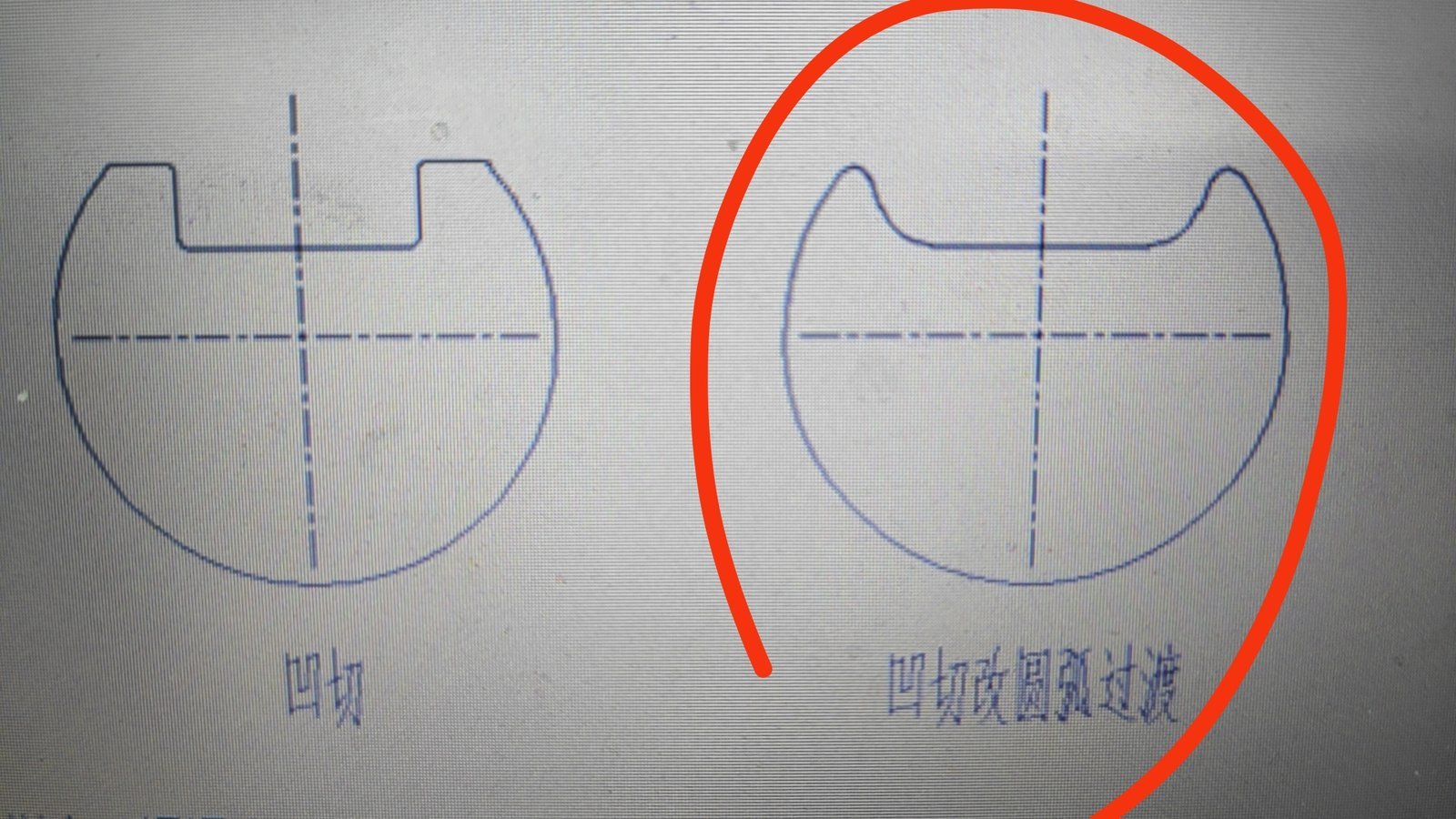
A crescent profile with R1 transitions and a 110° bevel
The drawing defines a 73.45 × 52.82 mm outline: an asymmetric arc-and-chord profile with two R6 corner radii, two R1 transitions, a 110° beveled upper edge, and an 85 mm spherical radius on the optical face. Six controlled dimensions govern the outline, and in irregular germanium lens cutting the drawing is the process — the wire path is programmed straight from these dimensions. This is the geometry that has to come off the saw clean — chipping at any R corner scraps the part, because the downstream grinding allowance at those features is nearly zero.
What happened in the two test cuts?
We don't qualify parts on claims; we qualify them on cut samples. Sunny Optical supplied germanium stock, we programmed the profile from their DXF, and we cut. The first article was measured against all six drawing dimensions in January 2024.
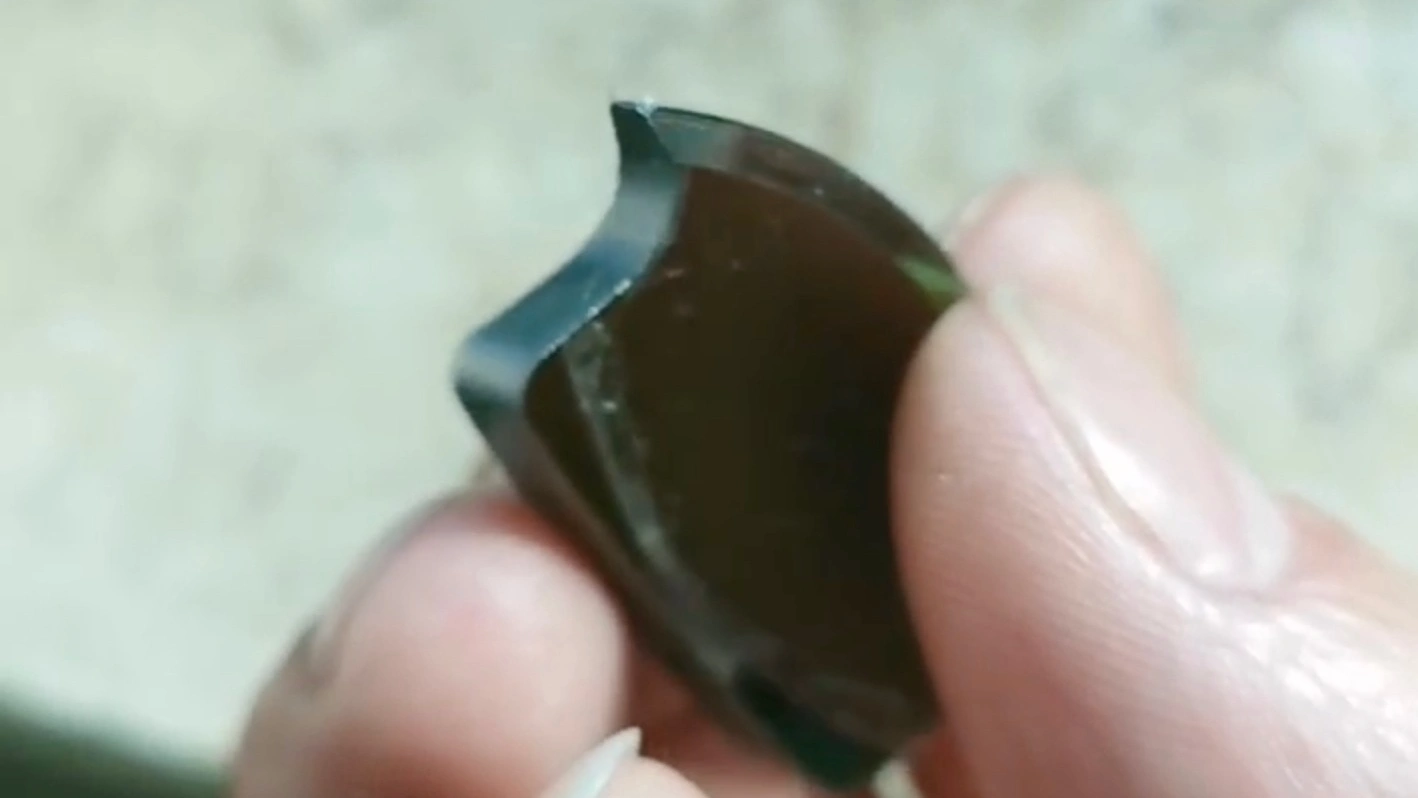
The first cut already met the customer's expectation. Edges came off the wire clean — no chipping anywhere on the profile, not even at the R1 transitions that had been scrapping their ground parts — and the outline accuracy was well beyond anything their earlier attempts had produced. Four of six dimensions sat comfortably inside the drawing tolerance. Dimensions 4 and 5 showed a small deviation worth tightening before series production.
The deviation signature told us exactly what to adjust. Dimensions 4 and 5 weren't scattered — they were offset together, in the same direction, by a consistent amount. That's not a wire problem or a material problem; it's a datum offset. The workpiece coordinate system sat 0.27 mm high in Y relative to the programmed path. One refinement — shifting the Y-axis origin down 0.27 mm — brought the last two dimensions in line. Nothing else in the program changed.
| Cut | Result | Action taken |
|---|---|---|
| Test 1 · Jan 2024 | Met customer expectation — zero edge chipping, R corners intact; 4 of 6 dims in tolerance, dims 4 & 5 with a consistent Y-direction deviation | Validation accepted; Y-axis datum refined −0.27 mm for the follow-up cut |
| Test 2 · Jan 2024 | All 6 dimensions in tolerance — precision fine-tuned, edge quality unchanged | Profile qualified; samples shipped to customer for incoming inspection |
The hard problem — the one that had defeated every previous method — was solved on the very first cut. The endless diamond wire runs in one direction at constant tension, so there is no reversal shock at the R1 transitions and no exit-face cleavage — the failure modes that had scrapped parts under the grinding approach. What remained after test 1 was fine-tuning, and the fine-tuning was a coordinate offset, not a fight with the material. That is the recurring lesson of irregular germanium lens cutting on an endless wire: the crystal behaves; precision comes down to datum discipline.
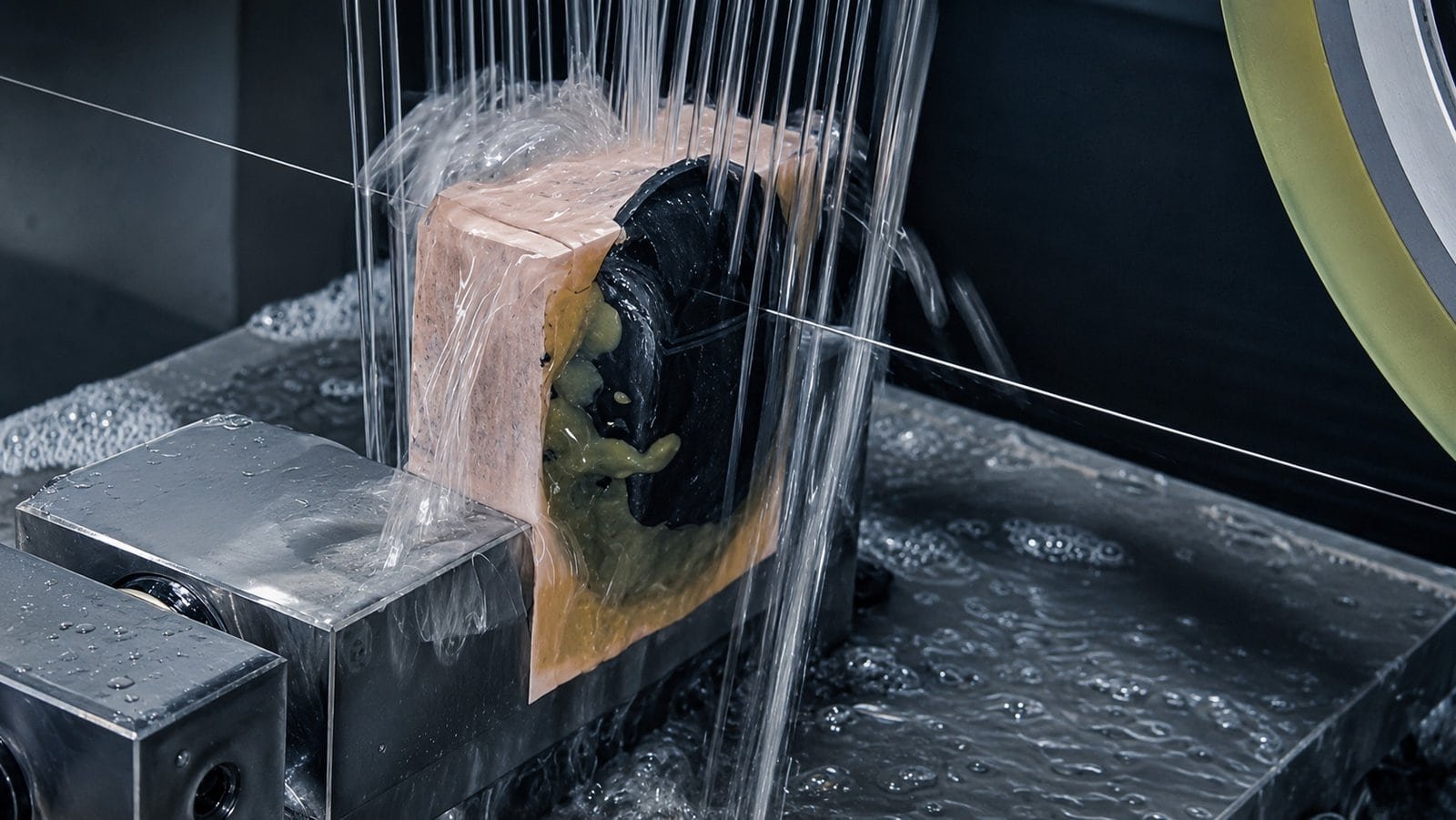
One SGI 20, two cutting systems
The machine Sunny Optical qualified is the SGI 20 endless diamond wire saw — a 200 × 200 mm worktable, 220 mm workpiece height, wire diameters from 0.35 to 1.0 mm, and wire speed up to 61 m/s. Two independent control systems run on the same platform:
- Contour system. Load the customer's CAD drawing (DXF), set cutting parameters, and the wire follows the path — arcs, free curves, and small-radius corners included. Kerf equals wire diameter, so a 0.4 mm wire consumes 0.4 mm of germanium along the path instead of the centimeters of stock a ground-from-square approach wastes.
- Slicing system. Set slice thickness and quantity; the machine sections pucks or rods automatically, with different thicknesses allowed in one run. Feed rates of 10–20 mm/min on germanium.
That second system is why this case didn't end at one machine. Sunny Optical brought us an irregular germanium lens cutting problem nothing else could solve, then found the same platform handled their routine puck slicing and rod extraction. A special-shape machine that idles between special-shape jobs is a hard capital case; one that fills its idle hours with production slicing is not.
Four purchase orders and a standing platform decision
After incoming inspection of the qualified samples, Sunny Optical placed its first order. Three more followed — four purchase orders in total, building to dozens of machines, and the company now operates more than 30 Vimfun wire saws across its production sites. Their reported production yield on this product family improved roughly 30% after the switch, driven mostly by eliminating R-corner chipping and by the shallower subsurface damage a wire cut hands to the polishing line.
For readers mapping this onto their own parts: the irregular germanium lens cutting workflow shown here is the front end of a larger toolchain. The SGI-series saws sit alongside our centering, spherical grinding, and polishing stations within a coordinated germanium lens manufacturing equipment lineup, which itself belongs to the broader infrared optics processing equipment range. Teams planning a complete line from ingot to coated lens should start from the infrared optics production line overview.
If you have a germanium profile that core drills and ID saws can't touch, the qualification path is the one documented above: send the drawing, we cut your material, you measure the samples. In this file, the first cut of an irregular germanium lens cutting program already outperformed every method the customer had tried; the second simply tightened the numbers.
Send a DXF or PDF drawing to daria@endlesswiresaw.com for a test-cut plan.