In optical lens manufacturing, engineers often focus heavily on grinding and polishing processes because these stages directly determine the final surface finish of the lens. However, an earlier step—material cutting—plays an equally critical role in determining the final performance of optical components.
The concept of optical cutting quality refers to the condition of the material immediately after the cutting stage. Unlike polishing quality, which focuses on surface smoothness, cutting quality involves both visible surface conditions and hidden structural damage within the material.
Poor cutting quality can introduce micro-defects that propagate during later manufacturing steps and eventually affect optical performance.
Understanding the mechanisms behind optical cutting quality is therefore essential for engineers working in precision optics manufacturing.
What Is Optical Cutting Quality?
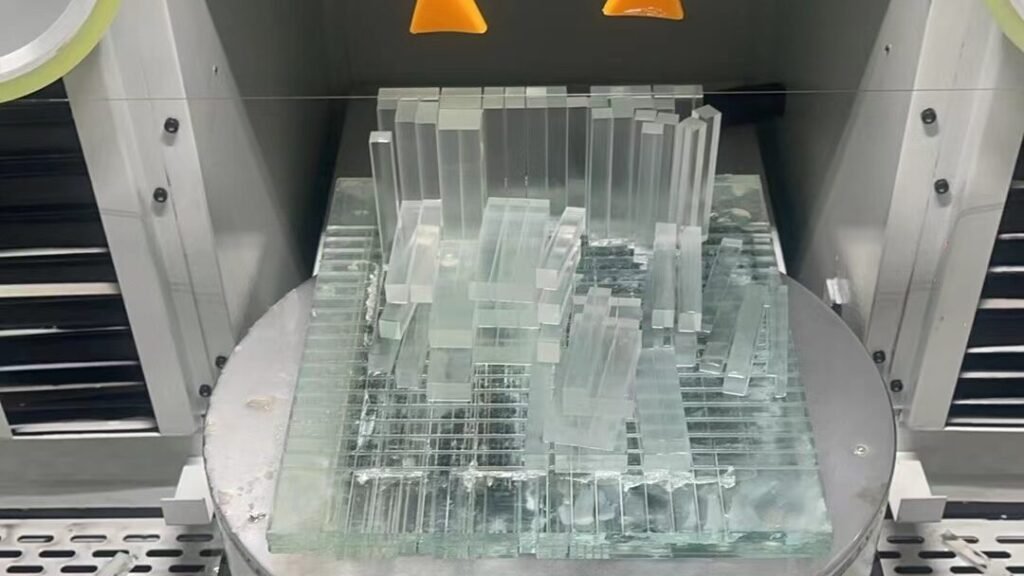
The term optical cutting quality describes the physical condition of an optical material immediately after it is separated from the raw block during manufacturing.
Cutting quality is typically evaluated through several factors:
- surface integrity
- edge chipping
- kerf consistency
- subsurface damage depth
It is important to distinguish cutting quality from polishing quality.
Polishing processes focus on improving surface roughness and optical clarity. In contrast, cutting quality determines the initial structural integrity of the optical blank.
If defects are introduced during cutting, later processes may not completely remove them.
This is why cutting quality is considered a critical early-stage control parameter in optical manufacturing.
Surface Defects vs Subsurface Damage
A key aspect of optical cutting quality is the distinction between visible surface defects and hidden subsurface damage.
Surface Defects
Surface defects are relatively easy to identify during inspection.
Common examples include:
- edge chipping
- surface scratches
- uneven kerf surfaces
- visible fracture lines
These defects usually occur when cutting forces exceed the fracture strength of brittle optical materials such as BK7, quartz, or sapphire.
Subsurface Damage
Subsurface damage is more difficult to detect because it occurs beneath the visible surface.
Typical forms include:
- micro-cracks below the cut surface
- grain pull-out
- stress-induced microfractures
These defects may remain hidden during early inspection but can become problematic during later grinding or polishing stages.
Research on brittle optical material processing shows that subsurface cracks can propagate during finishing processes if they are not removed during grinding.
External reference:
https://www.rp-photonics.com/optical_materials.html
This makes subsurface damage one of the most critical factors affecting optical cutting quality.
How Optical Cutting Quality Affects Imaging Performance
In optical systems, even small structural defects can influence imaging performance.
Poor optical cutting quality may lead to several downstream problems.
Optical Scattering
Micro-cracks and internal defects can scatter light inside the lens.
This scattering may cause:
- reduced image contrast
- increased stray light
- degraded optical resolution
Wavefront Distortion
Subsurface damage may introduce localized stress fields inside the material.
These stress variations can slightly change the refractive index distribution, which may lead to wavefront distortion in high-precision optical systems.
This is particularly important in applications such as:
- laser optics
- semiconductor lithography
- scientific imaging instruments
Additional information about optical surface quality and its impact on imaging can be found here:
https://www.edmundoptics.com/knowledge-center/application-notes/optics/surface-quality/
Because of these effects, controlling optical cutting quality is essential for achieving high-performance optical components.
Why Cutting Quality Problems Are Often Detected Later
One of the challenges in optical manufacturing is that cutting-related defects are not always immediately visible.
Many cutting problems become apparent only during later stages such as grinding, polishing, or optical testing.
Several factors contribute to this delay.
Hidden Micro-Cracks
Subsurface cracks created during cutting may remain stable until later processes introduce additional stress.
When grinding removes surface material, these cracks may suddenly expand.
Material Removal During Polishing
Polishing removes only a small amount of material compared with grinding.
If subsurface damage extends deeper than the polishing removal depth, defects may remain in the final optical surface.
Optical Testing Sensitivity
Some defects only become visible during high-precision optical testing.
For example:
- interferometry
- laser transmission measurements
- imaging performance tests
This delayed detection makes optical cutting quality a crucial early-stage control parameter in optical manufacturing workflows.
Conclusion
Although grinding and polishing often receive the most attention in optical manufacturing, the cutting stage establishes the structural foundation of every optical component.
Optical cutting quality determines whether the initial optical blank contains surface defects or subsurface damage that may affect later processing stages.
Because many cutting defects remain hidden until later manufacturing steps, controlling cutting conditions early in production is critical.
By understanding the relationship between cutting parameters, material behavior, and defect formation, engineers can significantly improve the reliability and performance of optical components.