
Germanium Ingot Cutting Wire Saw
A germanium ingot cutting wire saw for Ø 185 × L 400 mm Ge ingots — slicing mode for production wafers, DXF輪郭モード for free-form lens blanks (crescents, off-axis shapes) that a core drill or ID saw simply cannot make.
A dual-mode wire saw for raw germanium ingots
Same closed-loop endless-wire frame as the rest of the SGI family, sized for full-size Ge ingots — Ø 185 mm × L 400 mm — and equipped with both straight-slicing and DXF-driven contour-cut modes on one controller.

The SGI 40 germanium ingot cutting wire saw ships as a fully enclosed upright unit on the proven SGI family frame. The cabinet contains coolant mist and swarf during long runs, the observation window lets the operator watch a multi-hour contour cut, and the side touchscreen carries two parallel cutting systems — straight-slice mode and DXF contour mode — selectable per job. Load a DXF file via USB, set kerf compensation and feed rate, run the cut.
- Ingot range Ø ≤ 185 mm × L ≤ 400 mm — full-size Ge stock
- Cutting modes straight slicing · DXF free-form contour cut
- Wire system closed-loop endless diamond wire · ~0.5 mm kerf
- インターフェース side touchscreen + handheld controller (English) · USB DXF import
- Cooling built-in coolant tank + circulation · mist recovery
- Drawing standard ISO 10110 — contour tolerances flow station to station
What the SGI 40 germanium ingot cutting wire saw does
The germanium ingot cutting wire saw carries two cutting modes on one closed-loop endless-wire platform — straight slicing for routine production, and DXF contour cutting for shapes that traditional methods can't make. Same machine, same kerf, same hour.
DXF contour mode — free-form shapes
Load a DXF file via USB, set kerf compensation, hit run. The wire follows any closed contour — crescents, off-axis lens blanks, irregular polygons. None of these geometries can be produced on a core drill or an ID saw.
Straight-slice mode in the same controller
For routine production wafers, the second mode is just thickness + count, hit start. The machine indexes through the cut list automatically. You don't pay for the contour capability when you don't need it; you have it when you do.
Ø ≤ 185 mm × L ≤ 400 mm ingot capacity
Full-size Ge ingot stock fits inside the enclosure. Worktable swallows the entire ingot — no pre-trimming, no fixture stack-up. Long-axis cuts (up to 400 mm) run in one pass.
約0.5 mm クローズドループカーフ
Same endless-wire kerf as every other SGI / SG model. On a $2,200/kg ingot, that's $200–$600 of germanium kept per ingot versus a core drill. For contour cuts where the wire follows the part outline instead of removing a shell, the saving is even bigger.
Servo YZ — ±0.01 mm repeatability
Linear guides and ball screws on both axes give 0.01 mm feed resolution. Contour tolerance is bounded by the DXF file, not the machine — the machine traces what you draw.
Endless wire + coolant circulation
Closed-loop endless diamond wire runs unidirectional — no reverse stripe on the cut face. Built-in coolant tank with circulation and mist recovery keeps a multi-hour contour run clean and the wire predictable.
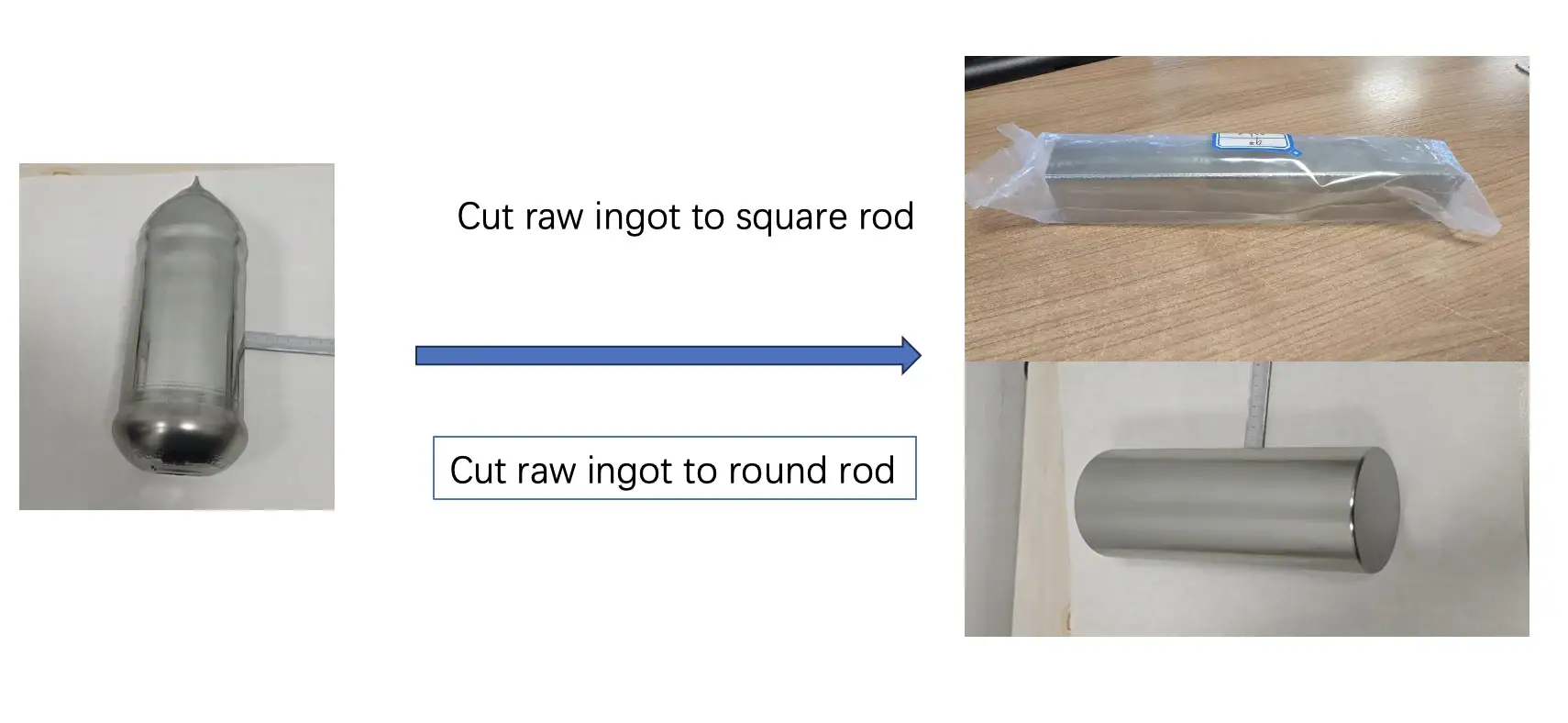
See both cutting modes on a real ingot
The SGI 40 germanium ingot cutting wire saw carries two operating modes on the same touchscreen. Two clips below — one walking through DXF contour mode for a free-form crescent blank, one showing routine straight-slice mode.
▸ Contour mode — free-form CAD cut
▸ Slice mode — production wafer slicing
Have a DXF you want to see run on the machine? Send it with your sample cut request — we'll run it on a real Ge blank and ship the result with a metrology report.
Why contour cutting on the ingot saves more than slicing does
A full-size Ge ingot — Ø 185 mm × 400 mm — is worth $20,000–$40,000 at today's $1,800–$2,400/kg spot price. Standard practice for any non-round shape is to cut a rectangular blank first, then mill or grind it to the final outline. That second step removes a lot of material, and on a $2,200/kg substrate every milligram is on the invoice.
Here's the math for a 73 × 53 mm crescent lens blank (the geometry from a real customer use case, more on that below). Cut a rectangular blank first — kerf 0.5 mm × 4 edges, then mill the crescent profile off the rectangle. The milled-off material is roughly 35% of the rectangle, plus chipping rejects. Total Ge wasted per blank: ~6.5 g, or about $13 of material plus the milling cycle.
Run the same part on the SGI 40 germanium ingot cutting wire saw in DXF contour mode and the wire traces the crescent outline directly. Kerf is 0.5 mm along the contour path; everything inside is the blank, everything outside is reusable Ge. Wasted material per blank: ~0.8 g, or about $1.60. At 1,000 blanks per year that's $11,400 of germanium kept — before the cycle-time win from skipping the milling pass.
For the broader Ge-line economics — kerf, edge chipping, downstream grind allowance — see our ゲルマニウムレンズ製造 solution page and Crystranのゲルマニウムデータシート.
DXF in, finished blank out
The contour workflow
Draw the contour in any CAD package, export as DXF, load it on the SGI 40 via USB. The controller reads closed polylines and arcs; on the touchscreen you set kerf compensation (typically 0.25 mm offset for a 0.5 mm kerf), feed rate, and cut sequence if the file has multiple contours. The machine traces what the file says — contour tolerance is bounded by the DXF, not the machine.
Slice mode for routine production
Switch the controller to slicing mode and the same machine becomes a SG-class slicing platform — set thickness and quantity, supports mixed thicknesses in one job. The Y/Z servos resolve to 0.01 mm and repeat to ±0.01 mm. Slice mode runs at the same kerf and feed rates as the dedicated slicing models. You're not paying for a contour capability and using a slower machine when you don't need contour.
The contour mode reads closed polylines. Open paths get rejected by the controller at file load — saves you from a half-finished cut, but it means you can't feed in a partial geometry to "try it." We see customers most often miss this on radii: drawn as arcs but not joined into the closed boundary. Fix in the CAD package, re-export, re-load. We help with the first file on every new customer.
How does free-form contour cutting compare to traditional methods?
For non-round germanium blanks — crescents, off-axis lenses, irregular outlines — three traditional approaches exist, plus the SGI 40 germanium ingot cutting wire saw's contour mode. Each has a niche; only contour cutting actually produces the geometry directly from the ingot without a downstream removal step.
| Method | Geometry capability | Material waste | サイクルタイム |
|---|---|---|---|
| コアドリル | round only | ~30–40% (shell) | fast |
| IDソー | straight cuts only | low | fast |
| Rectangle + mill to shape | any shape | ~35% mill-off | + milling pass |
| SGI 40 contour mode | any closed DXF | kerf only (~0.5 mm path) | single pass |
For straight cuts on round wafers, the comparison is different — the wire saw isn't faster than a multi-wire ingot saw on parts-per-hour, but it costs much less and leaves a cleaner edge. The honest answer is: if your job is 100% straight wafers, the dedicated SG40 germanium wafer slicing machine is the right model. If you also need prism, square, or polygonal blanks, the SGR40 with rotary axis is the right model. The SGI 40's value is the DXF mode for shapes the other two can't produce — see the customer case below.
Germanium properties feeding into kerf-loss math are in Crystranのゲルマニウムデータシート. Tolerance flow follows ISO 10110.
Sunny Optical — a Ge lens shape three traditional methods couldn't make
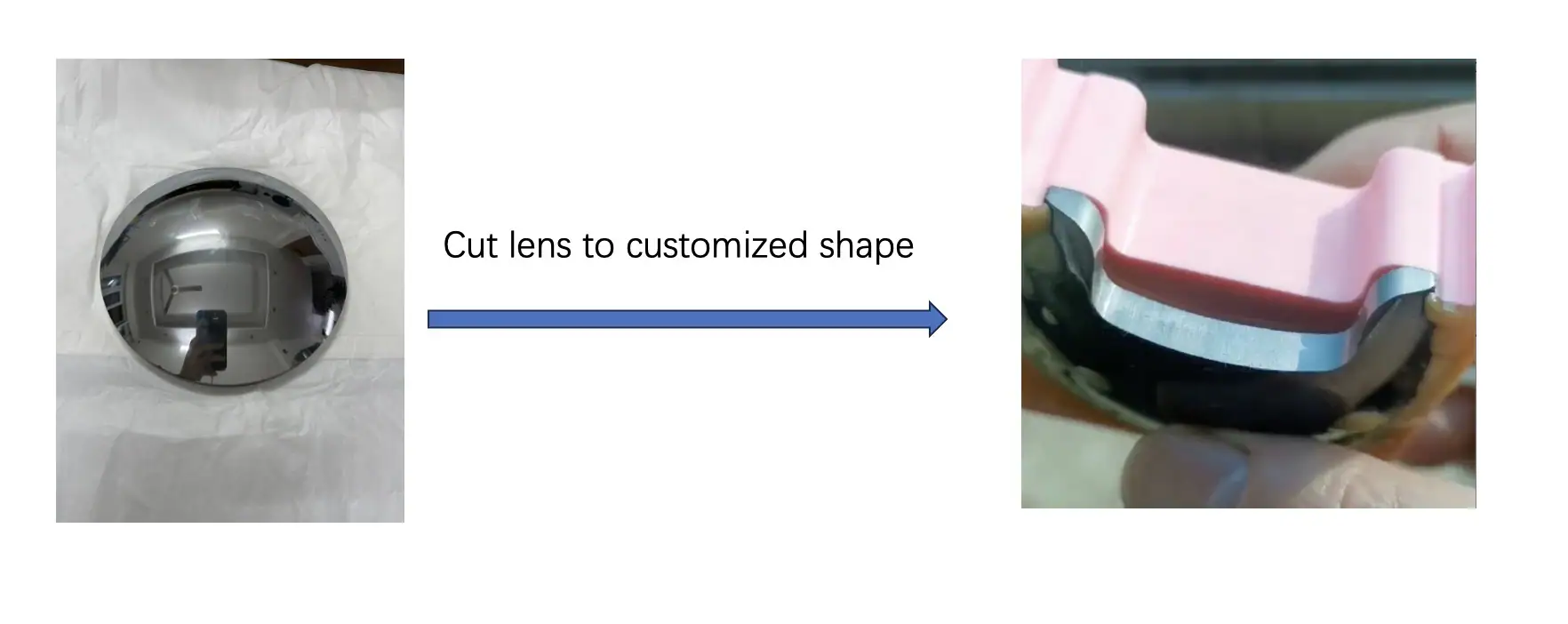
Sunny Optical Technology Group (HKSE: 2382) is one of the world's largest optical-component manufacturers. They came to us not for a kerf upgrade, but with a part traditional methods couldn't produce — an asymmetric crescent germanium lens for a thermal-imaging system. Outline: 73.45 × 52.82 mm, two R6 corner radii, two R1 transitions, a 110° × 1° upper chamfer, and an 85 mm spherical optical face.
Each traditional method fails on this part for a different reason. A core drill produces round shapes only — the crescent profile is outside its geometric envelope. An ID saw cuts straight lines, so multiple repositioning cuts are needed for the R1/R6 arcs, with stack-up tolerance error and re-fixturing chips on every step. The "rectangle blank + mill to shape" approach is geometrically feasible but loses ~35% of starting material to milling waste, and the R-corner regions chip readily during the milling pass. Sunny tried all three; throughput, yield, and repeatability all failed at the volumes they needed to ship.
The solution was the SGI 20 — the smaller sibling of the SGI 40 germanium ingot cutting wire saw on this page, running the same closed-loop endless-wire technology and the same DXF contour mode. One Vimfun engineer worked with Sunny's tooling team to convert their crescent drawing to a DXF, set kerf compensation, and run the first batch. The wire traced the crescent profile directly out of the Ge stock — kerf 0.4 mm along the contour, single-pass, no milling.
After integrating the SGI machine into the crescent-lens line, Sunny reported a ~30% production yield improvement — chip rejects from the R-corner regions disappeared, and the same machine also handled their routine straight-slice and rod-extraction work in slice mode. Sunny has since scaled their Vimfun footprint to 30+ machines across multiple production sites, covering both contour work and routine slicing on the same platform.
For full-size ingot work (Ø 185 mm class, longer ingots), the SGI 40 germanium ingot cutting wire saw is the right model for the same kind of unique-geometry job. The DXF mode, the closed-loop wire, the kerf compensation logic — all identical to the platform Sunny scaled on. Send us your part drawing and we'll convert it to DXF, run a sample contour cut on your supplied Ge blank, and ship back the part with a metrology report.
Built for full-size Ge ingots and free-form blanks
What the SGI 40 germanium ingot cutting wire saw commits to — the numbers that drive yield on a $30,000 ingot and unlock shapes traditional cutting can't make.
SGI 40 technical specifications
Standard-configuration specs for the SGI 40 germanium ingot cutting wire saw. Worktable, travel, and contour-mode parameters configurable on request.
| Workpiece size (ingot) | Ø ≤ 185 mm × L ≤ 400 mm |
| ワークテーブルサイズ | 400 × 400 mm |
| Y / Z軸トラベル | 400 mm / 400 mm |
| Cutting modes | straight slicing · DXF closed-contour cut |
| DXF input | USB · closed polylines & arcs · kerf compensation programmable |
| ダイヤモンドワイヤ径 | 0.35–0.5 mm (Ge optimum) |
| カーフ幅 | ~0.5 mm (closed-loop endless wire) |
| 最大ワイヤ線速度 | 52 m/s |
| Y / Z最小送り量 | 0.01 mm |
| Y / Z繰り返し精度 | ±0.01 mm |
| 切断 / 手動速度 | 0–1000 mm/min (adjustable) |
| ガイドホイール | 2 × Ø250 mm + 1 × Ø180 mm (3輪パス) |
| ドライブモーター出力 | 1.5 kW (最大4500 RPM) |
| 電源 | 220 V 三相・60 Hz |
| Cooling | built-in coolant tank + circulation + mist recovery |
| Cutting oil consumption (single shift) | ~80 L / month |
| Drawing standard | ISO 10110 |
| Warranty | 1 year (parts + engineering support) |
Tolerances on the cut blank — kerf, edge chipping, contour deviation — flow into the centering and grinding stages per ISO 10110.
Which materials does the SGI 40 cut?
The endless wire cuts anything softer than diamond, but the SGI 40 was built around full-size germanium ingot work — that's where the Ø 185 × L 400 mm capacity and the DXF contour mode pay back first. Other brittle optics materials run on the same platform with their own parameter sets:
- ゲルマニウム (Ge) — primary material · 0.35–0.5 mm wire, 100–140 N tension, white mineral oil coolant
- シリコン (Si) — mature parameter set · 0.42–0.5 mm wire
- Zinc selenide (ZnSe) & zinc sulfide (ZnS) — chalcogenide windows · gentler infeed
- サファイア — 0.5–0.65 mm wire, higher tension, slower feed
- Optical glass (BK7 / K9) and fused quartz — same closed-loop wire, parameter set per glass family
Cutting something not on the list — chalcogenide glass, exotic ceramic, layered composite? Send a sample and we'll test-cut it before quoting parameters. We don't guess on materials we haven't run.
Where does the SGI 40 fit in a Ge lens line?
The SGI 40 germanium ingot cutting wire saw is the front end for any production that includes free-form Ge lens blanks alongside routine wafers. It takes ingots in (Ø ≤ 185 × L ≤ 400 mm) and outputs either straight-sliced wafers or DXF-defined contour blanks, in the same machine, on the same shift. Everything downstream — edge centering, spherical grinding, polishing, AR coating — flows from what this machine cuts.
For the full chain — five-stage workflow from ingot to coated lens — see the ゲルマニウムレンズ製造 solution page. The broader equipment range is at the 赤外線光学製造装置 ハブから開始してください。.
If your job is 100% round wafer slicing at production volume, the leaner SG40 germanium wafer slicing machine covers it at lower CapEx — same kerf, no contour-mode capability you wouldn't use. If your job mixes round wafers with prism, square, or polygonal blanks (predefined geometric shapes via rotary indexing — not free-form curves), the SGR40 with rotary axis covers that with the same closed-loop wire. The SGI 40's exclusive value is the DXF mode for shapes neither of the other two can make.
Get a sample contour cut on your own Ge ingot
Pick the SGI 40 germanium ingot cutting wire saw if your production includes free-form Ge lens blanks that core drills and ID saws can't make — crescents, off-axis shapes, irregular polygons — and you still want a single machine that handles routine straight wafer slicing too. Send us your DXF and a Ge sample; we'll convert if needed, run the contour, and ship the cut part back with a metrology report before you commit.
ヴィムファン · ISO 9001 · CE準拠 · 20カ国以上に発送
光学分野のお客様には、Edmund OpticsやCoherentが含まれます。.
電話 +1 (408) 571-8651 · daria@endlesswiresaw.com