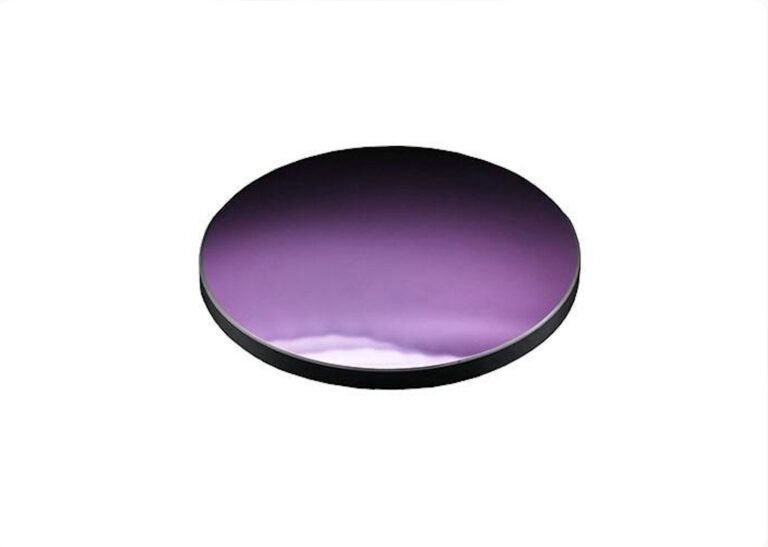
If you’re processing germanium for infrared optics, the cutting method you choose determines how much usable material you get from each ingot — and at $1,800–$2,400/kg for optical-grade germanium, every millimeter of kerf loss has a dollar value.
The traditional germanium cutting workflow uses two machines: a coring machine to extract cylindrical preforms from the ingot, then an internal diameter (ID) saw to slice those preforms into blanks. The newer approach uses a single closed-loop diamond wire saw to do both jobs. This article compares these two approaches with verified production data.
How the Traditional ID Saw Germanium Workflow Actually Works
It’s important to understand that an ID saw doesn’t work alone in germanium processing. The standard traditional workflow requires two separate machines:
Step 1 — Coring machine extracts a cylindrical preform from the raw ingot. This is where the biggest material loss happens: the coring blade cuts a kerf of 5–10 mm per pass.
Step 2 — ID saw slices the preform into individual blanks. The ID saw itself is relatively efficient, with a kerf of 0.3–0.5 mm — comparable to wire cutting.
The problem isn’t the ID saw’s kerf. It’s the coring stage that precedes it. For a 200 mm diameter ingot weighing 3–4 kg ($6,000–$10,000 in raw material), each coring cut wastes $11–$15 of germanium at the 5 mm kerf width alone.
How Wire Saw Cutting Replaces Both Machines
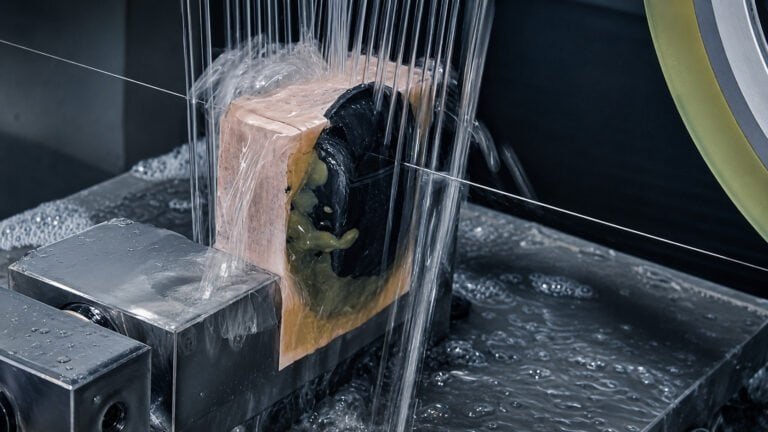
A closed-loop diamond wire saw like the SGI 40 eliminates the two-machine workflow entirely. One machine performs both contour extraction and slicing:
| Operation | Wire Saw Parameter | Value |
|---|---|---|
| Contour cutting (preform extraction) | Kerf width | 0.5–0.6 mm |
| Contour cutting | Đường kính dây | 0.35–0.5 mm |
| Contour cutting | Wire speed | 40–60 m/s |
| Contour cutting | Feed rate | 4–8 mm/min |
| Slicing (blank cutting) | Kerf width | 0.5–0.6 mm |
| Cắt lát | Đường kính dây | 0.35–0.42 mm |
| Cắt lát | Wire speed | 30–50 m/s |
| Cắt lát | Feed rate | 10–20 mm/min |
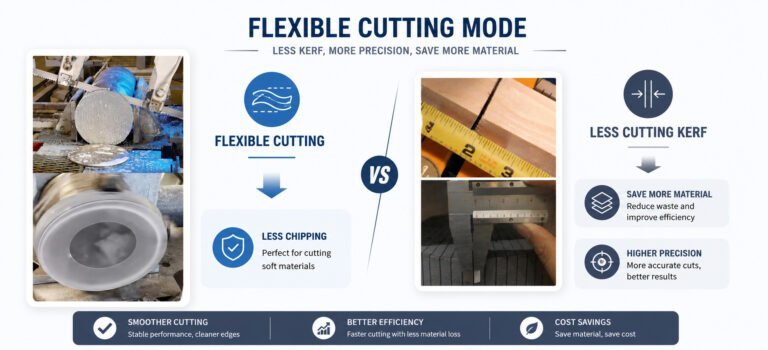
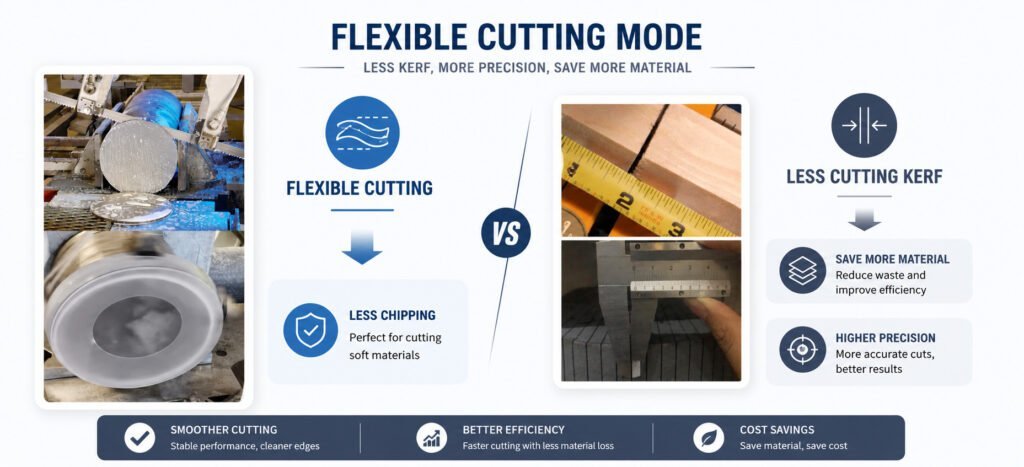
The wire saw’s kerf at the contour stage is 0.5–0.6 mm — roughly 10x less than the coring machine’s 5–10 mm. That’s where the material savings come from.
Wire Saw vs ID Saw Germanium: Side-by-Side Comparison
| Thông số kỹ thuật | Wire Saw (SGI 40) | Traditional (Coring + ID Saw) |
|---|---|---|
| Machines required | 1 | 2 |
| Contour/coring kerf | 0.5–0.6 mm | 5–10 mm |
| Slicing kerf | 0.5–0.6 mm | 0.3–0.5 mm (ID saw) |
| Surface roughness (Ra) | 0.6–1.2 μm | Comparable |
| TTV (Φ50 mm blank) | 8–15 μm | Comparable |
| Edge chipping | < 0.1 mm | 0.3–0.8 mm |
| Equipment cost | $31,000–$39,000 | $85,000–$120,000 |
| Max ingot capacity | Φ185 mm × 400 mm | Varies by model |
Two things stand out in this comparison:
1. The ID saw actually has a narrower slicing kerf (0.3–0.5 mm vs 0.5–0.6 mm). If you only compared the slicing step, the ID saw wins on kerf. But the comparison that matters is the total workflow — and the coring machine’s 5–10 mm kerf dwarfs any slicing-stage advantage.
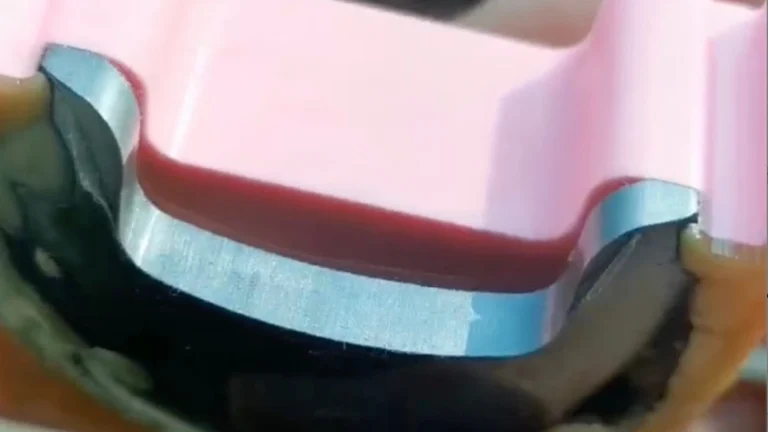
2. Edge chipping drops by 3–8x. Wire cutting produces edge chipping below 0.1 mm, compared to 0.3–0.8 mm from traditional methods. This matters because lower edge chipping means the downstream centering and grinding stages can remove less material — saving additional germanium and reducing cycle time.

Economic Impact of Wire Saw vs ID Saw Germanium Processing
The economics break down into three categories:
Equipment Investment
| Mục | Cưa dây | Traditional Combo |
|---|---|---|
| Capital cost | $31,000–$39,000 | $85,000–$120,000 |
| Monthly electricity (single shift) | ~$35 | Higher |
| Monthly cutting oil | ~$320 (80L) | — |
| Diamond wire life | 40 operating hours/wire | — |
The wire saw costs roughly 65% less in upfront equipment investment. For operations that need to cut germanium wafers without cracks, this lower entry point makes it accessible to smaller manufacturers.
Material Savings
At a germanium price of $2,200/kg and processing 50 ingots per month:
- Each coring cut saved (5 mm → 0.5 mm kerf) recovers $11–$15 of germanium per cut
- Annual material savings from kerf reduction alone: >$240,000
- Estimated equipment payback period: 12–18 months (multi-shift operation)
These material savings are cumulative — the more you cut, the larger the gap between wire saw and traditional processing economics.
Downstream Cost Reduction
Lower edge chipping (< 0.1 mm vs 0.3–0.8 mm) means the grinding stage removes less material and runs fewer passes. While exact savings vary by lens geometry, the principle is straightforward: a cleaner cut requires less correction downstream.
When Wire Saw Cutting Has Limitations
The wire saw vs ID saw germanium comparison isn’t one-sided in every category:
Slicing kerf: As noted above, the ID saw’s 0.3–0.5 mm slicing kerf is narrower than the wire saw’s 0.5–0.6 mm. For very thin germanium wafers where every 0.1 mm matters, this difference is relevant.
Existing equipment integration: If you already own a coring machine and ID saw with years of remaining life, the economic case for switching depends on your production volume. At low volumes, the material savings may not justify replacing working equipment immediately.
Non-standard geometries: Wire saws can follow CNC-programmed contour paths — useful for non-circular shapes like custom optical elements. ID saws are limited to straight cuts. This is an advantage for wire saws, but only matters if your product mix includes non-standard shapes.
Production Reference: Φ50 mm Germanium Lens
To put the wire saw performance in context, here’s the complete cycle time for a Φ50 mm double-convex germanium lens using wire saw cutting as the front end:
| Bước Quy trình | Thiết bị | Thời gian |
|---|---|---|
| Trích xuất đường viền | SGI 40 | ~26 phút |
| Cắt lát | SGI 40 | ~5 phút |
| Mài cạnh + vát mép | C-120L | 1–3 phút |
| Tạo hình cầu (mặt 1) | G-100 | ~5 phút |
| Tạo hình cầu (mặt 2) | G-100 | ~5 phút |
| Đánh bóng (mặt 1) | Máy đánh bóng phi cầu | ~3 phút |
| Đánh bóng (mặt 2) | Máy đánh bóng phi cầu | ~3 phút |
| Total (excluding AR coating) | ~50 phút |
Reference: Sunny Optical operates 30+ Vimfun wire cutting machines in their germanium lens production, with yield improvements of approximately 30% attributed in part to better upstream cutting quality.
Which Method Should You Choose?
Choose wire saw if:
- You’re building a new germanium processing line (lower CapEx, single machine)
- Material cost is a major factor (it almost always is with germanium)
- You need contour cutting capability for non-circular shapes
- You want to reduce edge chipping for cleaner downstream processing
Keep your ID saw if:
- You’re cutting very thin wafers where 0.1–0.2 mm kerf difference matters
- Your existing equipment is recently purchased and production volume is low
- You don’t need contour cutting capability
For most infrared optics manufacturers, the wire saw replaces the coring machine + ID saw combination with a single, lower-cost machine that saves significant material at the contour stage. The full equipment range for germanium and other IR materials is covered in our thiết bị sản xuất quang học hồng ngoại tổng quan.