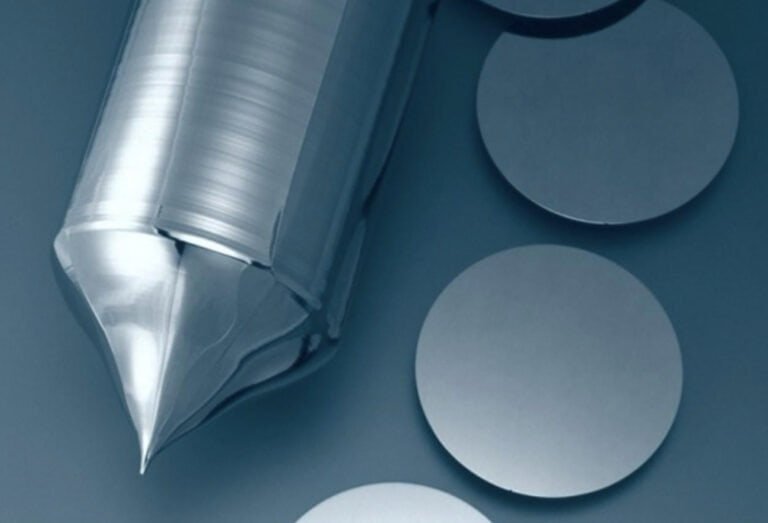
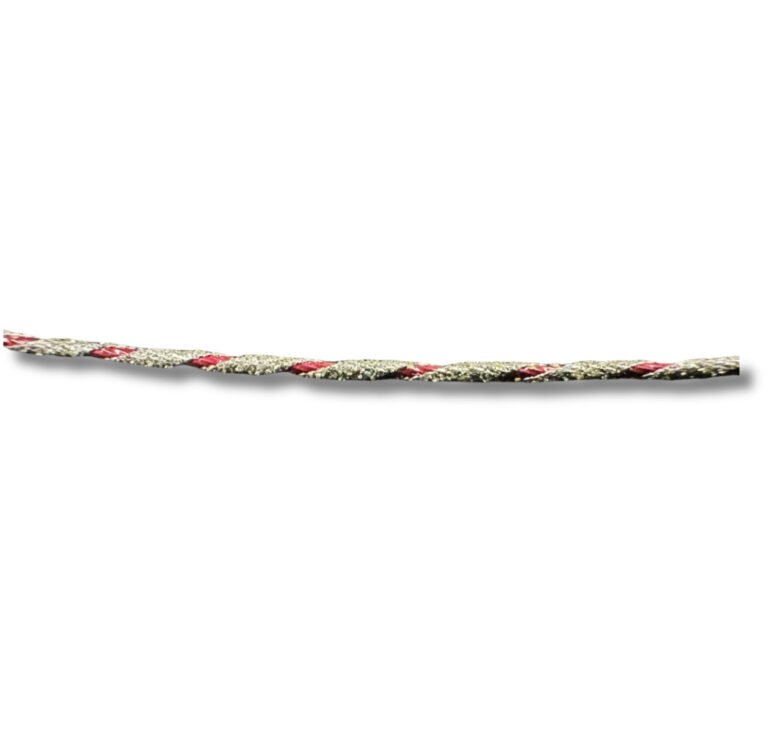
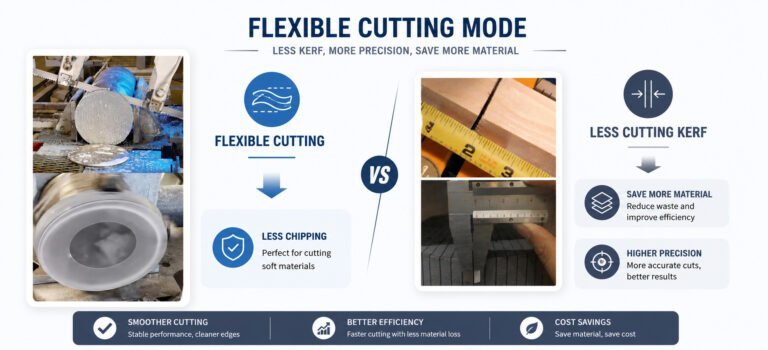
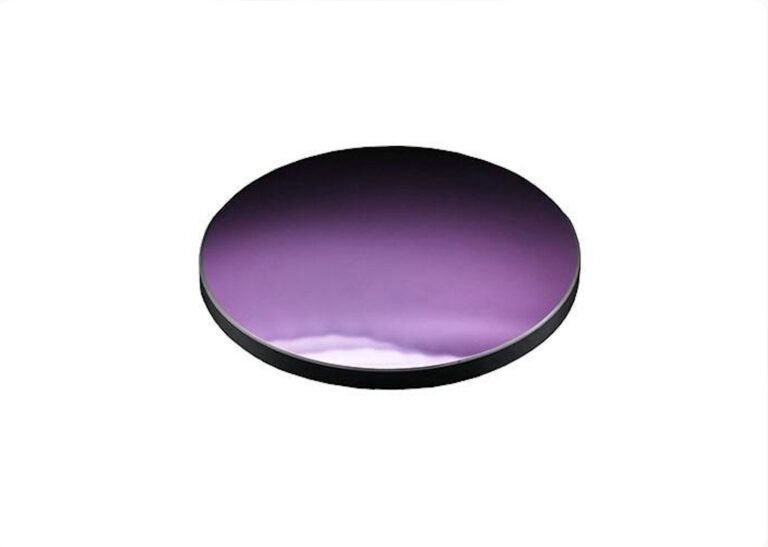
After wire saw slicing, a germanium blank has two problems: the surfaces aren’t flat enough, and they aren’t parallel enough. Wire cutting delivers Ra 0.6–1.2 μm surface roughness with TTV (total thickness variation) of 8–15 μm on a Φ50 mm blank. For many infrared optics applications, that’s not good enough to go straight into spherical grinding.
Germanium wafer double sided lapping solves both problems in a single operation — improving flatness, parallelism, and surface condition simultaneously on both faces of the blank.
Where Double Sided Lapping Fits in the Germanium Production Line
Lapping sits between cutting/centering and grinding in the flux de fabrication d'optiques infrarouges. workflow:
| Étape | Processus | Équipement | Output |
|---|---|---|---|
| 1 | Découpe de contour | Wire saw (SGI 40) | Shaped preform |
| 2 | Tronçonnage | Wire saw (SGI 40) | Flat disc, Ra 0.6–1.2 μm, TTV 8–15 μm |
| 3 | Centering + chamfer | Machine de centrage (C-120L) | Round blank, ≤ 5 μm roundness |
| 3.5 | Double sided lapping | Lapping machine | Flat blank, Ra 0.2–0.4 μm, TTV < 5 μm |
| 4 | Rectification sphérique | Grinder (G-100/G-250) | Curved surfaces, Ra 0.1–0.3 μm |
| 5 | Polishing + AR coating | Machine de polissage | Ra < 5 nm, finished lens |
Not every germanium lens requires a dedicated lapping step. For applications with looser flatness requirements (±0.01 mm), blanks can move directly from centering to grinding. But for precision IR optics — thermal imaging lenses, FLIR systems, spectroscopy windows — germanium wafer double sided lapping is the process that ensures the grinding stage starts from a geometrically correct blank.
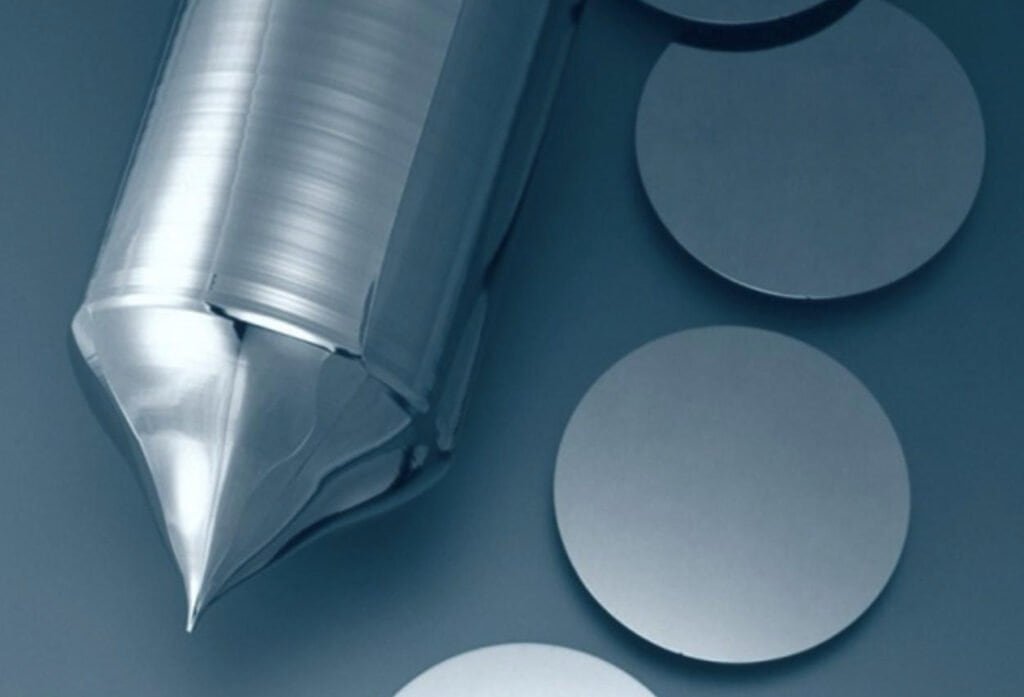
Why Germanium Needs Double Sided Lapping
Material Properties That Create Problems
Germanium (Ge) has specific material properties that make post-cutting surface condition worse than many other optical materials:
Crystal structure. Germanium is a single-crystal semiconductor with a diamond cubic lattice. Wire saw cutting generates subsurface damage — micro-cracks along crystal planes that extend 5–15 μm below the visible surface. Lapping removes this damaged layer in a controlled manner.
Softness. With a Knoop hardness of approximately 780 (compared to 1,000+ for most optical glasses), germanium is relatively soft. This makes it responsive to lapping but also susceptible to over-removal if process parameters aren’t controlled.
High material cost. Optical-grade germanium costs $1,800–$2,400 per kilogram. A Φ50 mm blank weighs approximately 25–30 grams, making each blank worth $45–$72 in raw material alone. Every micron of unnecessary material removal during lapping reduces the value available for the final lens. According to Umicore Electro-Optic Materials, germanium remains the primary choice for 8–14 μm thermal imaging optics — meaning demand for precision-processed germanium blanks continues to grow.
What Lapping Accomplishes
Germanium wafer double sided lapping achieves three things simultaneously:
- Flatness correction — removes the bow and warp left by wire saw cutting, bringing surface flatness from 10–20 μm down to < 3 μm across the blank
- Parallelism improvement — ensures both faces are equidistant, reducing TTV from 8–15 μm (as-cut) to < 5 μm
- Subsurface damage removal — the lapping action removes the microcrack layer from wire cutting, creating a clean surface for grinding
How Germanium Wafer Double Sided Lapping Works
Process Principle
In double sided lapping, the germanium blank is placed in a carrier (typically a thin metal or polymer disc with cutouts) that sits between two flat lapping plates. Both plates rotate — typically in opposite directions — while the carrier orbits between them. Diamond abrasive slurry is fed between the plates and the workpiece.
The key difference from single sided lapping: both faces are processed simultaneously under equal pressure. This automatically improves parallelism because any high spot on either face receives more contact pressure and is removed preferentially.
Critical Process Parameters
| Paramètre | Typical Range for Germanium | Effect |
|---|---|---|
| Lapping plate material | Cast iron (grooved) | Provides flat reference surface |
| Diamond slurry grit size | 9 μm → 3 μm (two-stage) | Coarser for removal, finer for finish |
| Lapping pressure | 0.5–2.0 psi (3.4–13.8 kPa) | Higher = faster removal but more subsurface damage |
| Plate speed | 20–60 rpm | Affects removal rate and uniformity |
| Slurry concentration | 0.5–2.0 carat/liter | Too low = scratching; too high = waste |
| Material removal target | 15–30 μm per face | Enough to remove wire saw damage layer |
Two-Stage Lapping Approach
For germanium, a two-stage lapping process produces the best results:
Stage 1 — Coarse lapping (9 μm diamond)
- Purpose: remove wire saw damage layer and correct gross geometry errors
- Removal rate: 3–8 μm/min per face
- Duration: 3–5 minutes per batch
- Target: flatness < 5 μm, Ra 0.3–0.5 μm
Stage 2 — Fine lapping (3 μm diamond)
- Purpose: improve surface finish and reduce subsurface damage depth
- Removal rate: 1–3 μm/min per face
- Duration: 2–4 minutes per batch
- Target: flatness < 3 μm, Ra 0.2–0.3 μm
Total lapping time: approximately 5–10 minutes per batch. Multiple blanks (4–12 pieces depending on size) can be lapped simultaneously in a single carrier, making this a high-throughput step despite the precision it delivers.
Double Sided vs. Single Sided Lapping for Germanium
| Factor | Double Sided Lapping | Single Sided Lapping |
|---|---|---|
| Parallelism improvement | Excellent (both faces processed equally) | Limited (one face at a time) |
| Flatness | Very good (mutual reference) | Good (depends on chuck flatness) |
| Débit | Higher (both faces simultaneously) | Lower (must flip and repeat) |
| Setup complexity | More complex (carrier design, dual plates) | Simpler (single plate) |
| Risk of wedge shape | Faible | Higher (mounting/re-mounting introduces error) |
| Best for | Production volumes, tight parallelism specs | Single pieces, asymmetric requirements |
For germanium wafer double sided lapping in production environments, the throughput and parallelism advantages make it the preferred choice. Single sided lapping is reserved for rework situations or prototypes where only one face needs correction.
Quality Metrics After Germanium Wafer Double Sided Lapping
| Metric | As-Cut (Wire Saw) | After Lapping | Improvement |
|---|---|---|---|
| Surface roughness (Ra) | 0.6–1.2 μm | 0.2–0.4 μm | 3–5× better |
| TTV (Φ50 mm blank) | 8–15 μm | < 5 μm | 2–3× better |
| Flatness | 10–20 μm | < 3 μm | 5–7× better |
| Subsurface damage depth | 10–20 μm | < 5 μm | Removed by lapping |
| Edge condition | Minor chipping from cutting | Clean (chamfered in centering) | No change |
These numbers matter because they directly determine grinding stage efficiency. A blank entering grinding with TTV < 5 μm requires less curve generation correction than one with 15 μm TTV. That translates to shorter grinding cycles and less diamond wheel wear.
Common Germanium Wafer Double Sided Lapping Problems
1. Orange Peel Surface
Symptom: the lapped surface has a dimpled texture visible under magnification, resembling orange skin.
Cause: lapping pressure too high for the slurry grit size, or slurry concentration too low. Individual diamond particles dig in rather than rolling across the surface.
Fix: reduce pressure to < 1.5 psi and verify slurry concentration is within specification.
2. Uneven Removal (Center vs. Edge)
Symptom: the blank is thinner at the center or at the edges after lapping.
Cause: carrier positioning error or lapping plate wear pattern. If the plates develop a concave or convex wear profile, they impose that shape on every blank.
Fix: condition (re-flatten) the lapping plates regularly. For cast iron plates, condition with a conditioning ring after every 20–30 batches.
3. Scratches in One Direction
Symptom: linear scratches visible on one or both surfaces after fine lapping.
Cause: contamination in the slurry — either from a previous coarser stage or from external particles. Even a single 20 μm particle in a 3 μm slurry will scratch every blank in the batch.
Fix: flush the lapping system thoroughly between coarse and fine stages. Use dedicated slurry delivery systems for each grit size. Filter recirculated slurry to remove breakdown particles.
4. Edge Chipping During Lapping
Symptom: small chips appear on the blank edge during lapping.
Cause: insufficient chamfer from the centering stage. Sharp edges catch on the lapping plate grooves and fracture. Proper centering and chamfering before lapping prevents this.
Fix: verify chamfer width is ≥ 0.2 mm before lapping. Return under-chamfered blanks to centering.
When to Skip Lapping
Not every germanium blank needs double sided lapping. Consider skipping it when:
- Flatness from wire cutting is already sufficient (TTV < 8 μm on small blanks < 25 mm diameter)
- The grinding stage can absorb the extra correction (longer grinding cycle may cost less than a separate lapping step)
- Non-critical applications where surface quality after grinding and polishing doesn’t require pristine starting geometry
- Prototype quantities where the cost of lapping setup exceeds the cost of extra grinding time
For production volumes of precision IR optics, however, the math almost always favors lapping. The 5–10 minutes of lapping time per batch saves more time in grinding than it consumes — and produces more consistent lens-to-lens quality across production runs.
Integrating Germanium Wafer Double Sided Lapping Into Your Process
If you’re currently moving blanks directly from cutting to grinding, evaluate whether lapping would improve your output quality and reduce grinding cycle time. The key indicators:
- Grinding wheel wear is higher than expected — you may be asking the grinder to correct geometry that lapping should handle
- Lens-to-lens thickness variation exceeds specification — inconsistent starting geometry propagates through the entire process
- Polishing time varies significantly between lenses — subsurface damage from cutting is not being fully removed by grinding alone
For specifications on kerf loss optimization during the cutting stage — which directly affects how much material is available for lapping — and the complete IR optics production workflow, see our équipement de fabrication d'optique infrarouge pillar guide.